Basecamp is great
for non-technical teams
Basecamp nails simplicity for general project management. But dev teams need releases, Git integration, and technical workflows. That's where GitScrum comes in.
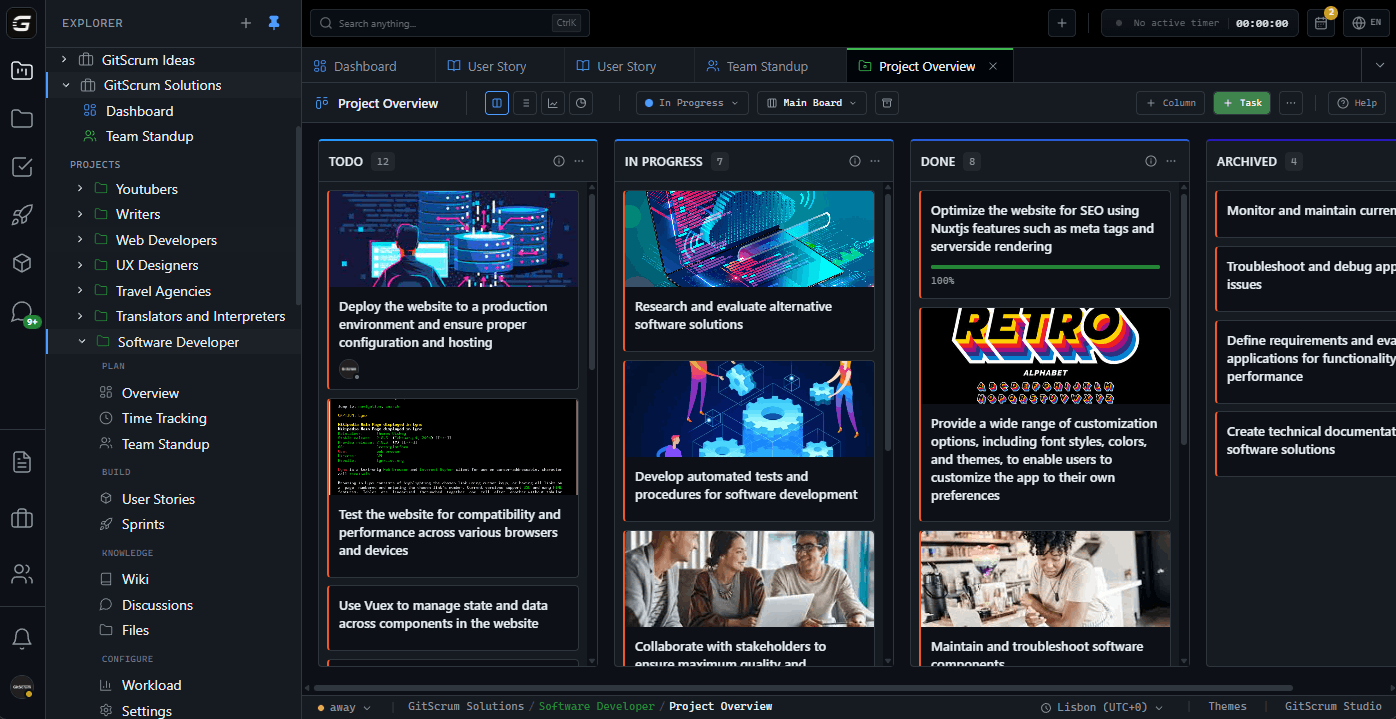
Different DNA
different teams
Basecamp was built by a design agency for design agencies. GitScrum was built by developers for development teams. Both are opinionated—just about different things.
GitScrum fits if you
- Ship code and run releases
- Need GitHub/GitLab integration
- Track billable dev hours
- Want progress dashboards and delivery pace
Basecamp fits if you
- Run creative or marketing projects
- Prefer simplicity over methodology
- Don't need Git integration
- Want flat-rate team pricing
"Basecamp pioneered async communication. I respect what they built. But for dev teams shipping code, the gaps are real: no Git integration, no release planning, no estimates. And their flat pricing that seems cheap? For a 10-person dev team, you're overpaying for features built for 50+ users."
Renato Marinho
Founder, GitScrum
Feature breakdown no spin
Basecamp keeps things simple. GitScrum adds developer-specific capabilities.
| Capability | GitScrum | Basecamp |
|---|---|---|
| Task Management | Boards + Lists | To-do lists |
| Release Planning | Native delivery pace | Not available |
| Git Integration | GitHub, GitLab, Bitbucket | Not available |
| Story Points | Native | Not available |
| Progress Dashboards | Native | Not available |
| Time Tracking | Native | Basic |
| Invoicing | Native | Not available |
| Client Portal | Approval workflows | Workspace access |
| Message Boards | Discussions | Excellent |
| File Storage | Per project | 500GB included |
| Hill Charts | Not available | Native |
| Automatic Check-ins | Not available | Native |
| Team Chat | Slack-style | Campfire |
| Pricing Model | Per user | Flat rate |
Basecamp wasn't built
for shipping code
Basecamp excels at async communication and simple project tracking. But software development needs more: release cycles, Git workflows, code-to-task linking, and delivery pace tracking.
Pricing models differ
significantly
Basecamp's flat rate is great for large teams. GitScrum's per-user model wins for smaller dev teams.
10 × $4.20
Flat rate unlimited
- Unlimited users
- 500GB storage
- No per-user fees
- No dev-specific tools
- Great for 30+ users
Client workflows
built for agencies
Basecamp lets clients enter your workspace. GitScrum provides structured client interactions—approval workflows, change requests, and invoice tracking. Clients get what they need without workspace access.
Built for different workflows
Methodology vs Simplicity
Basecamp rejects agile methodology by design—they believe it's overhead. GitScrum embraces it—releases, estimates, delivery pace. Neither is wrong; they serve different philosophies.
Code-Aware vs Code-Agnostic
GitScrum links commits to tasks, shows PR status, tracks deployments. Basecamp treats code like any other deliverable. Dev teams need the former; creative teams don't.
Billing Integration
Agencies billing hourly need time-to-invoice workflows. GitScrum tracks hours and generates invoices natively. Basecamp requires external tools for billing.
Pricing Philosophy
Basecamp charges $299/month regardless of team size—great value at 50 users, expensive at 5. GitScrum scales with your team at $4.20/user.
Teams that write code for clients
Dev agencies billing clients
Track time on features, link hours to Git commits, generate invoices from logged work. The dev-to-billing pipeline Basecamp lacks.
Teams running actual releases
Two-week cycles, story point estimation, delivery pace tracking, progress dashboard visualization. Real agile, not just task lists.
Shops needing Git integration
Link commits to tasks automatically. See PR status in your board. Know what shipped without asking developers.
Small-to-medium dev teams
Under 30 people, per-user pricing makes more sense than Basecamp's flat $299. You pay for what you use.
Where Basecamp wins (genuinely)
Large creative teams
50+ person agencies paying $299 flat is incredible value. No per-seat math, just unlimited access.
Teams rejecting agile
If releases feel like overhead and you prefer simple to-dos, Basecamp's anti-methodology stance is refreshing.
Async-first remote teams
Automatic check-ins, message boards, and Campfire chat are built for async communication. Basecamp wrote the book on remote work.
Non-technical project work
Marketing campaigns, editorial calendars, event planning. Basecamp's simplicity shines when you don't need dev tools.
Transition without disruption
Your team can be productive in GitScrum within a day
Export Basecamp data
Download projects as JSON/CSV
Map to GitScrum
To-dos become tasks, projects stay projects
Connect your repos
Link GitHub, GitLab, or Bitbucket
Run your first release
Start shipping with delivery pace tracking
Questions developers ask
How do dev agencies use GitScrum instead of Basecamp?
Basecamp is to-dos and messages. GitScrum is releases, Git integration, time tracking, and invoicing. Dev teams need to link commits to tasks, track delivery pace, bill clients. Basecamp can't do any of that. For a 10-person dev shop: GitScrum at $89/month vs Basecamp at $299/month—plus you get the features you actually need.
What's the break-even point between Basecamp and GitScrum pricing?
Basecamp: $299/month flat. GitScrum: $4.20/user. Break-even: 34 users. Under 34 people, GitScrum is cheaper. Over 34, Basecamp wins on price. But price isn't the only factor—if you ship code, Basecamp lacks Git integration, releases, and progress dashboards. You'd need additional tools anyway.
Can I import my Basecamp projects to GitScrum?
Yes. Export Basecamp as JSON/CSV, import into GitScrum. To-dos become tasks, projects stay projects. Most teams migrate in 3-4 hours. The harder part: rewiring workflows from to-do lists to releases. Worth it for delivery pace tracking and client billing.
Does GitScrum have Hill Charts like Basecamp?
No Hill Charts—we use progress dashboards and delivery pace tracking instead. Both show 'are we on track?' Hill Charts are visual intuition. Progress dashboards are data-driven. For dev teams shipping releases, progress dashboards provide more actionable insight.
How long does it take to migrate from Basecamp to GitScrum?
Data migration: 2-3 hours. Workflow adjustment: 1-2 releases. The mental shift from to-dos to releases takes a bit, but teams report improved visibility within the first release. Connect your Git repos on day one—that integration alone justifies the switch for most dev teams.
When should I NOT switch from Basecamp to GitScrum?
Stay with Basecamp if: you have 50+ people (flat pricing wins), you don't ship code (no Git integration needed), you prefer async check-ins over release ceremonies, or you run creative/marketing projects without billing. Basecamp is excellent for non-technical teams; GitScrum is built for developers.
Built for teams that ship code
Basecamp is great for what it does. GitScrum is great for developers.
No credit card required · Setup in 2 minutes