Notion Alternative
for Project Execution
Notion is a brilliant knowledge base. But when projects need releases, time tracking, and invoicing—you need a tool built for execution, not documentation.
The honest take
no marketing fluff
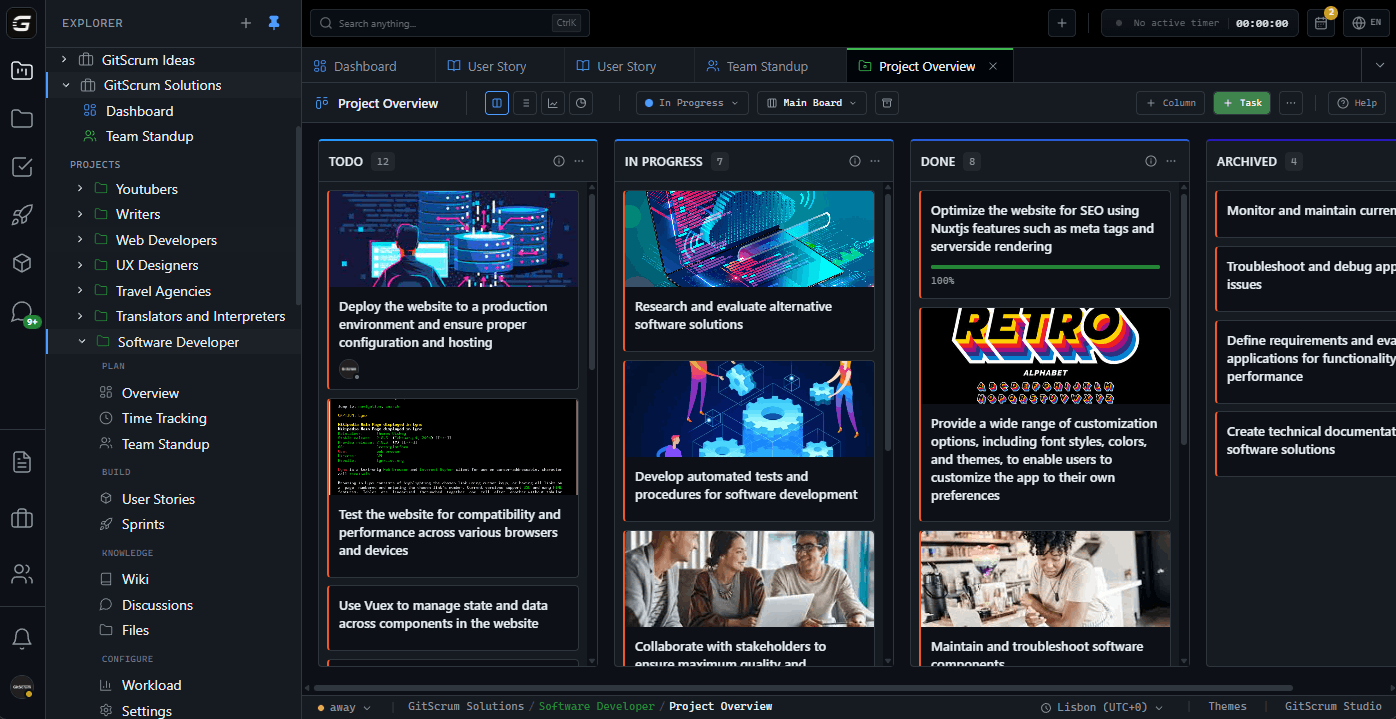
Notion excels at documentation, wikis, and flexible databases. GitScrum excels at project execution—releases, time tracking, invoicing, client visibility. Most teams need both: Notion for knowledge, GitScrum for delivery.
Choose GitScrum if you
- Need real release planning with progress dashboards
- Track billable hours and generate invoices
- Want client portals for transparency
- Run agile workflows (Scrum/Kanban)
Choose Notion if you
- Need flexible documentation and wikis
- Want custom databases for anything
- Prioritize note-taking over execution
- Need a personal productivity system
"Notion is incredible for knowledge management. Our own internal wiki runs on it. But project execution? Configuring databases for releases, adding Clockify for time tracking, using separate tools for invoicing... GitScrum handles what Notion isn't built for: shipping billable work with client visibility."
Renato Marinho
Founder, GitScrum
Side by side the facts
Notion is a knowledge tool. GitScrum is an execution tool. Different jobs.
| Feature | GitScrum | Notion |
|---|---|---|
| Kanban Boards | Native + WIP limits | Basic boards |
| Release Planning | Native delivery pace | Not available |
| Progress Dashboards | Native | Not available |
| Time Tracking | Native | Not available |
| Invoicing | Native | Not available |
| Client Portal | Native | Guest access only |
| Features & Notes | Native | Manual setup |
| Wiki & Docs | Per project | Excellent |
| Custom Databases | Limited | Extensive |
| Note-taking | Basic | Excellent |
| Git Integration | GitHub, GitLab, Bitbucket | Limited |
| Templates | Project templates | Extensive library |
| Real-time Collaboration | Native | Native |
| Setup for PM | < 10 minutes | Hours of config |
Notion documents work
GitScrum delivers it
Notion is incredibly flexible—you can build anything. But that flexibility means you spend hours configuring project management instead of doing project management.
Real cost comparison
for a team of 10
What you actually pay for project execution
10 × $4.20
Plus integrations
- Notion Plus: $10/user
- + Clockify: $5/user
- + External invoicing tool
- + No client portals
- Manual release tracking
The real story different tools, different jobs
Documentation vs Execution
Notion is a knowledge base that can be configured for project management. GitScrum is a project execution tool with documentation built-in. One documents work, the other delivers it.
Flexibility vs Purpose
Notion's flexibility is its strength and weakness—you can build anything, but you have to build it. GitScrum ships with release planning, progress dashboards, and time tracking ready to use.
Time & Billing
Notion has no time tracking or invoicing. For agencies billing clients, this means extra tools, extra cost, extra friction. GitScrum tracks time and generates invoices natively.
Agile Native
Notion can mimic Scrum with custom databases. GitScrum was built for it—real releases, delivery pace tracking, progress dashboards, estimates. No configuration needed.
Built for teams that ship and bill
Agencies billing clients
Track time on tasks, generate invoices from logged hours, get client approval. Notion can't do this without external tools.
Teams running real releases
Release planning with delivery pace, estimates, progress dashboards. Not a database pretending to be Scrum—actual agile workflows.
Client-facing project work
Client portals show progress without exposing internal chaos. Approval workflows for change requests. Branded experience.
Developers who hate setup
Create project, start release, track time. No hours spent configuring databases and relations.
Where Notion wins (honestly)
Knowledge management
Company wikis, documentation, SOPs, meeting notes. Notion's nested pages and flexible blocks are unmatched for organizing knowledge.
Custom databases for anything
CRM, inventory, content calendar, habit tracker—Notion's relational databases can model almost anything. GitScrum is focused on projects.
Personal productivity
Note-taking, journaling, personal knowledge management. Notion is a brilliant second brain. GitScrum is for teams shipping work.
Non-technical teams
Marketing, HR, operations teams who need flexible workspaces without agile methodology. Notion's visual approach fits better.
Start executing in minutes
Keep Notion for docs, use GitScrum for execution
Create your project
Set up takes under 5 minutes
Import your team
Invite via email or link
Configure your release
Add tasks, set estimates
Start tracking
Time, progress, deliverables
Common questions
How do agencies use GitScrum instead of Notion for project management?
Notion requires hours configuring databases for releases, plus Clockify for time tracking (+$7/user), plus invoicing tool (+$10/user). GitScrum: native releases, native time tracking, native invoicing. 10-person agency saves $170+/month and eliminates 3 tools worth of context switching.
Should I replace Notion with GitScrum or use both?
Use both. Notion excels at knowledge management—company wikis, SOPs, meeting notes. GitScrum excels at project execution—releases, time tracking, client billing. They complement each other. Many agencies run Notion for docs + GitScrum for delivery.
What's the real cost of using Notion for project management vs GitScrum?
Notion Plus: $10/user. Add Clockify: +$7/user. Add invoicing: +$10/user. 10-person team: $270/month. GitScrum all-inclusive: $89/month. Plus Notion requires hours of database configuration. GitScrum works immediately.
How long does it take to set up releases in GitScrum vs Notion?
Notion: 2-4 hours configuring databases, relations, rollups, and formulas. GitScrum: 5 minutes. Create project, add tasks, start release. We're opinionated about agile workflows so you don't have to build them from scratch.
Does GitScrum have Notion's database flexibility?
No—and intentionally. Notion lets you build anything from scratch. GitScrum ships with pre-built release planning, time tracking, and invoicing. Less flexibility, more immediate productivity. If you need custom databases for CRM or inventory, use Notion. If you need to ship and bill, use GitScrum.
When should I NOT use GitScrum instead of Notion?
Stay with Notion if: you need company-wide knowledge bases, you want custom databases for non-project data (CRM, inventory), you don't bill clients for project work, or you prefer building systems over using pre-built tools. Notion is a platform; GitScrum is a focused solution.
Ready to execute? Start shipping
Keep Notion for knowledge. Use GitScrum for delivery.
No credit card required · Setup in 2 minutes