Stop Finding Out 3 Days Before Launch That 40% of Products Have No Photography
If you're the e-commerce manager or founder at a DTC brand with 5-20 people, you know the chaos: holiday collection launches November 1st. On October 28th, you discover 60 products have no photos. Photographer says 'I never got the samples.' Merchandising says 'photos were supposed to be done last week.' Meanwhile, copywriting is waiting for images to write descriptions. You scramble, launch half the collection, lose €12,000 in first-week revenue. You've looked at Akeneo, Salsify—but €2,000/month PIM systems for a 15-person team is absurd. You need one board where every SKU, its photography status, copy status, and go-live readiness is visible.
problem.identify()
The Real Cost of Spreadsheet-Based Product Launches
Photography Status Unknown = €8,000/Season in Delayed Launches
E-commerce manager asks 'Are holiday products photographed?' Photographer checks—'most of them.' Which ones? Nobody knows. Spreadsheet says 'in progress' for 80 products. Reality: 40 photographed, 25 waiting for samples, 15 never scheduled. Discovery happens October 28th. Launch date: November 1st. 60 products launch 2 weeks late. 60 × €200 first-week revenue = €12,000 lost. Happens every season.
Sample-to-Photography Handoff Chaos = €3,600/Season in Coordination Overhead
Samples arrive at warehouse. Someone emails photographer 'samples ready.' Email gets buried. A week later: 'Why haven't you started shooting?' Photographer: 'I never knew samples arrived.' Every product requires 3-5 Slack messages to coordinate sample→photographer→stylist→retoucher handoff. 100 products × 20 minutes coordination overhead = 33 hours/season × €110/hour = €3,630 wasted.
Copy Waiting on Photography = €4,800/Season in Writer Idle Time
Copywriter needs product images to write descriptions. Photography schedule is unclear. Writer asks 'Which products are shot?' No clear answer. Writer works on other projects, loses context. When images finally arrive, writer scrambles between 5 projects. 100 products × 30 minutes context-switching overhead = 50 hours × €95/hour = €4,750 in writer productivity loss.
Launch Week Fire Drill = €6,000/Season in Senior Time
Every seasonal launch becomes a fire drill. E-commerce director personally tracks each product. Status meetings every morning the week before launch. Spreadsheet updates constantly. Director spends 40 hours/season being human project tracker instead of strategic work. 40 hours × €150/hour director rate = €6,000/season in misallocated senior time.
Sound familiar?
See how GitScrum handles this in 2 minutes.
solution.implement()
Every SKU Tracked, Every Handoff Visible, Every Launch On Time
Visual Product Pipeline = Zero Status Mystery
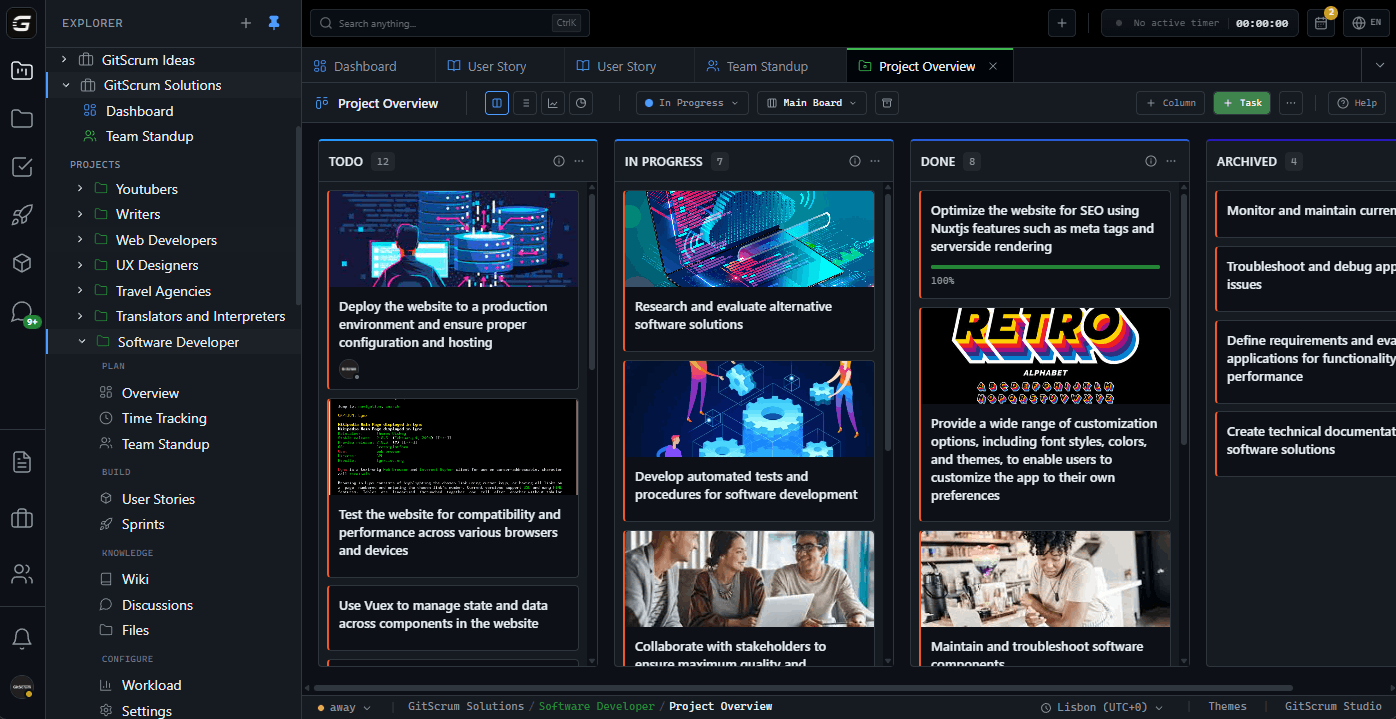
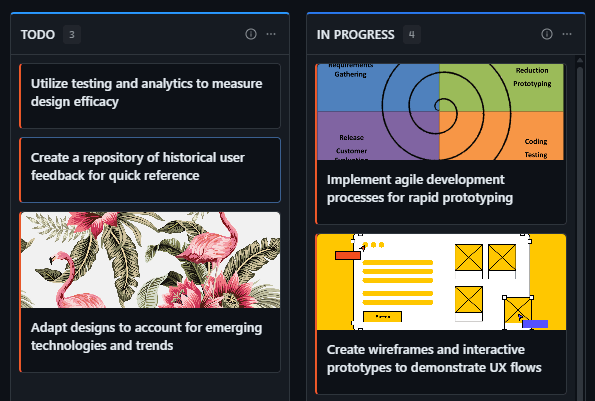
Every SKU is a card. Columns: Sample Received → Photographed → Retouched → Copy Written → QA → Live. E-commerce manager sees all 120 products at once: 45 in photography, 30 in copy, 25 in QA, 20 live. Which products are blocking? Visible instantly. Zero 'I thought photography was done' surprises.
Sample→Photo→Copy Handoffs = Automatic Notifications
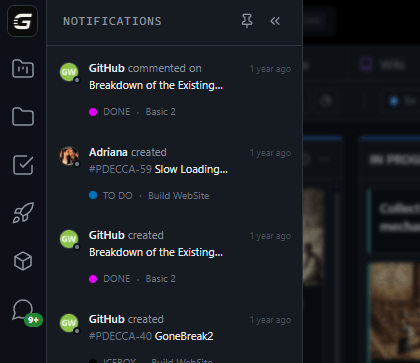
Sample arrives at warehouse? Photographer gets notified immediately. Photography complete? Copywriter gets notified with image links. No buried emails. No 'I didn't know it was ready.' Every handoff triggers the next person in the pipeline automatically.
Launch Date Countdown = Proactive Bottleneck Alerts
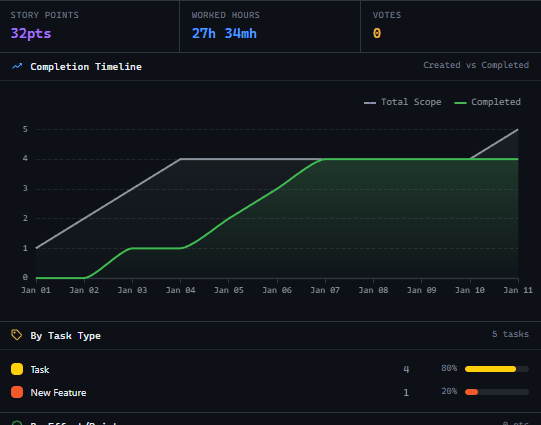
Set launch date: November 1st. System calculates: photography needs completion by October 15th, copy by October 22nd, QA by October 28th. If photography falls behind, board indicator turns red BEFORE it's too late. You fix bottlenecks proactively, not in panic mode.
Vendor Sample Tracking = No More 'Where's the Sample?'
Vendors submit sample shipment info through portal. You see: 'Sample shipped October 5th, tracking #XYZ.' When sample arrives, photographer sees it in 'Ready to Shoot' column. No more email chains asking 'Did the samples arrive?'
These solutions work together. Try them today.
Team size GitScrum is built for
For teams up to 2 users
Per user, per month
"We stopped losing hours to status meetings. Now everyone sees progress in real-time."
Sarah Chen
Operations Lead, 15-person team
Frequently Asked Questions
Still have questions? Contact us at customer.service@gitscrum.com
Does this replace Shopify or our e-commerce platform?
No. GitScrum manages pre-launch workflow—getting products through photography, copy, and QA. Once a product is launch-ready, your team publishes to Shopify/BigCommerce/etc. as normal. GitScrum tracks the coordination, not the storefront.
How do we handle product variants (colors, sizes)?
Parent product card tracks the overall launch. Create subtasks for variant-specific work (photography for each color, for example). When all variants complete, parent product moves to next stage. Variant status rolls up to the parent view.
What about integrating with our DAM or photo editing workflow?
GitScrum doesn't replace Adobe DAM or Capture One. It tracks when photography is complete and ready for the next step. Attach final asset links to tasks. Most teams link to Google Drive, Dropbox, or their DAM directly in task attachments.
Can vendors see their sample status?
Yes. Create a vendor-specific portal view showing: sample shipped, sample received, photography scheduled, photography complete. Vendors check status themselves instead of emailing 'Did you get our samples?' three times per collection.
Ready to solve this?
Start free, no credit card required. Cancel anytime.