VS Code

GitScrum for VS Code, Google Antigravity, Cursor and Windsurf!

GitScrum logo
Solution

Agile Transformation 2026 | Sprints Boards Ready Now

How to start agile transformation? GitScrum: sprints, boards, backlogs ready immediately. No months of configuration. First sprint in under 1 day. Free trial.

Agile Transformation 2026 | Sprints Boards Ready Now

Agile transformation fails when teams try to adopt processes without supporting tools, or when they're given enterprise tools so complex that configuration takes months.

Teams read the Scrum Guide, get excited, then realize they have no infrastructure for sprints, backlogs, or velocity tracking. They try using spreadsheets or generic project tools—neither enforces agile practices.

Without guardrails, teams drift back to old habits. Successful agile adoption requires tools that embody agile principles: timeboxed sprints, prioritized backlogs, visual boards, empirical metrics.

GitScrum provides this immediately: create a project, and you have sprints, backlog, board, burndown. No configuration odyssey.

The tool guides the process while teams focus on delivering value.

The GitScrum Advantage

One unified platform to eliminate context switching and recover productive hours.

01

problem.identify()

The Problem

Teams want agile but lack infrastructure to implement it properly

Enterprise agile tools require months of configuration before use

Spreadsheets and generic tools don't enforce agile practices

No velocity, burndown, or sprint metrics without specialized tools

Process changes without tool support revert to old habits quickly

02

solution.implement()

The Solution

Opinionated agile structure out of the box—sprints, backlog, board ready immediately

Guided setup gets teams running sprints within hours, not weeks

Built-in velocity and burndown charts provide metrics without configuration

Visual boards enforce WIP limits and workflow stages naturally

Sprint ceremonies supported: planning, daily standups, reviews, retrospectives

03

How It Works

1

Start with Structure

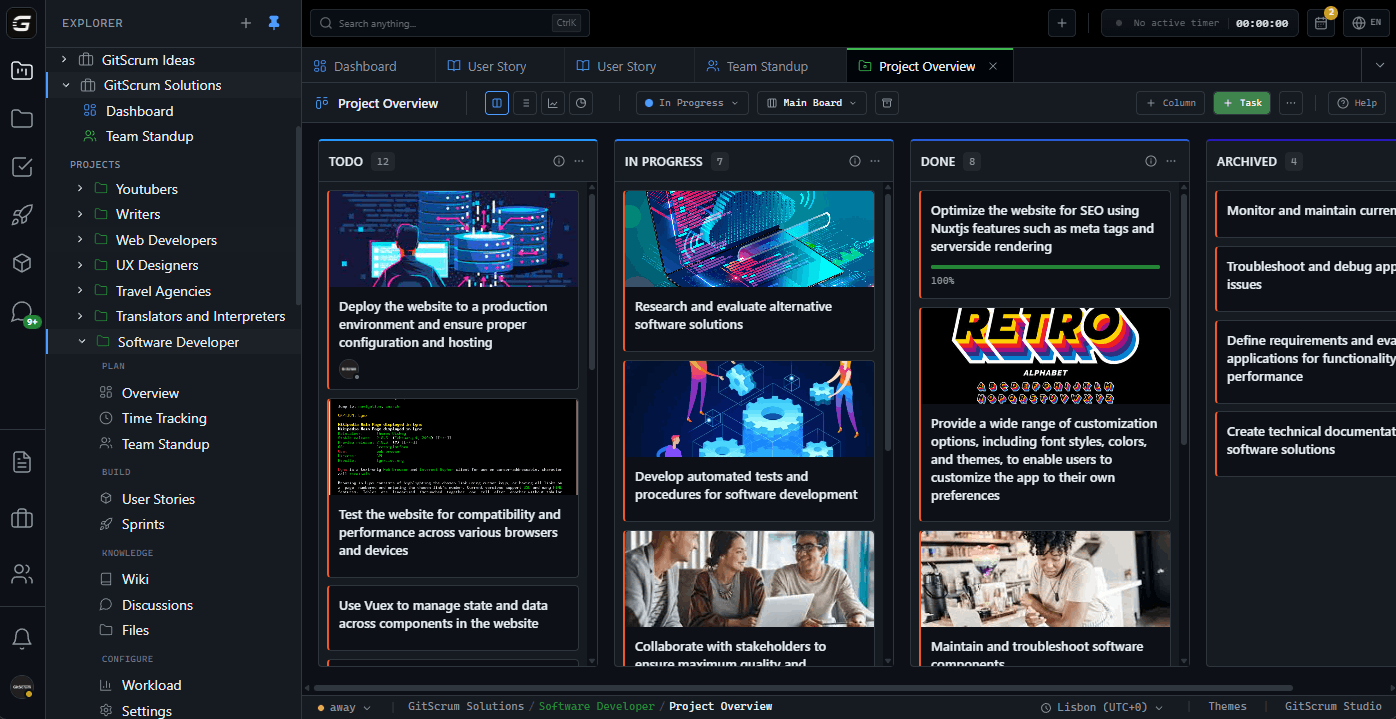
Create your first project. GitScrum provides: a Backlog for user stories, a Board with columns (To Do, In Progress, Review, Done), Sprint containers for timeboxed work. No configuration needed—agile structure is there immediately. Start adding work items.

2

Build Your Backlog

Add User Stories to the backlog. Use the 'As a... I want... so that...' format encouraged by GitScrum. Prioritize: drag high-value items to top. Estimate: use story points or time. Your backlog becomes the single source of what to build, in what order.

3

Run Your First Sprint

Create a sprint (1-2 weeks). Pull items from top of backlog into sprint. Commit to what team can deliver. Once sprint starts, the burndown chart shows progress. The board visualizes flow. Daily standups reference the board—what moved, what's blocked.

4

Establish Ceremonies

Use GitScrum features for each ceremony: Planning (backlog view for selection, capacity), Daily Standup (board view, Team Standup for async updates), Review (show completed items), Retrospective (sprint metrics, action items as tasks). The tool supports the rituals.

5

Improve with Data

After a few sprints, velocity stabilizes. Use it for forecasting. Review burndown patterns—steady progress or last-minute rush? Examine cycle time—how long from start to done? Data guides continuous improvement. Agile becomes measurable, not just aspirational.

04

Why GitScrum

GitScrum addresses Agile Transformation for Development Teams through Kanban boards with WIP limits, sprint planning, and workflow visualization

Problem resolution based on Kanban Method (David Anderson) for flow optimization and Scrum Guide (Schwaber and Sutherland) for iterative improvement

Capabilities

  • Kanban boards with WIP limits to prevent overload
  • Sprint planning with burndown charts for predictable delivery
  • Workload views for capacity management
  • Wiki for process documentation
  • Discussions for async collaboration
  • Reports for bottleneck identification

Industry Practices

Kanban MethodScrum FrameworkFlow OptimizationContinuous Improvement

Frequently Asked Questions

Still have questions? Contact us at customer.service@gitscrum.com

How long does agile adoption take with GitScrum?

Teams can run their first sprint within a day. Tool setup takes hours, not weeks. Process adoption takes longer—3-6 sprints for teams to feel comfortable. The tool provides structure immediately; habits develop over time. Start simple: backlog, sprint, board. Add complexity (estimation, velocity tracking) as team matures.

We're not a pure Scrum team. Can we adapt?

GitScrum supports Scrum, Kanban, and hybrid approaches. Don't want sprints? Use continuous flow with the board. Want longer iterations? Sprints can be any length. The tools are flexible while providing enough structure to keep you on track. Customize to your context.

How do we train the team on agile using GitScrum?

Learning by doing. Create a practice project. Run a mock sprint planning: create stories, estimate, commit. Watch the burndown over a few days. The tool teaches the concepts through use. Supplement with short readings (Scrum Guide is 13 pages). Avoid 3-day certification courses—practice matters more.

What if leadership doesn't understand agile?

Show results. After a few sprints, present: what was committed, what was delivered, velocity trend. Demonstrate predictability—velocity enables forecasting. Show waste reduction through cycle time. Leadership cares about outcomes; agile delivers faster, higher-quality results. Let the metrics speak.

How do we handle fixed-scope, fixed-timeline projects?

Agile still works. Use velocity to forecast: will scope fit in timeline? If not, negotiate scope reduction early—before deadline crisis. Prioritize ruthlessly: must-have vs nice-to-have. Deliver incrementally so there's something working if time runs out. Fixed constraints, flexible scope prioritization.

Ready to solve this?

Start free, no credit card required. Cancel anytime.

Works with your favorite tools

Connect GitScrum with the tools your team already uses. Native integrations with Git providers and communication platforms.

GitHubGitHub
GitLabGitLab
BitbucketBitbucket
SlackSlack
Microsoft TeamsTeams
DiscordDiscord
ZapierZapier
PabblyPabbly

Connect with 3,000+ apps via Zapier & Pabbly