GitScrum PRO Annual — 2,500+ SaaS apps via MCP

GitScrum logo
Solution

Dev Work Visibility 2026 | Real Activity Not Status Cards

Jira cards lie—'In Progress' for days with no updates. GitScrum's GitHub integration shows real commits, PRs on tasks. Auto-status updates. Free trial.

Dev Work Visibility 2026 | Real Activity Not Status Cards

A developer has had a task 'In Progress' for three days.

Is it almost done? Stuck on a blocker?

Actually being worked on, or did they context-switch to something else? The task card tells you nothing.

Getting answers requires interrupting the developer—which breaks their focus and makes them feel micromanaged. Multiply this across a team of ten developers and you have a manager spending hours in one-on-ones just to understand basic status, while developers spend hours being interrupted about basic status.

Everyone is frustrated. The core problem is that Jira tracks task intentions, not work reality.

Moving a card to 'In Progress' is a declaration of intent, not evidence of activity. When task data and work activity are disconnected, visibility requires human status reporting.

GitScrum solves this by connecting task status to actual development activity. When a developer commits code, the linked task shows it.

When they open a PR, the task reflects it. When the PR is reviewed and merged, the task auto-updates.

Managers see development activity without asking—visibility becomes automatic, not interrogation-driven.

The GitScrum Advantage

One unified platform to eliminate context switching and recover productive hours.

01

problem.identify()

The Problem

Task boards show status that may or may not reflect reality

Getting actual work status requires interrupting developers

Managers spend hours in check-ins just to understand basic status

Developers feel micromanaged when asked 'what are you working on?' constantly

No connection between task status and actual development activity

02

solution.implement()

The Solution

GitHub integration shows commits and PRs connected to tasks—real activity, not status declarations

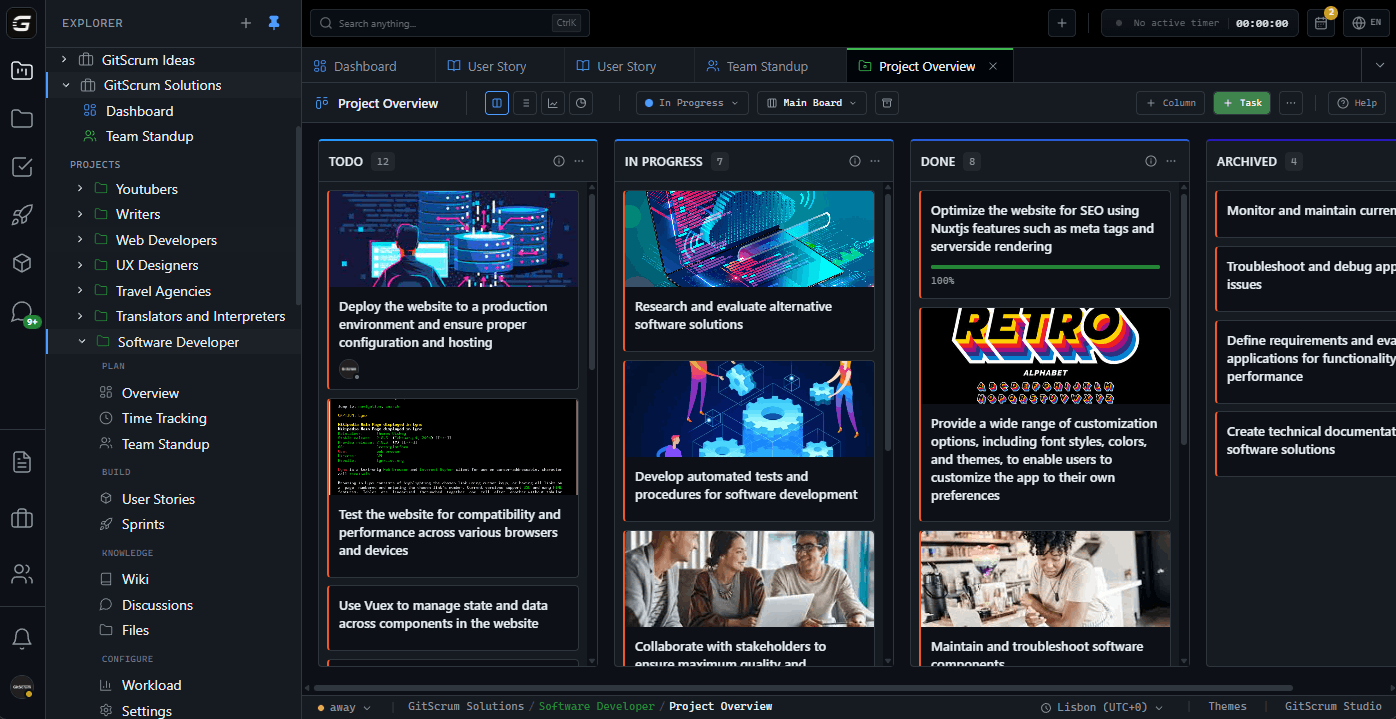
Task cards display development activity timeline without developer input

Managers see what's happening without interrupting developers

Status auto-updates based on code activity—no manual card-moving required

Trust-based visibility: evidence of work, not interrogation about work

03

How It Works

1

Connect GitHub to GitScrum

Link your GitHub repositories to GitScrum. The integration watches for commits, branches, pull requests, and code reviews associated with your project.

2

Link Commits and PRs to Tasks

When developers reference task IDs in commits or PR titles, GitScrum automatically links them. Task cards show the associated development activity—commits made, PRs opened, reviews in progress.

3

View Activity Without Interrupting

Managers can see real development activity on any task: when the last commit was, what the PR status is, whether reviews are pending. No need to ask the developer—the work activity is visible.

4

Auto-Update Status from Activity

Configure workflows to auto-update task status based on GitHub events. PR merged? Task moves to Review. Branch created? Task moves to In Progress. Status stays accurate automatically.

04

Why GitScrum

GitScrum addresses No Visibility Into What Developers Are Actually Working On through Kanban boards with WIP limits, sprint planning, and workflow visualization

Problem resolution based on Kanban Method (David Anderson) for flow optimization and Scrum Guide (Schwaber and Sutherland) for iterative improvement

Capabilities

  • Kanban boards with WIP limits to prevent overload
  • Sprint planning with burndown charts for predictable delivery
  • Workload views for capacity management
  • Wiki for process documentation
  • Discussions for async collaboration
  • Reports for bottleneck identification

Industry Practices

Kanban MethodScrum FrameworkFlow OptimizationContinuous Improvement

Frequently Asked Questions

Still have questions? Contact us at customer.service@gitscrum.com

Doesn't this feel like surveillance?

There's a difference between surveillance and visibility. Surveillance is tracking keystrokes and monitoring screen time. Visibility is seeing work output—commits, PRs, code reviews. Developers already create this activity; GitScrum just connects it to tasks so managers don't have to ask. Most developers prefer showing work evidence to constant check-ins.

What about work that doesn't involve code—research, design, planning?

GitHub integration shows coding activity; other work still needs manual updates. But a significant portion of developer work involves code, and automating that visibility reduces the status update burden substantially. For non-code work, task comments provide a natural place to note progress.

How do we get developers to reference task IDs in commits?

Make it easy: configure commit message templates, use IDE plugins that suggest task IDs, enable branch naming conventions that include task IDs. When linking is frictionless, developers do it naturally because it helps them too—their work gets properly attributed.

What if a developer is stuck but hasn't committed anything?

No commits for an extended period can indicate a blocker—and that's useful information too. Rather than interrupting to ask status, the lack of activity prompts a supportive check-in: 'I noticed no recent commits on Task X—do you need help with anything?' This is visibility enabling support, not surveillance enabling criticism.

Ready to solve this?

Start free, no credit card required. Cancel anytime.

Works with your favorite tools

Connect GitScrum with the tools your team already uses. Native integrations with Git providers and communication platforms.

GitHubGitHub
GitLabGitLab
BitbucketBitbucket
SlackSlack
Microsoft TeamsTeams
DiscordDiscord
ZapierZapier
PabblyPabbly

Connect with 3,000+ apps via Zapier & Pabbly