VS Code

GitScrum for VS Code, Google Antigravity, Cursor and Windsurf!

GitScrum logo
Industry Vertical

Strapi Agency PM 2026 | Headless CMS GraphQL Multi-Tenant

How do Strapi agencies manage projects? GitScrum helps headless CMS teams deliver content types 40% faster with schema tracking and wiki docs. Free trial.

Strapi Agency PM 2026 | Headless CMS GraphQL Multi-Tenant

Strapi development agencies deliver flexible headless CMS solutions with customizable content types and auto-generated APIs.

Your team builds content architectures, implements custom plugins, creates webhook integrations, and deploys scalable CMS backends. Content type relationships require careful planning, plugin customizations need documentation, and multi-tenant setups demand proper isolation.

Sprint planning includes content modeling sessions and API performance testing. Wiki documents content structures and plugin configurations.

Git integrations track schema changes and customizations. Time tracking helps estimate content migration efforts.

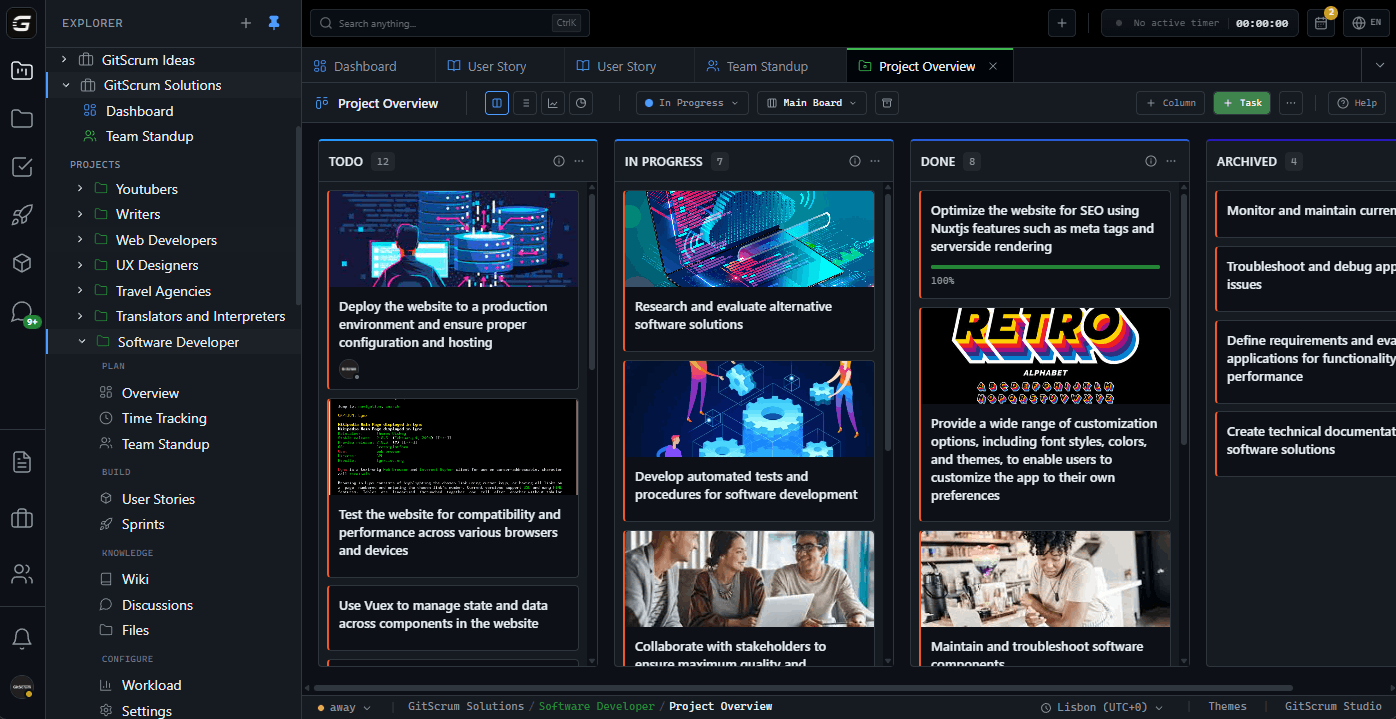
GitScrum helps Strapi agencies: boards visualize content type development, user stories capture editorial requirements, and discussions centralize architectural decisions about content modeling.

The GitScrum Advantage

One unified platform to eliminate context switching and recover productive hours.

01

challenges.identify()

Challenges

Content type relationship complexity

Plugin customization maintenance

Multi-tenant architecture challenges

API performance at scale

02

solution.implement()

How GitScrum Helps

Boards track content type development

Git integrations link schema commits

Wiki documents content structures

User stories capture editorial needs

Time tracking estimates migrations

03

useCases.list()

Use Cases

Building content management backends

Developing multi-site CMS platforms

Creating editorial workflows

Implementing headless e-commerce

Migrating from WordPress to headless

04

Why GitScrum

GitScrum provides Kanban boards, sprint planning with burndown charts, and workflow automation for Strapi Development Agency teams

Project management based on Scrum Guide (Schwaber and Sutherland) and Kanban Method (David Anderson)

Capabilities

  • Kanban boards with customizable columns and WIP limits
  • Sprint planning with burndown and burnup charts
  • Time tracking with billable rates
  • Wiki for documentation
  • Git integration for code linkage
  • Client Portal for stakeholder visibility

Industry Practices

Scrum FrameworkKanban MethodAgile Project ManagementContinuous Improvement
features.related()

Key Features

View all features

Visual project management that actually fits how {vertical} work. Create unlimited Kanban boards with custom columns—from 'Client Review' to 'Ready to Deploy'—and set WIP limits that prevent the bottlenecks {city} teams know too well. Every card, comment, and status change syncs instantly across devices, so whether your {vertical} team is in the office or remote across {city}, everyone sees the same real-time picture.

Ship faster without the chaos. Drag-and-drop backlog prioritization, velocity tracking across iterations, and burndown charts that update as work gets done—not when someone remembers to update a spreadsheet. Your team always knows what's next, stakeholders see progress without asking, and {vertical} across {city} consistently hit their sprint commitments.

Code and project management finally speak the same language. Connect GitHub, GitLab, or Bitbucket in two clicks—every commit, branch, and pull request automatically links to the right task. Developers in {city} push code and managers see progress instantly, no status meetings required. {vertical} teams ship faster when the code tells the whole story.

Requirements written in developer-speak lose context by the time they ship. Write user stories with clear acceptance criteria, group them into epics, and let the team vote on story points together. {city} stakeholders see progress at the epic level while {vertical} developers know exactly what 'done' means.

Every unbilled hour is money walking out the door. One-click timers capture billable minutes automatically—no more end-of-week timesheet scrambles that plague {city} teams. Set custom rates per project, get nudges when timers run too long, and export reports that make invoicing effortless. {vertical} using GitScrum track 23% more billable hours on average.

New hires asking the same questions. Process docs scattered across Google Docs, Notion, and Slack pins. Sound familiar? Build your team's single source of truth with rich text editing, nested pages, and instant search. {vertical} in {city} onboard new members 3x faster when everything is documented once and findable forever.

Frequently Asked Questions

Still have questions? Contact us at customer.service@gitscrum.com

How do we manage content type development?

Board columns track content lifecycle: Modeling, Fields, Relations, API Testing, Documentation, Production. Cards link to content type schemas.

How do we document content structures?

Wiki contains complete content type documentation with field definitions, relations, and validation rules. Link tasks to content schemas.

How do we handle plugin customizations?

Wiki documents custom plugin development patterns. Tasks track plugin updates. Labels indicate customization dependencies.

How do we migrate content?

Create migration sprint with content type mapping. Tasks track data transformation steps. Wiki documents migration scripts.

Ready to get started?

Start free, no credit card required. Cancel anytime.

Works with your favorite tools

Connect GitScrum with the tools your team already uses. Native integrations with Git providers and communication platforms.

GitHubGitHub
GitLabGitLab
BitbucketBitbucket
SlackSlack
Microsoft TeamsTeams
DiscordDiscord
ZapierZapier
PabblyPabbly

Connect with 3,000+ apps via Zapier & Pabbly