Backend Work Is Invisible Backend reality: ├─ API design and documentation ├─ Database migrations ├─ Authentication/authorization ├─ Third-party integrations ├─ Performance optimization ├─ Security hardening ├─ Background jobs ├─ Caching layers ├─ Logging/monitoring ├─ API versioning None visible to stakeholders.
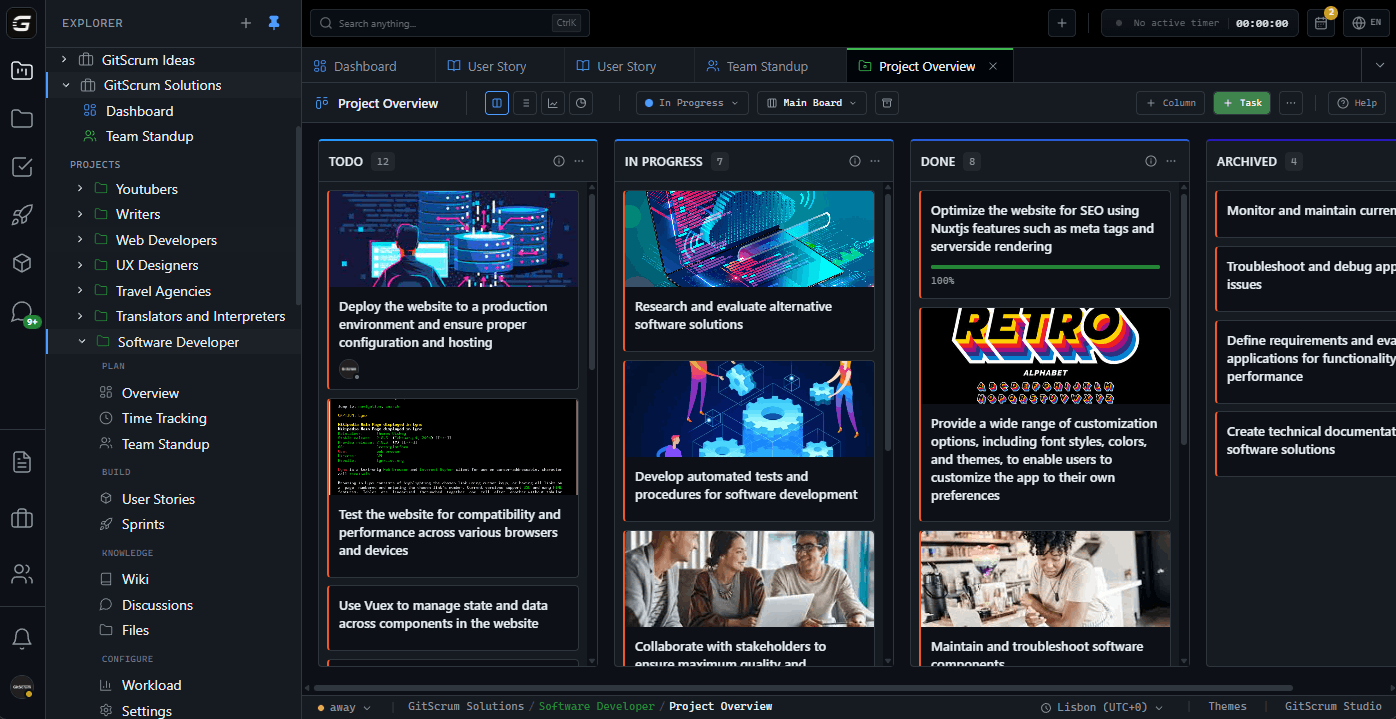
'Why does this take so long?' Why Generic PM Fails Backend Typical story: ├─ 'User can update profile' - 2 points ├─ What's actually needed: │ ├─ API endpoint design │ ├─ Database migration │ ├─ Validation logic │ ├─ Auth middleware update │ ├─ Background job for email │ ├─ Cache invalidation │ ├─ API versioning consideration │ ├─ Documentation update │ ├─ Integration tests │ └─ Frontend waiting on all this ├─ Story shows 'In Progress' ├─ For 2 weeks No visibility into actual work. GitScrum for Backend Teams Backend-aware tracking: ├─ Task per API endpoint ├─ Task per migration ├─ Task per service change ├─ Git commits show real progress ├─ Dependencies visible ├─ Technical debt tracked ├─ Documentation in wiki Backend work becomes visible.
API Development Workflow API task structure: ├─ Design (OpenAPI/Swagger spec) ├─ Implementation ├─ Validation ├─ Auth integration ├─ Tests (unit + integration) ├─ Documentation ├─ Review GitScrum approach: ├─ One task per endpoint ├─ Checklist for completion criteria ├─ OpenAPI spec link attached ├─ Commits auto-link ├─ Frontend blocker visible 'GET /users ready, POST /users in review' Database Migration Tracking Migration reality: ├─ Schema change designed ├─ Migration written ├─ Tested on staging ├─ Rollback plan documented ├─ Deployed to production ├─ Verified in prod GitScrum tracking: ├─ Migration tasks with checklist ├─ Staging deploy = checkbox ├─ Prod deploy = checkbox ├─ Rollback plan in wiki ├─ Blocking relationships visible 'Profile update blocked on migration in staging.' Microservices Coordination Multiple services: ├─ User service ├─ Order service ├─ Payment service ├─ Notification service ├─ API gateway Cross-service feature: ├─ User service: Add field ├─ Order service: Use field ├─ API gateway: Route update ├─ All must deploy together GitScrum handles: ├─ Multiple repos, one board ├─ Dependencies across services ├─ Release coordination ├─ 'v2.3 needs changes in 3 services' See the whole picture. Technical Debt Visibility Tech debt is real: ├─ 'This endpoint is slow' ├─ 'This query needs indexing' ├─ 'This should be a service' ├─ 'This auth is legacy' ├─ But 'no time' for tech debt GitScrum approach: ├─ Tech debt tasks visible on board ├─ Label for tech debt ├─ Velocity shows capacity ├─ Sprint allocation for debt ├─ Not hidden, not forgotten '20% of sprint for tech debt' visible and tracked.
API Versioning Tracking Versioning workflow: ├─ v1 (deprecated, removal date set) ├─ v2 (current, stable) ├─ v3 (in development) ├─ Breaking changes documented ├─ Client migration support GitScrum tracking: ├─ Label per API version ├─ Deprecation tasks visible ├─ Breaking change tasks tracked ├─ Wiki documents version changes ├─ Migration guides linked 'v1 removal blocked by Client X still on v1.' Performance Work Tracking Performance optimization: ├─ Identify bottleneck ├─ Profile and measure ├─ Implement fix ├─ Benchmark improvement ├─ Deploy and monitor ├─ Often invisible work GitScrum approach: ├─ Performance tasks with metrics ├─ Before: 500ms, After: 50ms ├─ Commits linked to task ├─ Monitoring links in description ├─ Value demonstrated Stakeholders see: 'Reduced API latency from 500ms to 50ms.' Integration Tracking Third-party integrations: ├─ Stripe for payments ├─ SendGrid for email ├─ Twilio for SMS ├─ AWS services ├─ Each with own complexity GitScrum tracking: ├─ Task per integration ├─ Credential management notes ├─ Sandbox vs production status ├─ Documentation in wiki ├─ Maintenance tasks ongoing 'Stripe webhook handling - 3 of 5 events implemented.' Backend + Frontend Coordination Frontend waiting on backend: ├─ Frontend: 'Need /users endpoint' ├─ Backend: 'Implementing' ├─ Frontend: 'When?' ├─ Backend: 'Soon' ├─ Frontend: Still waiting... GitScrum solution: ├─ API task visible to both teams ├─ Dependency linked ├─ Status clear: 'In Review' ├─ ETA based on velocity ├─ No back-channel questions 'Frontend unblocked when PR 234 merges.' Authentication Work Auth complexity: ├─ JWT implementation ├─ OAuth integration ├─ Role-based access ├─ Permission system ├─ Token refresh ├─ Security audit GitScrum tracking: ├─ Auth epic with subtasks ├─ Security checklist ├─ Wiki documents auth flow ├─ Commits to auth service linked ├─ Review by security team tracked Auth work visible, not hidden.
Background Jobs Tracking Background processing: ├─ Email sending ├─ Report generation ├─ Data sync ├─ Cleanup jobs ├─ Often forgotten GitScrum approach: ├─ Jobs are tasks like any other ├─ Scheduling in task description ├─ Monitoring links attached ├─ Error handling documented ├─ Not second-class work 'Email worker: 5 of 7 templates implemented.' Pricing for Backend Teams Solo backend dev: $0 (free) 2-person team: $0 (free) 5-person team: $26.70/month 10-person team: $71.20/month 20-person team: $160.20/month $8.90/user/month. 2 users free forever.
All features included: ├─ Git integration (all providers) ├─ Multiple repos (microservices) ├─ Wiki (API documentation) ├─ Sprint tracking ├─ No per-service pricing Compared to Other Tools Jira: ├─ Story-centric (not API-centric) ├─ Backend work invisible ├─ Heavy configuration ├─ Expensive at scale Linear: ├─ Better UX ├─ Still story-focused ├─ No multi-repo view ├─ Microservices awkward GitScrum: ├─ Git-native (commits = progress) ├─ Multi-repo for microservices ├─ Backend work visible ├─ $8.90/user vs $$/user Real Backend Experience 'Every PM tool treats backend as a black box. "User can do X" hides database migrations, API versioning, auth changes, performance tuning.
GitScrum lets us break that down into visible tasks. When PM asks why its taking 2 weeks, we point to the board: migration in staging, API in review, auth update pending security.
Visibility changed the conversation from "why so slow?" to "what can we unblock?"' - Backend Tech Lead Daily Workflow Morning: ├─ Check board: What's blocked? ├─ Any failed deploys overnight?
├─ Dependencies updated? ├─ 5 minutes, start coding During work: ├─ Commit messages reference task ├─ PR links to task automatically ├─ Migration deployed = task updated ├─ Tests passing = checklist item End of day: ├─ Board reflects actual state ├─ No manual status updates ├─ Git activity is the update Sprint Planning for Backend Backend estimation: ├─ CRUD endpoint: Small (known pattern) ├─ New integration: Medium-Large (unknowns) ├─ Performance fix: Medium (profiling time) ├─ Auth change: Large (security review) ├─ Migration: Varies (depends on data) GitScrum sprint: ├─ Velocity calibrated to backend work ├─ Tech debt allocation visible ├─ Dependencies front-loaded ├─ Frontend sync points planned Documentation in Wiki Backend documentation: ├─ API specifications ├─ Architecture decisions ├─ Database schema ├─ Integration guides ├─ Runbooks GitScrum wiki: ├─ All docs in one place ├─ Linked from tasks ├─ Searchable ├─ Version history ├─ Not scattered in Confluence/Notion/README Start Free Today 1.
Sign up (30 seconds) 2. Connect backend repos (mono or micro) 3.
Create API/service tasks 4. Make backend work visible Backend-aware project management.
The GitScrum Advantage
One unified platform to eliminate context switching and recover productive hours.