Competitive disadvantage from slower execution represents the ultimate cumulative cost of tool fragmentation—the systematic inability to compete effectively because operational complexity constrains execution speed.
In modern markets, speed of execution often matters more than quality of strategy. Two companies with the same strategic insight will have dramatically different outcomes based on how quickly they can execute.
The company that ships first establishes market position, captures early customers, generates learning from real usage, and iterates while competitors are still in development. Tool fragmentation creates execution drag at every level.
Individual contributors spend time switching between applications. Teams spend time coordinating across incompatible systems.
Managers spend time reconciling data from different sources. Executives make decisions based on stale information because real-time aggregation is impossible.
Each of these inefficiencies may seem small in isolation, but they compound into systematic execution slowness that affects everything the organization tries to accomplish. Competitors with unified platforms do not have this drag.
Their individuals work faster because everything is in one place. Their teams coordinate faster because everyone sees the same information.
Their managers understand status faster because data does not need reconciliation. Their executives decide faster because real-time visibility is built in.
Over time, this execution advantage compounds into market advantage. The solution is not working harder or hiring more people—the fundamental constraint is operational architecture.
A unified platform removes the execution drag by eliminating the coordination overhead, data reconciliation, and system complexity that slow everything down. The same team can execute faster simply because they are not fighting their tools.
The GitScrum Advantage
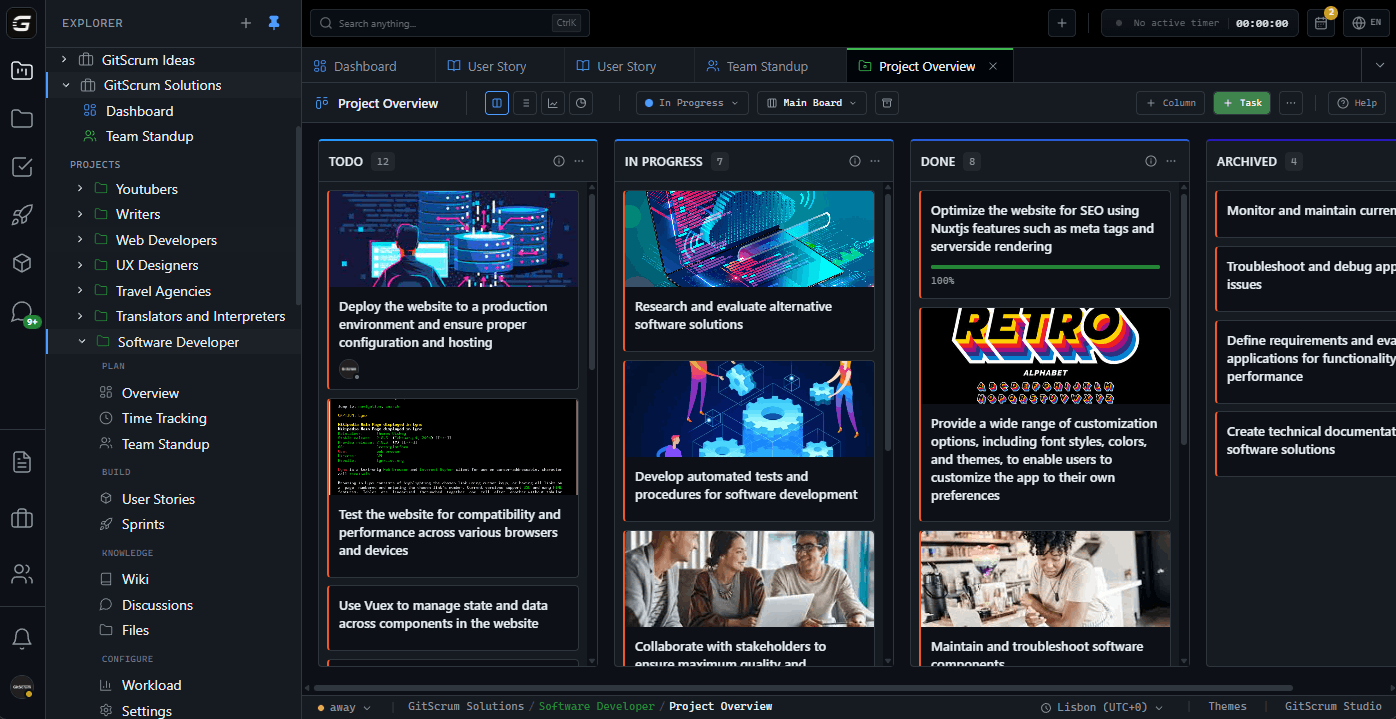
One unified platform to eliminate context switching and recover productive hours.