







VS Code

GitScrum for VS Code, Google Antigravity, Cursor and Windsurf!

GitScrum logo
Solution

Real Developer Velocity Metrics 2026 | Not Vanity Dashboards

847 commits this week sounds impressive until you see 'fix typo' and 'merge'. Flow metrics that matter: cycle time, blocker duration, estimation accuracy. Drive improvement not impressions. Free trial.

Real Developer Velocity Metrics 2026 | Not Vanity Dashboards

Vanity metrics plague software development measurement.

Commit counts, lines of code, and tasks closed are all gameable and misleading. They create wrong incentives (more commits = split work artificially) and hide real issues.

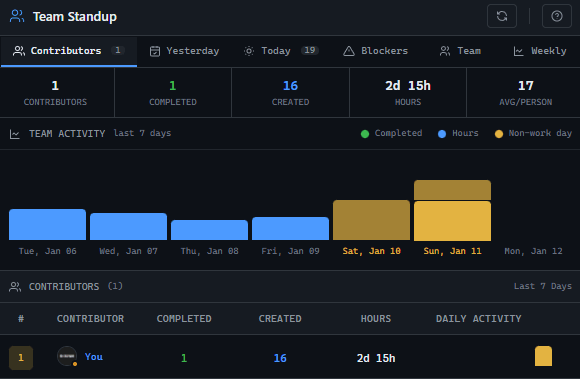
Flow metrics—cycle time, lead time, blocker impact—reveal actual team effectiveness. These can't be gamed without improving the process.

Teams using flow metrics improve; teams chasing vanity metrics optimize for appearances.

The GitScrum Advantage

One unified platform to eliminate context switching and recover productive hours.

01

problem.identify()

The Problem

Commit counts, LOC easily gamed

Story points inflated for 'success'

Metrics don't answer real questions

Dashboards are theater, not insight

Wrong incentives from wrong metrics

02

solution.implement()

The Solution

Flow metrics: cycle time, lead time

Ungameable without actual improvement

Answer real questions about team

Dashboards drive action, not impressions

Right incentives: flow optimization

03

How It Works

1

Cycle Time Focus

Measure what matters: 'How long from 'started' to 'done'? This is cycle time—the actual work duration. Can't be gamed: faster cycle time means work actually finishing faster. Dashboard shows: average cycle time trending down = team improving. No artificial inflation possible.'

2

Blocker Impact Visibility

See the real impediments: 'Dashboard shows: 47 developer-hours lost to blockers this sprint. Breakdown: 60% waiting for external API, 25% waiting for PR review, 15% unclear requirements. Now you know where to improve. Not 'we should communicate better'—specific, measurable.'

3

Estimation Accuracy Trends

Get better at planning: 'Are estimates improving? Dashboard shows: Q1 average variance 40%, Q2 average variance 28%. Team is calibrating. Which areas most inaccurate? Frontend estimates 35% off, backend 15%. Focus estimation improvement where needed.'

4

Flow Efficiency

Optimize the process: 'Task active time vs total time. If task takes 3 days but only 4 hours of actual work, 87% is wait time. Where's the wait? Review queue? Dependency? Environment? Flow efficiency metric reveals process improvement opportunities invisible to vanity metrics.'

04

Why GitScrum

GitScrum addresses Real Developer Velocity Metrics, Not Vanity Dashboards through Kanban boards with WIP limits, sprint planning, and workflow visualization

Problem resolution based on Kanban Method (David Anderson) for flow optimization and Scrum Guide (Schwaber and Sutherland) for iterative improvement

Capabilities

  • Kanban boards with WIP limits to prevent overload
  • Sprint planning with burndown charts for predictable delivery
  • Workload views for capacity management
  • Wiki for process documentation
  • Discussions for async collaboration
  • Reports for bottleneck identification

Industry Practices

Kanban MethodScrum FrameworkFlow OptimizationContinuous Improvement

Frequently Asked Questions

Still have questions? Contact us at customer.service@gitscrum.com

What's the difference between vanity and flow metrics?

Vanity metrics can be gamed without improving outcomes: more commits (split work), more LOC (verbose code), more points (inflate estimates). Flow metrics improve only when process improves: faster cycle time requires actual work flowing faster. You can't fake cycle time improvement—you have to actually get better.

Won't developers resist being measured?

Resistance usually comes from being measured on wrong things. Individual commit counts create bad incentives. Team flow metrics create good incentives—everyone benefits when blockers reduce, when cycle time improves. Frame as team diagnostic, not individual scorecard. Teams often embrace flow metrics because they highlight legitimate frustrations (wait times, blockers).

How do you prevent gaming of any metric?

No metric is perfectly ungameable, but flow metrics are harder to game. Gaming cycle time requires actually finishing work faster—which is the goal. Gaming blocker duration requires actually resolving blockers faster—also the goal. The incentives align with desired outcomes. Supplement with qualitative check-ins.

What's a good cycle time to target?

Depends on work type, but generally: tasks should flow in days, not weeks. If average cycle time is 10+ days, work items are likely too large or have too many blockers. Elite teams often achieve 1-3 day cycle times for typical tasks. Start by measuring current state, then target incremental improvement.

Ready to solve this?

Start free, no credit card required. Cancel anytime.

Works with your favorite tools

Connect GitScrum with the tools your team already uses. Native integrations with Git providers and communication platforms.

GitHubGitHub
GitLabGitLab
BitbucketBitbucket
SlackSlack
Microsoft TeamsTeams
DiscordDiscord
ZapierZapier
PabblyPabbly

Connect with 3,000+ apps via Zapier & Pabbly