VS Code

GitScrum for VS Code, Google Antigravity, Cursor and Windsurf!

GitScrum logo
Solution

Code Review Tracking 2026 | Assigned Reviewers, Aging Alerts

PRs sit for days. No assigned reviewer. Hidden bottleneck. GitScrum: Code Review board column, assigned reviewer per PR, GitHub linking, aging alerts >2 days. 24-48h SLA enforcement. Free trial.

Code Review Tracking 2026 | Assigned Reviewers, Aging Alerts

Code review is a bottleneck in most development teams.

A developer finishes a feature, opens a pull request, and then... waits.

The PR sits in the queue for days. No one is explicitly assigned to review it.

When finally reviewed, there's back-and-forth that extends the cycle time further. Meanwhile, the developer has context-switched to other work and lost the mental model of the original code.

The disconnect between task management and code review creates this problem. Task is 'done' in the project tracker, but PR is blocked in GitHub.

There's no visibility, no accountability, no urgency. GitScrum bridges this gap.

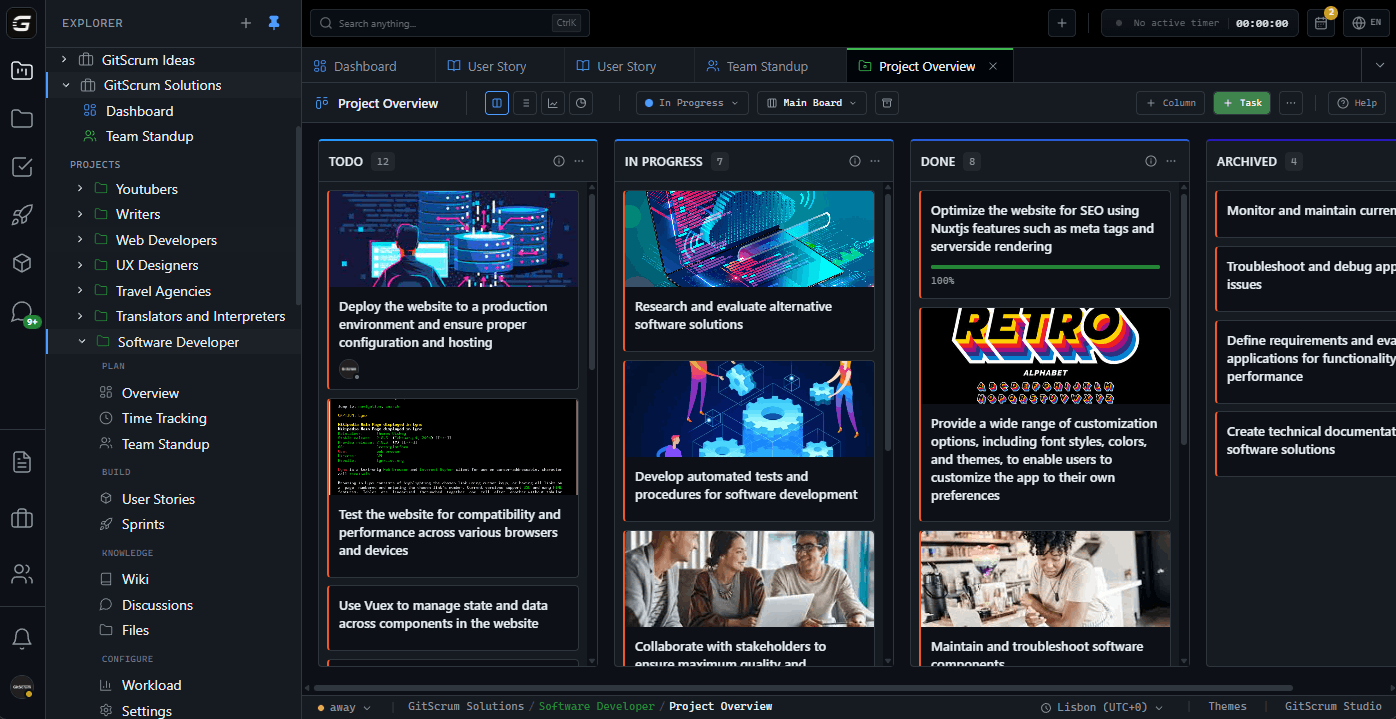
Add 'Code Review' as a board column so review status is visible. Link tasks to PRs so the full lifecycle is tracked.

Assign reviewers so there's accountability. Flag aging reviews so they don't languish.

Code review becomes part of the visible workflow, not a hidden bottleneck.

The GitScrum Advantage

One unified platform to eliminate context switching and recover productive hours.

01

problem.identify()

The Problem

Pull requests sit for days with no assigned reviewer—nobody owns the review

Task tracking and code review are disconnected—'done' in tracker but blocked in PR

No visibility into code review queue—hidden bottleneck not surfaced in project view

Aging PRs aren't flagged—reviews languish without urgency

Review back-and-forth extends cycle time with no tracking of iterations

02

solution.implement()

The Solution

Add 'Code Review' column to board so PR status is visible in project workflow

Link GitHub PRs to tasks so the full implementation-to-merge lifecycle is tracked

Assign specific reviewer to each task moving to code review—clear accountability

Flag aging reviews with due date indicators—reviews sitting >2 days get highlighted

Track review cycles in task comments—iterations and discussions in one place

03

How It Works

1

Add Code Review Column

Create a 'Code Review' (or 'In Review') column on your board. When developer finishes implementation and opens PR, task moves from 'In Progress' to 'Code Review'. Review status is now visible to everyone, not hidden in GitHub.

2

Assign Reviewer

When task enters Code Review, assign a specific reviewer. Not 'the team'—one accountable person. The reviewer sees it in their workload. No more PRs orphaned in the queue because nobody explicitly owned the review.

3

Link PR to Task

Add the GitHub/GitLab PR link in the task comments or description. The full lifecycle is visible: task description, implementation notes, PR link, review discussion. Everything in one place for context.

4

Set Review SLA

Team norm: reviews should complete within 24-48 hours. Set due dates on tasks when they enter Code Review. Reviews exceeding the SLA are flagged overdue—visible urgency for the reviewer to prioritize.

5

Track Review Iterations

Use task comments for review feedback that needs discussion. 'Changes requested: X, Y, Z.' Developer addresses, comments 'Ready for re-review.' The back-and-forth is tracked, not lost in GitHub notification noise.

04

Why GitScrum

GitScrum addresses Improving Code Review Accountability and Tracking through Kanban boards with WIP limits, sprint planning, and workflow visualization

Problem resolution based on Kanban Method (David Anderson) for flow optimization and Scrum Guide (Schwaber and Sutherland) for iterative improvement

Capabilities

  • Kanban boards with WIP limits to prevent overload
  • Sprint planning with burndown charts for predictable delivery
  • Workload views for capacity management
  • Wiki for process documentation
  • Discussions for async collaboration
  • Reports for bottleneck identification

Industry Practices

Kanban MethodScrum FrameworkFlow OptimizationContinuous Improvement

Frequently Asked Questions

Still have questions? Contact us at customer.service@gitscrum.com

How do we reduce the time PRs sit waiting for review?

Three changes: First, make review status visible with a board column—hidden work gets ignored. Second, assign specific reviewers—shared ownership means no ownership. Third, set a team SLA (24-48 hours max) with due date tracking. When reviews are visible, owned, and have deadlines, they get done faster.

Should reviewers be assigned per task or rotating?

Both can work. Assigned per task ensures accountability for that specific review. Rotating distribution (round-robin) balances load and spreads knowledge. Many teams do both: assign specific reviewer for accountability, but rotate the assignments across the team over time.

How do we track the back-and-forth of code review?

Use task comments as the discussion thread. Reviewer comments: 'Changes requested: [specifics]'. Developer responds when ready: 'Addressed feedback, ready for re-review.' The conversation is visible in the task, not buried in GitHub notifications. Status stays in 'Code Review' until final approval.

What's a reasonable SLA for code reviews?

24-48 hours for initial review is common. The goal isn't instant turnaround—it's preventing reviews from aging for days. Context switch cost for reviewers matters too. Allow time for focused review rather than rushed comments. But more than 48 hours means the PR is probably forgotten.

How do we handle urgent reviews that need to jump the queue?

Use task priority. Hotfixes or blocking work get high priority—visible in the Code Review column. Team norm: high-priority reviews get same-day turnaround. Regular priority follows normal SLA. The key is explicit prioritization, not everything claiming to be urgent.

Ready to solve this?

Start free, no credit card required. Cancel anytime.

Works with your favorite tools

Connect GitScrum with the tools your team already uses. Native integrations with Git providers and communication platforms.

GitHubGitHub
GitLabGitLab
BitbucketBitbucket
SlackSlack
Microsoft TeamsTeams
DiscordDiscord
ZapierZapier
PabblyPabbly

Connect with 3,000+ apps via Zapier & Pabbly