VS Code

GitScrum for VS Code, Google Antigravity, Cursor and Windsurf!

GitScrum logo
Industry Vertical

Developer Productivity Team PM 2026 | CI/CD Build Tooling

Developer productivity teams optimize CI/CD pipelines, build systems and testing infrastructure with ROI measurement and developer feedback. Boards track improvement initiatives with baseline metrics, Wiki documents tooling standards, User Stories capture friction points, Time Tracking supports ROI analysis. Ship improvements 40% faster. Free trial.

Developer Productivity Team PM 2026 | CI/CD Build Tooling

Developer productivity teams optimize engineering efficiency where build systems, testing infrastructure, and developer tooling accelerate deliver y velocity.

Your team improves CI/CD pipelines, implements testing frameworks, creates code quality tools, and ensures fast feedback loops. Measuring productivity impact requires careful metrics, competing developer preferences create tool fragmentation, and infrastructure scale affects build times.

Sprint planning balances quick wins with infrastructure investments. Wiki documents tooling standards and best practices.

Discussions capture developer pain points. Time tracking supports ROI analysis.

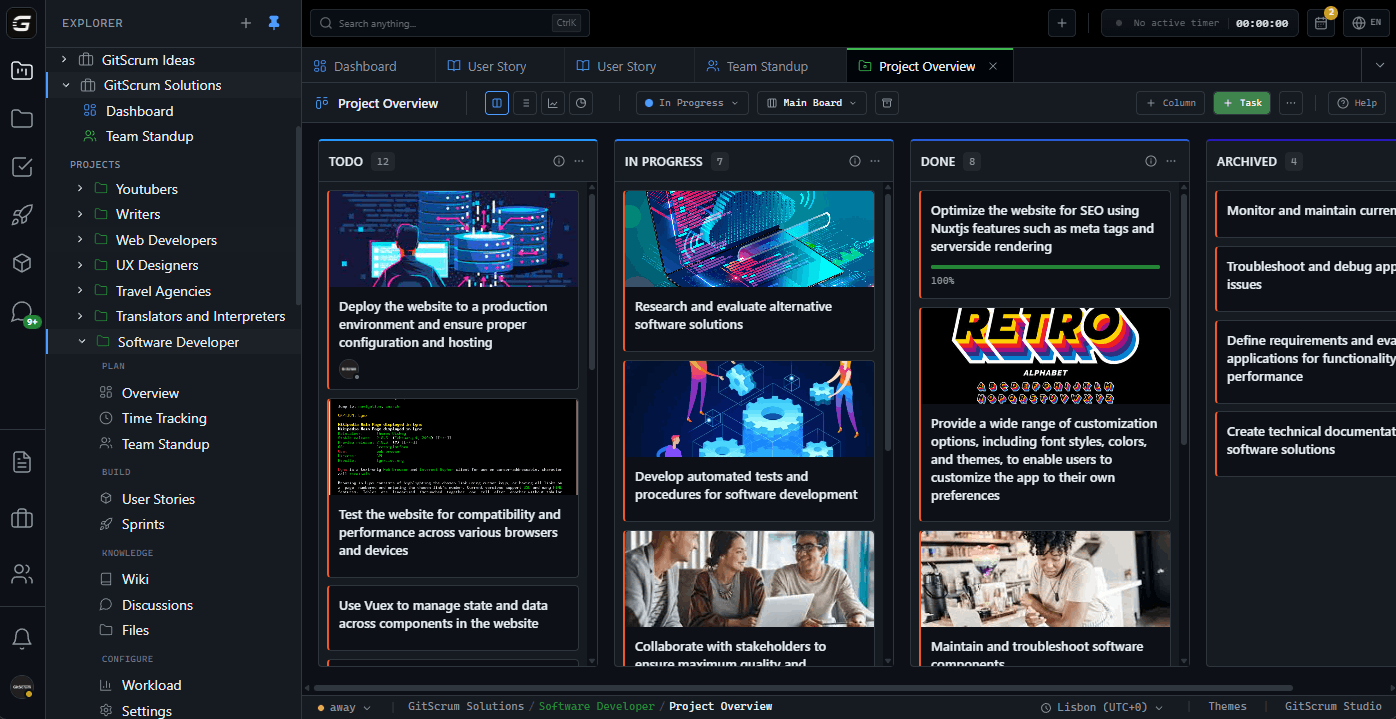
GitScrum helps productivity teams: boards track improvement initiatives through implementation stages, user stories capture developer friction points, and wiki centralizes tooling documentation.

The GitScrum Advantage

One unified platform to eliminate context switching and recover productive hours.

01

challenges.identify()

Challenges

Measuring productivity impact accurately

Competing developer preferences

Infrastructure scale affecting build times

Balancing quick wins with investments

02

solution.implement()

How GitScrum Helps

Boards track improvement initiatives

Wiki documents tooling standards

Discussions capture developer feedback

User stories define friction points

Time tracking supports ROI analysis

03

useCases.list()

Use Cases

Improving CI/CD pipelines

Implementing testing frameworks

Creating code quality tools

Optimizing build systems

Ensuring fast feedback loops

04

Why GitScrum

GitScrum provides Kanban boards, sprint planning with burndown charts, and workflow automation for Developer Productivity Team teams

Project management based on Scrum Guide (Schwaber and Sutherland) and Kanban Method (David Anderson)

Capabilities

  • Kanban boards with customizable columns and WIP limits
  • Sprint planning with burndown and burnup charts
  • Time tracking with billable rates
  • Wiki for documentation
  • Git integration for code linkage
  • Client Portal for stakeholder visibility

Industry Practices

Scrum FrameworkKanban MethodAgile Project ManagementContinuous Improvement
features.related()

Key Features

View all features

Visual project management that actually fits how {vertical} work. Create unlimited Kanban boards with custom columns—from 'Client Review' to 'Ready to Deploy'—and set WIP limits that prevent the bottlenecks {city} teams know too well. Every card, comment, and status change syncs instantly across devices, so whether your {vertical} team is in the office or remote across {city}, everyone sees the same real-time picture.

Ship faster without the chaos. Drag-and-drop backlog prioritization, velocity tracking across iterations, and burndown charts that update as work gets done—not when someone remembers to update a spreadsheet. Your team always knows what's next, stakeholders see progress without asking, and {vertical} across {city} consistently hit their sprint commitments.

New hires asking the same questions. Process docs scattered across Google Docs, Notion, and Slack pins. Sound familiar? Build your team's single source of truth with rich text editing, nested pages, and instant search. {vertical} in {city} onboard new members 3x faster when everything is documented once and findable forever.

{vertical} make hundreds of decisions weekly—and most get lost in chat noise. Threaded discussions keep conversations attached to the work they reference. Tag teammates, attach files, and search past decisions instantly. When clients in {city} ask 'why did we do it this way?'—you'll have the receipts.

Every unbilled hour is money walking out the door. One-click timers capture billable minutes automatically—no more end-of-week timesheet scrambles that plague {city} teams. Set custom rates per project, get nudges when timers run too long, and export reports that make invoicing effortless. {vertical} using GitScrum track 23% more billable hours on average.

Requirements written in developer-speak lose context by the time they ship. Write user stories with clear acceptance criteria, group them into epics, and let the team vote on story points together. {city} stakeholders see progress at the epic level while {vertical} developers know exactly what 'done' means.

Frequently Asked Questions

Still have questions? Contact us at customer.service@gitscrum.com

How do we track productivity improvements?

Board tracks improvement initiatives with baseline and target metrics. Tasks include before/after measurements. Labels indicate productivity domain.

How do we gather developer feedback?

Discussions capture pain points from development teams. Survey results inform backlog prioritization. Feature voting shows demand.

How do we document standards?

Wiki maintains tooling standards and best practices. Include setup guides and migration paths. Link documentation to implementation tasks.

How do we measure ROI?

Time tracking captures investment hours. Tasks include baseline measurements and outcomes. Wiki documents productivity metrics methodology.

Ready to get started?

Start free, no credit card required. Cancel anytime.

Works with your favorite tools

Connect GitScrum with the tools your team already uses. Native integrations with Git providers and communication platforms.

GitHubGitHub
GitLabGitLab
BitbucketBitbucket
SlackSlack
Microsoft TeamsTeams
DiscordDiscord
ZapierZapier
PabblyPabbly

Connect with 3,000+ apps via Zapier & Pabbly