VS Code

GitScrum for VS Code, Google Antigravity, Cursor and Windsurf!

GitScrum logo
Solution

Client Expectations Misaligned 2026 | Prevent Delivery Surprise

Client approved mockups, signed specs—delivery brings 'not what I wanted.' Prevent surprise with continuous progress visibility and explicit approval gates. Free trial.

Client Expectations Misaligned 2026 | Prevent Delivery Surprise

The agency delivered exactly what was specified.

Every requirement was met. Every mockup was implemented.

Every feature works as documented. The client is unhappy.

'It's not what I envisioned.' The problem: the client had a mental model that was never captured. The mockups showed screens, not flows.

The specs described features, not the experience they expected. The demos showed functionality, but the client approved without really imagining it in their daily work.

Now there's a gap between the delivered product and the client's unspoken expectations. Re-work is expensive.

The client relationship is strained. The team is frustrated because they delivered what was asked.

The client is frustrated because they didn't get what they wanted. Both are right—the alignment process failed, not the people.

The GitScrum Advantage

One unified platform to eliminate context switching and recover productive hours.

01

problem.identify()

The Problem

Client mental model never captured

Mockups show screens, not user experience

Approvals given without deep understanding

Unspoken expectations revealed at final delivery

Re-work strains budget and relationship

02

solution.implement()

The Solution

Continuous visibility into actual progress

Explicit approval gates with meaningful context

User journey documentation alongside features

Early access to working software, not just demos

Expectation gaps surface incrementally, not at delivery

03

How It Works

1

User Journey Alignment

Beyond mockups and specs, GitScrum captures user journeys: 'The client will open the app, see their dashboard, click into a project, update status, and receive a notification.' The journey reveals the mental model.

2

Continuous Access

Clients have view access to GitScrum. They see what's being built, not just polished demos. They can interact with staging environments. Misalignment surfaces when there's time to correct it.

3

Meaningful Approvals

Approval gates include explicit confirmation: 'You're approving that the user flow works as shown, the data displays as mocked, and the interactions feel right. Changes after this point require change requests.'

4

Incremental Delivery

Instead of big-bang delivery, clients receive incremental pieces. They use real software throughout the project. Expectation gaps surface in week 2, not month 4.

04

Why GitScrum

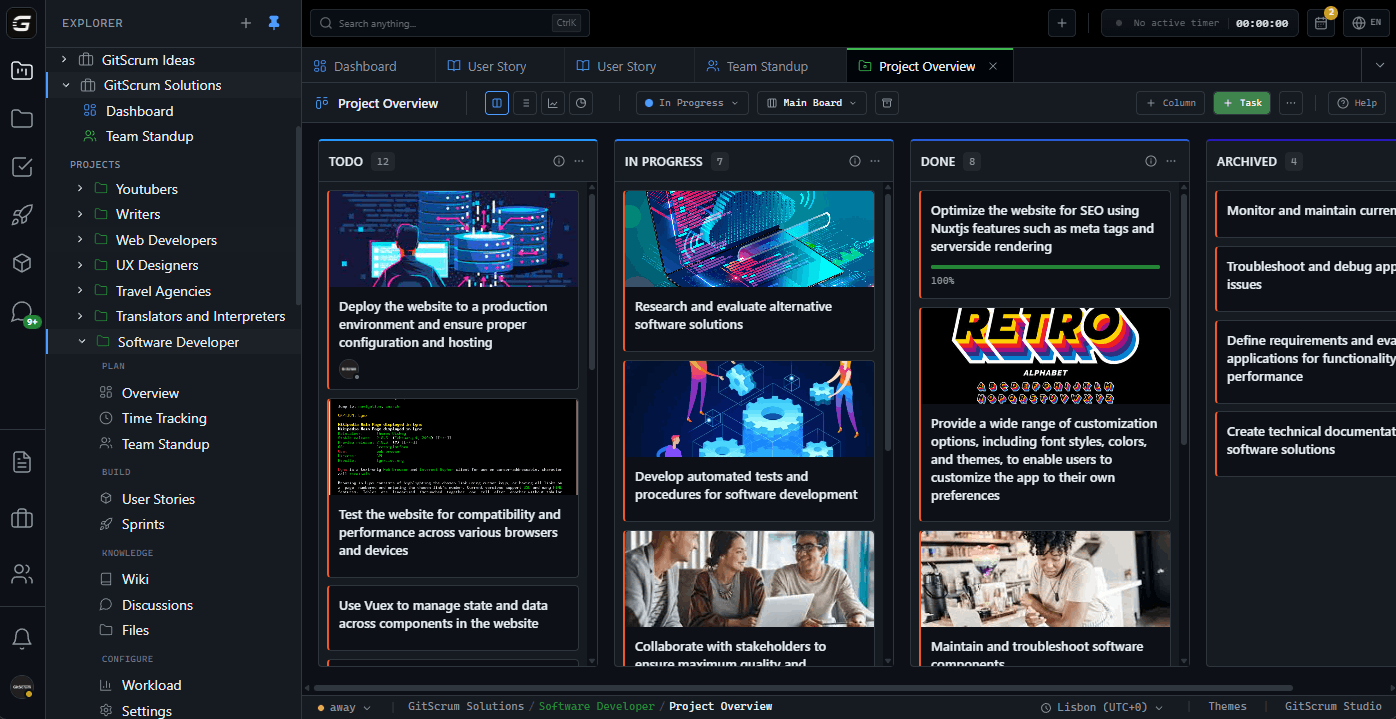
GitScrum addresses Client Expectations Misaligned with Delivery through Kanban boards with WIP limits, sprint planning, and workflow visualization

Problem resolution based on Kanban Method (David Anderson) for flow optimization and Scrum Guide (Schwaber and Sutherland) for iterative improvement

Capabilities

  • Kanban boards with WIP limits to prevent overload
  • Sprint planning with burndown charts for predictable delivery
  • Workload views for capacity management
  • Wiki for process documentation
  • Discussions for async collaboration
  • Reports for bottleneck identification

Industry Practices

Kanban MethodScrum FrameworkFlow OptimizationContinuous Improvement

Frequently Asked Questions

Still have questions? Contact us at customer.service@gitscrum.com

What if the client doesn't want to engage throughout the project?

Document it. 'Client prefers minimal involvement until delivery. Risks include expectation misalignment.' Make the tradeoff explicit. Some clients accept the risk; at least it's acknowledged.

How do we handle clients who keep changing their minds?

GitScrum tracks every approval and change. When a client changes direction, the history shows: 'Approved flow A on March 1. Changed to flow B on March 15.' The pattern becomes visible for honest conversation.

What about clients who approved but claim they didn't understand?

GitScrum creates explicit approval records: 'Approved with understanding that X, Y, Z.' If clients later claim misunderstanding, you have documentation. But more importantly, the approval process is designed to ensure real understanding.

How do we avoid overwhelming clients with too much detail?

GitScrum provides appropriate views. Clients see high-level progress and approval gates, not every technical task. They can drill into detail if they want, but the default view respects their time.

Ready to solve this?

Start free, no credit card required. Cancel anytime.

Works with your favorite tools

Connect GitScrum with the tools your team already uses. Native integrations with Git providers and communication platforms.

GitHubGitHub
GitLabGitLab
BitbucketBitbucket
SlackSlack
Microsoft TeamsTeams
DiscordDiscord
ZapierZapier
PabblyPabbly

Connect with 3,000+ apps via Zapier & Pabbly