
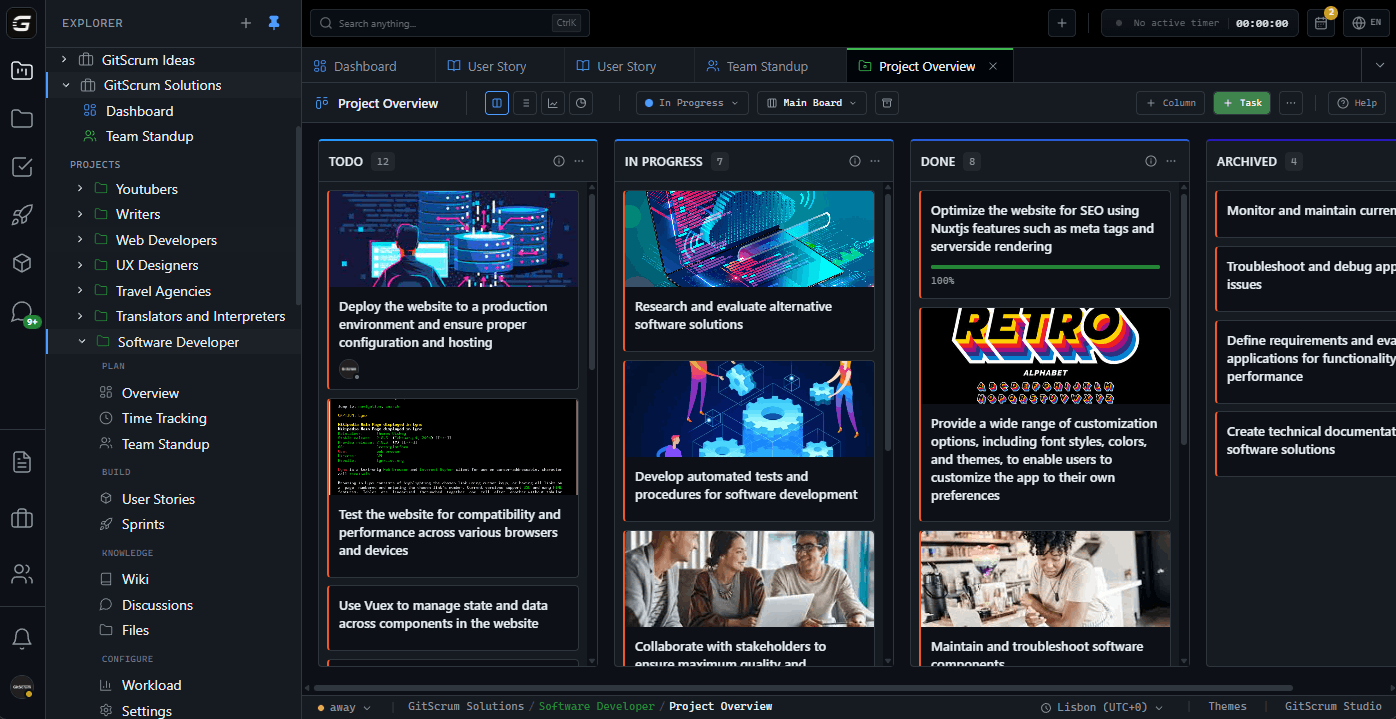
VS Code

GitScrum for VS Code, Google Antigravity, Cursor and Windsurf!

GitScrum logo
Solution

Cross-Functional Silos 2026 | Handoff Information Loss Ends

Design→Engineering→QA→Ops handoffs. Information lost at every transition. Late constraints, expensive rework. Shared visibility, early involvement. Free trial.

Cross-Functional Silos 2026 | Handoff Information Loss Ends

Handoff-based workflows create information loss at every transition.

Design intent doesn't survive handoff to engineering. Engineering decisions don't inform QA test strategy.

QA findings don't reach ops until deployment. Each silo has partial information and makes decisions that the next silo has to work around.

The 'finished' work accumulates compromises that nobody intended.

The GitScrum Advantage

One unified platform to eliminate context switching and recover productive hours.

01

problem.identify()

The Problem

Information lost at every handoff

Functions don't talk until problems occur

Late discovery of constraints and issues

Each function optimizes locally

Rework from misalignment

02

solution.implement()

The Solution

Shared work visibility across functions

Early involvement triggers

Cross-functional communication channels

Integrated workflow stages

Collaborative decision documentation

03

How It Works

1

Shared Visibility

GitScrum gives all functions view into work: 'Feature: Checkout Redesign. Status: In Development. Design: ✅ Complete (@designer). Engineering: 🔄 In progress (@dev-lead, @frontend). QA: 👀 Watching—test cases ready (@qa-lead). Ops: 👀 Watching—deployment plan needed (@ops-lead). All parties see progress and can raise concerns before handoff.'

2

Early Involvement

Functions get involved before their 'turn': 'Early Involvement Triggers: Feature: Payment Integration. Design phase: ☑ Engineering consulted on API constraints. ☑ QA reviewed for testability. ☑ Ops flagged security review requirement. Development phase: ☑ QA writing test cases in parallel. ☑ Ops preparing monitoring. Issues caught early: 3 (vs avg 8 when caught at handoff).'

3

Integrated Communication

Discussions happen in context: 'Feature Discussion: Payment Integration. @ops-lead: Payment provider requires IP whitelist in production. Need 2 days lead time. @qa-lead: Can we get sandbox credentials for automated testing? @designer: Changed button placement based on engineering feedback about API loading. All context in one place, all parties notified.'

4

Collaborative Decisions

Decisions include all perspectives: 'Decision: Use iframe for payment form. Participants: Design, Engineering, QA, Ops, Security. Design perspective: Acceptable UX with custom styling. Engineering: Simpler integration, better PCI compliance. QA: Need cross-browser iframe testing strategy. Ops: No server-side payment handling—reduces scope. Security: Iframe approach preferred for PCI scope reduction. Consensus: Approved.'

04

Why GitScrum

GitScrum addresses Cross-Functional Collaboration Is Siloed through Kanban boards with WIP limits, sprint planning, and workflow visualization

Problem resolution based on Kanban Method (David Anderson) for flow optimization and Scrum Guide (Schwaber and Sutherland) for iterative improvement

Capabilities

  • Kanban boards with WIP limits to prevent overload
  • Sprint planning with burndown charts for predictable delivery
  • Workload views for capacity management
  • Wiki for process documentation
  • Discussions for async collaboration
  • Reports for bottleneck identification

Industry Practices

Kanban MethodScrum FrameworkFlow OptimizationContinuous Improvement

Frequently Asked Questions

Still have questions? Contact us at customer.service@gitscrum.com

How do you get functions to collaborate without slowing down?

Early involvement doesn't mean waiting for approval—it means awareness and input opportunity. Functions can flag concerns asynchronously. The key is making collaboration the path of least resistance: information flows automatically, input is easy to give, and everyone benefits from fewer surprises.

What if functions have conflicting priorities?

Conflicts surface earlier, which is good. Address them explicitly: document the trade-off, decide with appropriate authority, and record the rationale. Hidden conflicts cause bigger problems than visible ones. Cross-functional visibility makes conflicts discussable.

How do you avoid too many cooks in the kitchen?

Clear roles and decision authority. Everyone has visibility and can raise concerns. Not everyone has veto power. The feature owner makes final calls with input, not consensus. Involvement means 'can speak' not 'must approve.'

Does this work with distributed teams?

Especially with distributed teams. Asynchronous collaboration through shared tools works better across time zones than trying to get everyone in the same room. The key is making information passively available (dashboards, notifications) rather than requiring active synchronization.

Ready to solve this?

Start free, no credit card required. Cancel anytime.

Works with your favorite tools

Connect GitScrum with the tools your team already uses. Native integrations with Git providers and communication platforms.

GitHubGitHub
GitLabGitLab
BitbucketBitbucket
SlackSlack
Microsoft TeamsTeams
DiscordDiscord
ZapierZapier
PabblyPabbly

Connect with 3,000+ apps via Zapier & Pabbly