The evolution is predictable.
Someone builds a quick script to solve an immediate integration problem. It works, so it gets scheduled to run regularly.
Other workflows start depending on it. More scripts get added.
Soon you have dozens of scripts handling critical data flows between tools. These scripts accumulate technical debt rapidly.
The original author knew the quirks of both APIs and coded around them. Undocumented edge cases are handled by mysterious conditionals.
Error handling may be minimal—the script was supposed to be temporary. There is no logging, no alerting, no runbook for when it fails.
The real crisis comes during personnel transitions. The script author moves to another team or leaves the company.
Their successor inherits a folder of Python files with cryptic names. Comments, if they exist, are outdated.
The business depends on these scripts running successfully, but nobody can confidently modify them without breaking something. Knowledge transfer for custom scripts is nearly impossible.
The author knows why they used that particular API call sequence, why timing matters, what happens if it runs twice. That knowledge lives only in their head.
Documentation exists in fragments if at all. Each integration script represents organizational risk—critical infrastructure that operates in the shadows, understood by few, documented by none.
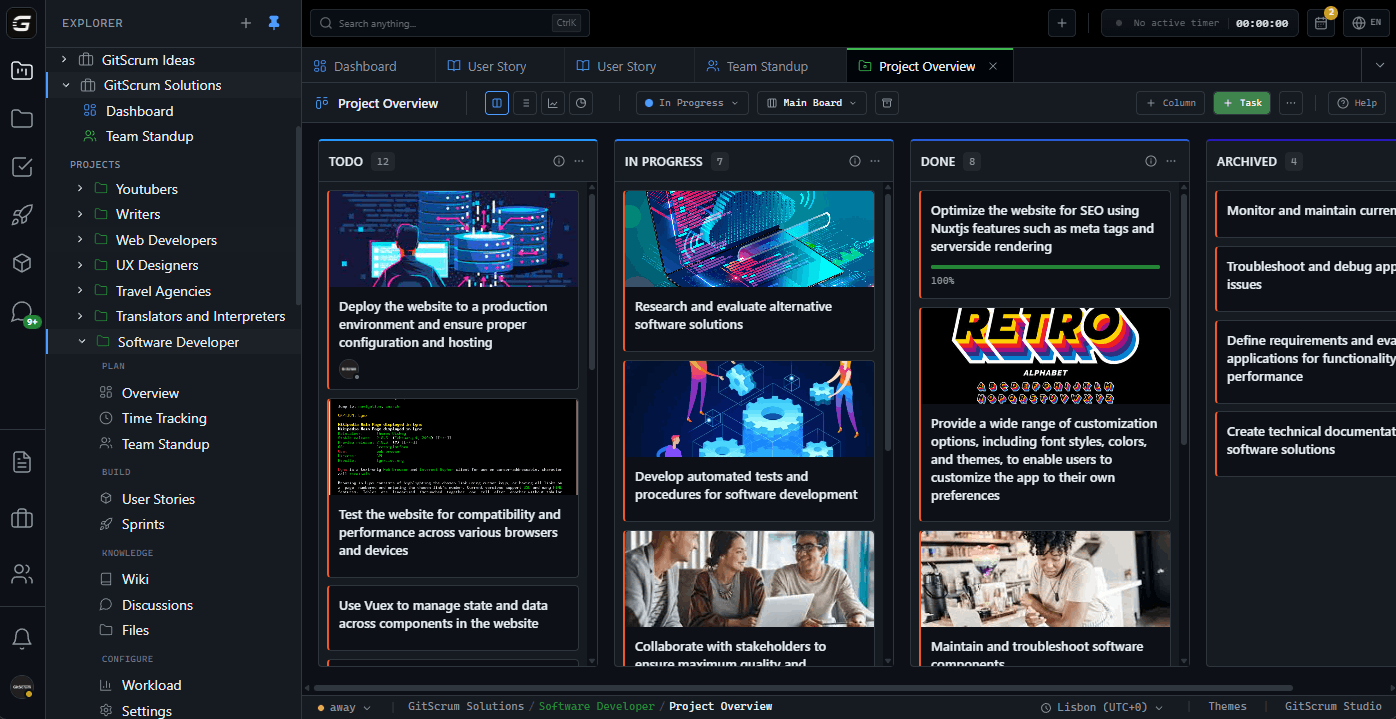
GitScrum eliminates the need for integration scripts by eliminating the integrations themselves. When all your data lives in one platform, there are no gaps to bridge with scripts.
The platform handles all data flows internally, with proper error handling, logging, and reliability.
The GitScrum Advantage
One unified platform to eliminate context switching and recover productive hours.