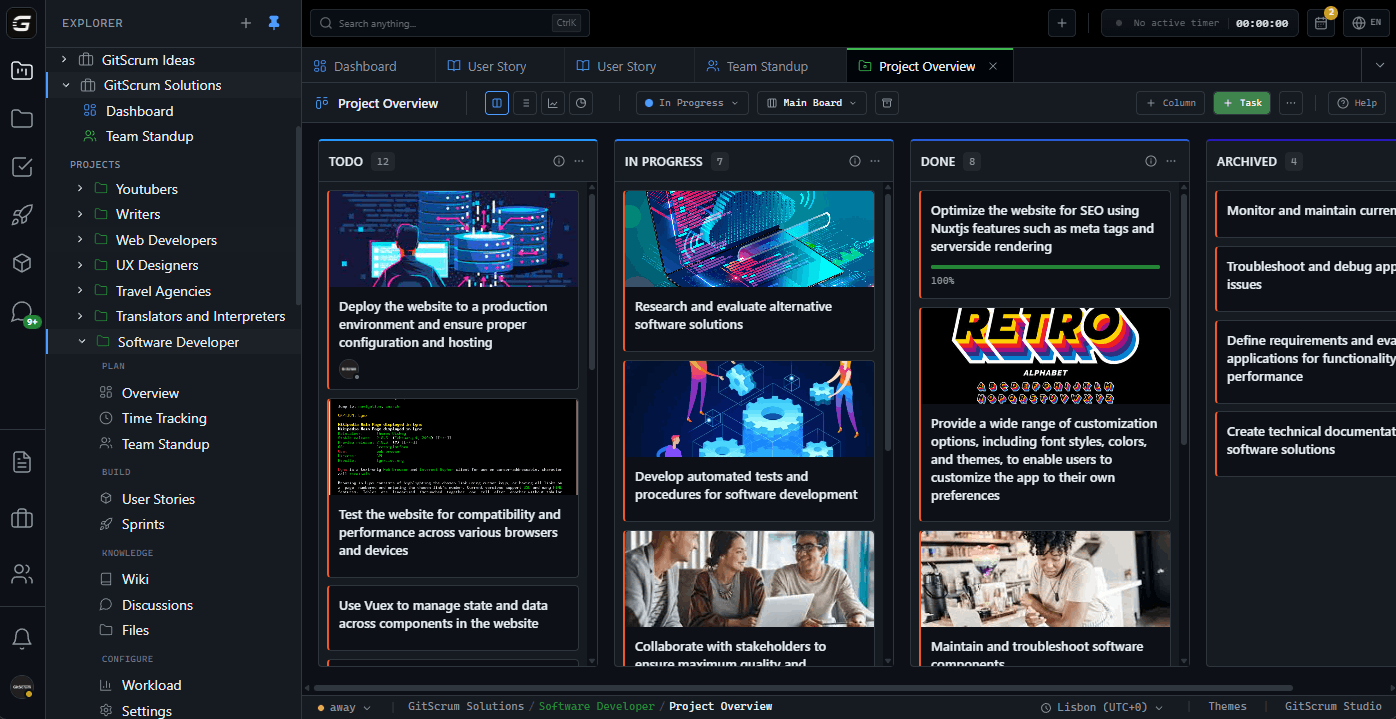
Sprint planning without GitHub integration creates a fundamental disconnect: the planning happens in one system, the work happens in another, and truth lives somewhere in between.
The Sprint-GitHub Disconnect: 1. Planning Phase Team opens Jira.
Reviews backlog. Estimates stories.
Commits to sprint scope. Sprint begins.
But none of this knows about GitHub yet. No branches exist.
No commits planned. Pure abstraction.
2. Execution Phase Developer opens GitHub.
Creates branch. Writes code.
Pushes commits. Opens PR.
But Jira doesn't know. Task status unchanged.
Sprint burndown static. Progress invisible in planning tool.
3. Status Sync Phase Developer remembers to update Jira.
Goes back. Changes status.
Adds PR link manually. Maybe.
This manual step is where accuracy dies. Developers forget.
Status lags reality. Sprint metrics become fiction.
4. Review Phase Sprint ends.
Velocity calculated from what was 'Done' in Jira. But was it really done?
Was the PR merged? Was the code deployed?
Jira doesn't know. Velocity becomes a measure of status updates, not code delivery.
What GitHub-Integrated Sprint Planning Looks Like: 1. Sprint Setup - Create sprint with date range - Add tasks from backlog - Tasks ready to create branches 2.
Development Flow - Click 'Create Branch' on task → branch created in GitHub - Commit to branch → activity appears on task - Open PR → task moves to 'In Review' - Merge PR → task completes automatically 3. Real-Time Visibility - Burndown reflects actual code delivery - Velocity measured by merged PRs - Stale tasks visible (no commits in X days) - Sprint health based on reality, not status updates 4.
Accurate Retrospectives - What actually shipped vs what was planned - Time from task creation to PR merge - Commit patterns through sprint - Bottlenecks identified from data The Velocity Truth Problem: Traditional sprint planning measures velocity in story points 'completed.' But 'completed' means 'someone clicked Done in Jira,' which might mean: - Code written but not reviewed - PR open but not merged - Merged but not deployed - Deployed but with bugs GitHub-integrated sprint planning measures velocity in code actually merged. PR merged = done.
No ambiguity. No manual status.
No fiction. Sprint Planning Features in GitScrum: 1.
Sprint Creation - Set sprint name, dates, goals - Drag tasks from backlog to sprint - Capacity planning based on team availability - Historical velocity for planning guidance 2. Backlog Management - Prioritized backlog view - Story point estimation - Task dependencies - Backlog grooming tools 3.
Sprint Board - Kanban columns (To Do, In Progress, Review, Done) - Swimlanes by assignee or type - GitHub activity overlay on cards - Real-time updates as code ships 4. GitHub Integration - One-click branch creation from task - Automatic status changes from PR lifecycle - Commit activity on task cards - PR review status visible 5.
Velocity Tracking - Points completed per sprint - Trend over time - Team vs individual velocity - Estimation accuracy metrics 6. Burndown Charts - Real-time burndown based on code delivery - Scope change tracking - Projected completion - Historical comparison 7.
Retrospective Data - What shipped vs planned - Cycle time metrics - Bottleneck identification - Improvement tracking For Scrum Teams: GitScrum supports full Scrum methodology: - Sprint planning meetings → drag tasks to sprint - Daily standups → see who's working on what via GitHub activity - Sprint review → demo what was merged - Retrospective → analyze actual delivery data For Kanban Teams: Not doing sprints? GitScrum works for continuous flow too: - Unlimited backlog - WIP limits on columns - Cycle time tracking - No forced timeboxes The Integration Difference: Other sprint tools + GitHub integrations: - Jira + GitHub app: 5-15 minute sync delay, manual smart commit syntax, branch creation outside Jira - Asana + Zapier: Third-party connector, one-way sync, limited automation - Monday + GitHub: Manual linking, webhook unreliability, no branch creation GitScrum + GitHub: - Native integration (not connector) - Real-time webhooks (instant sync) - Bidirectional (changes flow both ways) - Branch creation from task (one click) - PR lifecycle drives status (automatic) $8.90/user/month for sprint planning with native GitHub integration.
2 users free forever. Plan sprints where code lives.
The GitScrum Advantage
One unified platform to eliminate context switching and recover productive hours.