VS Code

GitScrum for VS Code, Google Antigravity, Cursor and Windsurf!

GitScrum logo
Industry Vertical

Architecture Firm Software Development PM 2026 | BIM CAD

Architecture software teams manage BIM and CAD integrations with dedicated boards. Wiki documents file format specs and offline-sync rules. Client Flow gives firms roadmap visibility. Align releases with construction phases. Ship 40% faster.

Architecture Firm Software Development PM 2026 | BIM CAD

Architecture software connects design vision to construction reality.

Your development team juggles BIM file handling, CAD integrations, permit tracking, and collaboration tools that must work offline on job sites. One broken sync and architects lose hours of work.

GitScrum organizes the complexity—separate boards for each integration, Wiki documenting file format specs, and sprints timed to construction milestones.

The GitScrum Advantage

One unified platform to eliminate context switching and recover productive hours.

01

challenges.identify()

Challenges

Large BIM/CAD file handling and versioning

Offline-first sync for job site use

Multi-stakeholder coordination (owners, contractors, engineers)

Construction timeline-dependent releases

02

solution.implement()

How GitScrum Helps

Workload balances developer assignments across BIM, CAD, and web teams

Wiki documents file format specifications and integration APIs

Client Flow gives architecture firms visibility into feature roadmaps

Sprints align releases with construction project phases

Discussions capture field feedback from architects on job sites

03

useCases.list()

Use Cases

Building BIM collaboration platforms with real-time sync

Developing permit tracking and compliance dashboards

Creating mobile apps for architects on construction sites

Implementing 3D visualization and virtual walkthroughs

Shipping project management tools for design-build firms

04

Why GitScrum

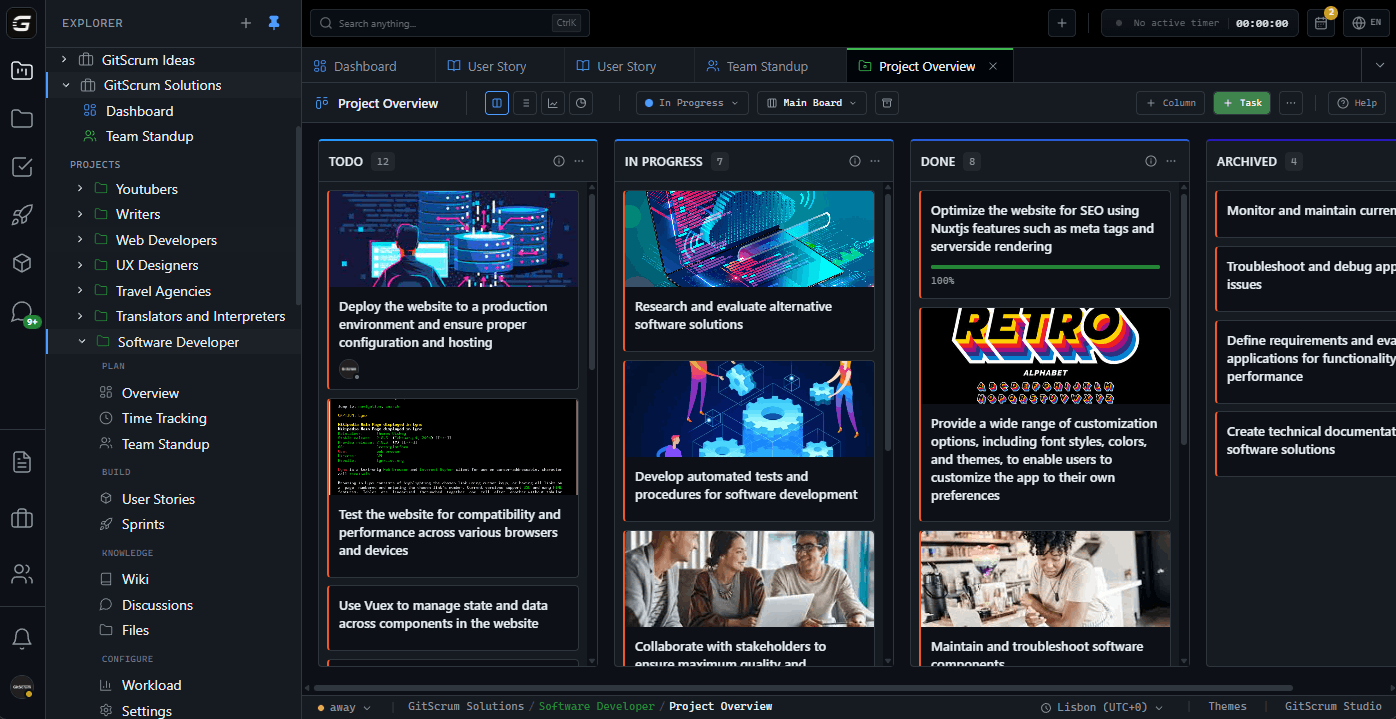
GitScrum provides Kanban boards, sprint planning with burndown charts, and workflow automation for Architecture Firm Software teams

Project management based on Scrum Guide (Schwaber and Sutherland) and Kanban Method (David Anderson)

Capabilities

  • Kanban boards with customizable columns and WIP limits
  • Sprint planning with burndown and burnup charts
  • Time tracking with billable rates
  • Wiki for documentation
  • Git integration for code linkage
  • Client Portal for stakeholder visibility

Industry Practices

Scrum FrameworkKanban MethodAgile Project ManagementContinuous Improvement
features.related()

Key Features

View all features

Visual project management that actually fits how {vertical} work. Create unlimited Kanban boards with custom columns—from 'Client Review' to 'Ready to Deploy'—and set WIP limits that prevent the bottlenecks {city} teams know too well. Every card, comment, and status change syncs instantly across devices, so whether your {vertical} team is in the office or remote across {city}, everyone sees the same real-time picture.

Ship faster without the chaos. Drag-and-drop backlog prioritization, velocity tracking across iterations, and burndown charts that update as work gets done—not when someone remembers to update a spreadsheet. Your team always knows what's next, stakeholders see progress without asking, and {vertical} across {city} consistently hit their sprint commitments.

New hires asking the same questions. Process docs scattered across Google Docs, Notion, and Slack pins. Sound familiar? Build your team's single source of truth with rich text editing, nested pages, and instant search. {vertical} in {city} onboard new members 3x faster when everything is documented once and findable forever.

{vertical} make hundreds of decisions weekly—and most get lost in chat noise. Threaded discussions keep conversations attached to the work they reference. Tag teammates, attach files, and search past decisions instantly. When clients in {city} ask 'why did we do it this way?'—you'll have the receipts.

The inbox overload ends here. Give clients in {city} their own dashboard where they track progress, approve deliverables, and leave feedback—without ever seeing your internal discussions or pricing. Everything stays organized in one place instead of scattered across email, Slack, and WhatsApp. {vertical} teams report cutting status meetings by 80% after switching.

Which version is final? Final_v2? Final_FINAL? End the madness. Every file lives alongside its task with full version history and instant preview—no downloading required. Drag and drop assets, link them to specific cards, and let your {city} clients access only what they need. {vertical} teams never lose another deliverable.

Frequently Asked Questions

Still have questions? Contact us at customer.service@gitscrum.com

How do we manage BIM integration complexity?

Dedicated boards for each BIM platform (Revit, ArchiCAD, etc.). Wiki documents file format specifications. Labels track integration status and compatibility issues.

Can architecture firms test features before release?

Client Flow provides staging environment access. Firms validate BIM workflows before production. Discussions capture feedback from actual project use.

How do we handle offline-first requirements?

Labels flag offline-critical features. Wiki documents sync conflict resolution rules. Sprint testing includes offline scenario validation.

Can we coordinate releases with construction schedules?

Sprint planning considers construction phase timing. Labels indicate project-phase relevance. Wiki documents deployment procedures for active job sites.

Ready to get started?

Start free, no credit card required. Cancel anytime.

Works with your favorite tools

Connect GitScrum with the tools your team already uses. Native integrations with Git providers and communication platforms.

GitHubGitHub
GitLabGitLab
BitbucketBitbucket
SlackSlack
Microsoft TeamsTeams
DiscordDiscord
ZapierZapier
PabblyPabbly

Connect with 3,000+ apps via Zapier & Pabbly