The Airtable Flexibility Trap 'Airtable can do anything!
But should it do everything? You've built a development PM system in Airtable: ├─ Tasks table (base of everything) ├─ Projects table (linked records) ├─ Sprints table (linked records) ├─ Team members table (linked records) ├─ Status field (single select) ├─ Story points field (number) ├─ Views for kanban (grouped by status) ├─ Views for sprints (filtered by sprint) ├─ Automations for notifications ├─ Formulas for calculations └─ Weeks of setup work Now maintain it.
When you need to add velocity tracking: ├─ Create rollup field for completed points ├─ Build formula for sprint dates ├─ Create chart block (paid feature) ├─ Hope calculation is correct ├─ Debug when numbers don't match This is called 'building PM from database primitives.' It's possible. It's not optimal.
Airtable's Actual Strengths Airtable excels at: ├─ Relational data management ├─ Flexible databases ├─ Content calendars ├─ CRM systems ├─ Inventory tracking ├─ Client management ├─ Marketing workflows ├─ Any 'rows and relations' problem For these use cases, Airtable is excellent. But Development Is Different Development workflow needs: ├─ Sprint planning → Native, not built from filters ├─ Story points → Understood by the system ├─ Velocity → Calculated automatically ├─ Burndown → Generated, not charted manually ├─ Git integration → Branch, PR, merge = status ├─ Developer UX → Backlogs and boards, not tables Airtable provides: ├─ Tables and fields ├─ Views and filters ├─ Automations ├─ Blocks/apps (some paid) └─ Building blocks, not solutions The 'Build vs Buy' Math Time to build PM in Airtable: ├─ Base structure: 4-8 hours ├─ Views configuration: 2-4 hours ├─ Automations: 4-8 hours ├─ Formulas for metrics: 8-16 hours ├─ Charts and dashboards: 4-8 hours ├─ Testing and refinement: 8-16 hours ├─ Ongoing maintenance: 2-4 hours/month └─ Total setup: 30-60 hours └─ Ongoing: 24-48 hours/year And still no Git integration.
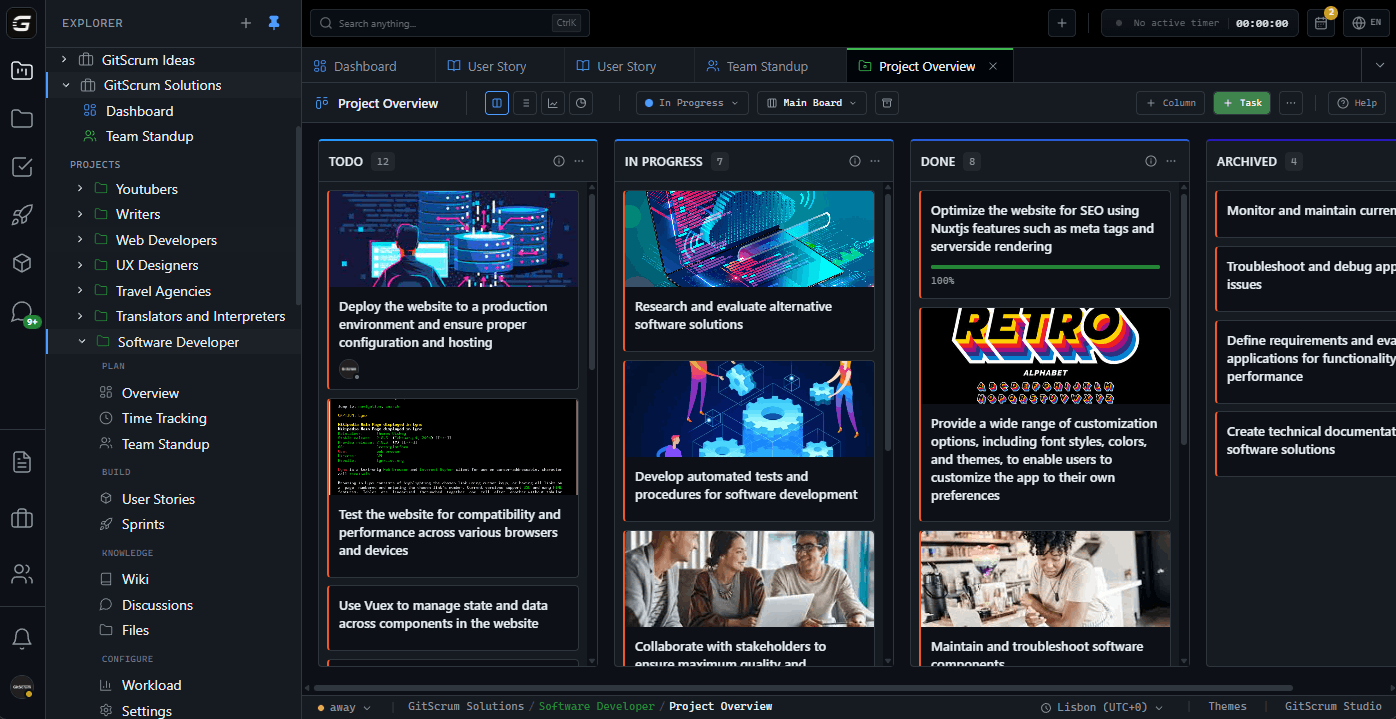
GitScrum setup: ├─ Create account: 5 minutes ├─ Connect Git: 5 minutes ├─ Create first sprint: 10 minutes ├─ Ongoing maintenance: 0 hours └─ Total: 20 minutes Your time has value. 30-60 hours × $100/hour = $3,000-$6,000 setup cost Plus opportunity cost of not shipping.
The Git Integration Gap This is the critical difference. Airtable + Git: ├─ No native integration ├─ Zapier/Make can connect (paid, complex) ├─ GitHub webhook → Airtable automation (limited) ├─ Manual commit references (no real link) ├─ No automatic status from code ├─ Two separate worlds GitScrum + Git: ├─ Native GitHub/GitLab/Bitbucket integration ├─ One-click OAuth connection ├─ Branch → task In Progress ├─ Commit → time tracking option ├─ PR → task Review ├─ Merge → task Complete ├─ Git drives PM entirely Developers live in Git.
Airtable doesn't speak Git. GitScrum was built for Git.
Price Comparison Airtable pricing: ├─ Free: Limited records and features ├─ Plus: $10/user/month (still limited) ├─ Pro: $20/user/month (needed features) ├─ Enterprise: Custom └─ Plus Zapier costs for integrations GitScrum pricing: ├─ Free: 2 users forever, ALL features ├─ All users: $8.90/user/month ├─ No limits, no tiers ├─ Git integration included 10-person team: ├─ Airtable Pro: $200/month + Zapier costs ├─ GitScrum: $71.20/month (8 paid, 2 free) GitScrum is 65%+ cheaper. With native features you'd have to build in Airtable.
Feature Comparison (Development Needs) | Feature | Airtable | GitScrum | |----------------------|---------------|------------------| | Task management | ✓ (tables) | ✓ (native) | | Sprint planning | Build it | Native | | Story points | Number field | Integrated | | Velocity tracking | Build formula | Automatic | | Burndown charts | Build block | Native | | Git integration | Zapier/manual | Native | | Auto status from Git | ✗ | ✓ | | Kanban views | ✓ | ✓ | | Time tracking | Build it | Native + Git | | Setup time | 30-60 hours | 20 minutes | When Airtable Makes Sense Keep Airtable for: ├─ Content calendars ├─ Client databases ├─ Marketing campaigns ├─ Inventory tracking ├─ Any relational data problem ├─ Non-development workflows └─ What it was designed for Use GitScrum for: ├─ Development task management ├─ Sprint planning and execution ├─ Git-integrated workflow ├─ Velocity and burndown ├─ What developers need The 'Use Both' Pattern Many teams: ├─ Airtable: Content, marketing, client management ├─ GitScrum: Development sprints and execution ├─ Integration: Share key milestones if needed Specialization beats generalization. Airtable is a great database.
GitScrum is a great development PM. Migration Path Airtable → GitScrum: 1.
Export tasks table (CSV) 2. Import to GitScrum 3.
Connect GitHub/GitLab 4. Create sprint structure 5.
Abandon maintaining formulas Your Airtable investment isn't lost. You're just using the right tool now.
Real Developer Experience 'Built our entire PM in Airtable. Proud of it, honestly.
Complex automations, rollup fields for velocity, grouped views for sprints. Took weeks.
Then we wanted Git integration. Tried Zapier - webhook triggers, complex mappings, still no real status automation.
Found GitScrum. Setup in an hour.
Native Git integration. Sprints work without formulas.
Velocity just... appears.
Now Airtable does what Airtable does best - our content calendar and client database. GitScrum does development.
Should have separated these from the start.' - Full-stack Developer Pricing Summary 2 developers: GitScrum $0/month (free forever, all features) 5 developers: GitScrum $26.70/month 10 developers: GitScrum $71.20/month vs Airtable Pro $200/month+ 20 developers: GitScrum $160.20/month vs Airtable Pro $400/month+ Plus 30-60 hours of setup time you don't spend. Start Free Today 1.
Sign up (30 seconds) 2. Connect Git repositories 3.
Create first sprint 4. Native features, no building required $8.90/user/month.
2 users free forever. Stop building PM from database primitives.
The GitScrum Advantage
One unified platform to eliminate context switching and recover productive hours.