
VS Code

GitScrum for VS Code, Google Antigravity, Cursor and Windsurf!

GitScrum logo
Solution

API Version Confusion 2026 | Registry Lifecycle Migration

How do teams manage API versioning in 2026? GitScrum provides version registry with lifecycle states, consumer migration tracking, and feature matrix. Clear deprecation timelines. Free trial.

API Version Confusion 2026 | Registry Lifecycle Migration

API versioning problems compound over time.

Each new version adds maintenance burden. Old versions never die because deprecation requires coordination with external consumers you can't control.

Documentation drifts between versions. Tests may or may not cover all active versions.

Breaking changes are discovered in production because the definition of 'breaking' varies by who you ask. The result: engineering spends more time maintaining API compatibility than building new features.

The GitScrum Advantage

One unified platform to eliminate context switching and recover productive hours.

01

problem.identify()

The Problem

Multiple versions running with unclear lifecycle

Deprecation policies not enforced

Feature parity gaps between versions

Breaking changes undefined or inconsistent

Consumer migration status unknown

02

solution.implement()

The Solution

Version registry with lifecycle states

Clear deprecation timeline and enforcement

Feature matrix across versions

Consumer migration tracking

Breaking change policy and detection

03

How It Works

1

Version Registry

Every API version is tracked: 'v1: Status DEPRECATED. Sunset: 2024-06-01. Active consumers: 3 (migrating). v2: Status STABLE. Current recommended. v3: Status BETA. Feature-complete, not for production.' Clear states. Clear recommendations.

2

Feature Matrix

Feature parity is visible: 'Endpoint /users: v1 ✓, v2 ✓, v3 ✓. Endpoint /analytics: v1 ✗, v2 ✓, v3 ✓. Endpoint /ai-assist: v1 ✗, v2 ✗, v3 ✓.' When v2 is missing something v1 has, you see it immediately. No surprise gaps.

3

Consumer Tracking

Migration status is known: 'Consumer: Acme Corp. Current: v1. Migration started: 2024-01-15. Progress: 60% endpoints migrated. Blocker: /legacy-export not available in v2. Owner: Sarah.' You know who's where and what's blocking them.

4

Breaking Change Policy

Breaking changes are defined: 'Breaking: Removing endpoint, changing response structure, requiring new auth. Not breaking: Adding optional fields, adding endpoints. Detection: CI compares schema between versions. Alert: PR flagged if breaking change in minor version.'

04

Why GitScrum

GitScrum addresses API Versioning Has Become Confusing through Kanban boards with WIP limits, sprint planning, and workflow visualization

Problem resolution based on Kanban Method (David Anderson) for flow optimization and Scrum Guide (Schwaber and Sutherland) for iterative improvement

Capabilities

  • Kanban boards with WIP limits to prevent overload
  • Sprint planning with burndown charts for predictable delivery
  • Workload views for capacity management
  • Wiki for process documentation
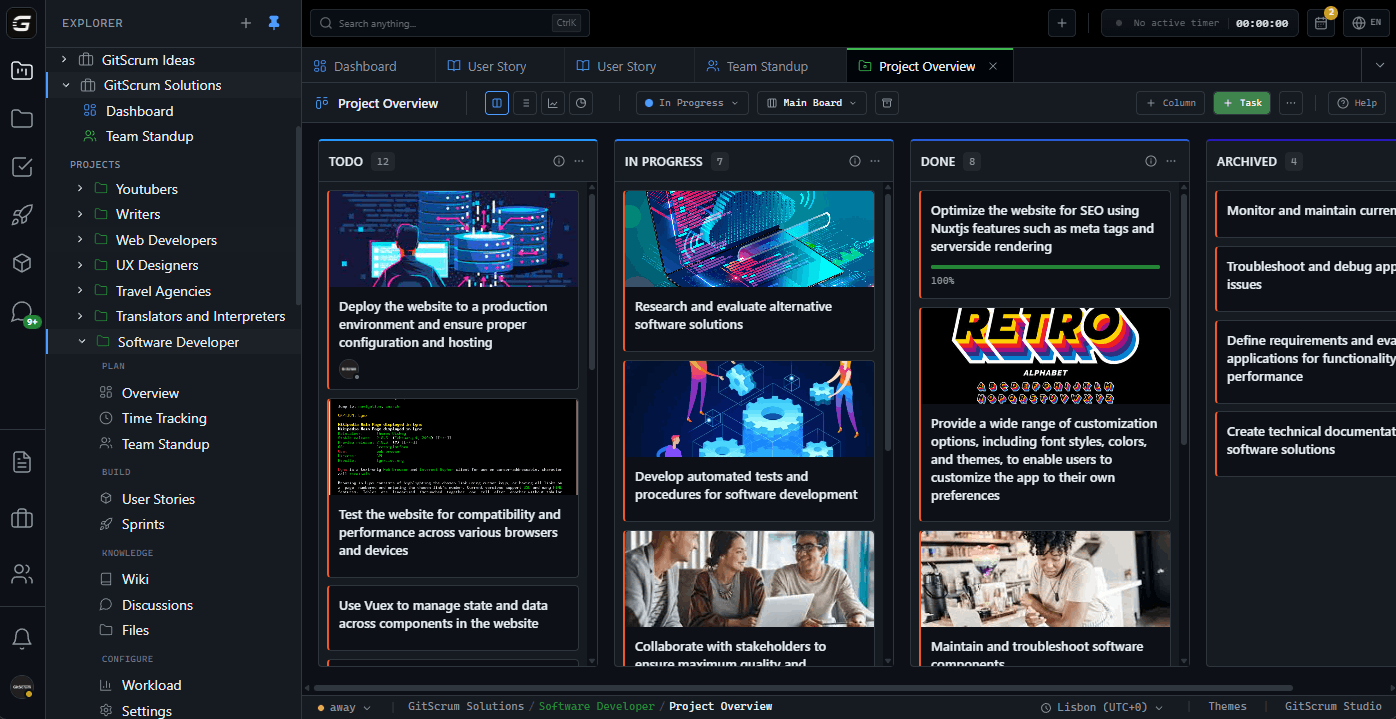
  • Discussions for async collaboration
  • Reports for bottleneck identification

Industry Practices

Kanban MethodScrum FrameworkFlow OptimizationContinuous Improvement

Frequently Asked Questions

Still have questions? Contact us at customer.service@gitscrum.com

How many API versions should we support?

Two is ideal: current stable and previous stable. Three is manageable. More than three is usually a sign that deprecation isn't being enforced. Each version has maintenance cost—the goal is minimizing active versions while respecting consumer migration timelines.

How do we get consumers to migrate off deprecated versions?

Clear timeline + consistent enforcement + migration support. 'v1 sunset: June 1. Migration guide available. Office hours every Thursday for migration questions. After June 1, v1 returns 410 Gone.' Be helpful but firm. Endless extensions teach consumers that deadlines are negotiable.

What about internal API consumers?

Internal consumers often need MORE discipline, not less. Internal teams assume they can skip migration because 'we can always coordinate.' Track internal consumers the same way. Make internal migration part of sprint work, not 'someday' work.

How do we handle emergency deprecation for security issues?

Have a policy before you need it: 'Critical security: Immediate deprecation with 30-day grace. High security: 90-day deprecation. Normal: 6-month deprecation.' When emergency happens, the policy is already agreed upon. No negotiation under pressure.

Ready to solve this?

Start free, no credit card required. Cancel anytime.

Works with your favorite tools

Connect GitScrum with the tools your team already uses. Native integrations with Git providers and communication platforms.

GitHubGitHub
GitLabGitLab
BitbucketBitbucket
SlackSlack
Microsoft TeamsTeams
DiscordDiscord
ZapierZapier
PabblyPabbly

Connect with 3,000+ apps via Zapier & Pabbly