
The Click Tax Every project management tool makes you click.
Task done? - Drag to Done column - Change status dropdown - Update completion percentage - Add completion note - Notify stakeholder - Update time estimate 6 clicks.
Per task. Multiply by 50 tasks per sprint.
300 clicks just to mark things done. The Manual Workflow Reality Morning standup: 1.
Open PM tool 2. Update each task's status 3.
Add comments about blockers 4. Change assignees for handoffs 5.
Update time estimates 6. Move cards between columns 20 minutes of clicking before actual work.
During the day: 1. Task ready for review → update status, assign reviewer, notify in Slack 2.
Code review done → update status, notify developer, update time 3. Bug found → create new task, link to original, update priority, assign 4.
Sprint planning → move tasks, update estimates, assign owners Each transition: 3-5 clicks minimum. The Cognitive Cost It's not just time.
It's context. You're in flow, coding.
Remember to update that task. Open PM tool.
Find task. Update status.
Back to code. Context switch.
Flow broken. Productivity gone.
Multiply by 10 task updates daily. That's 10 flow interruptions.
What Should Automate Status transitions: - Task moves column → status updates automatically - All columns have matching status? Why click twice?
Notifications: - Task assigned → assignee notified automatically - Task blocked → relevant people notified - No manual 'ping them in Slack' Git events: - PR opened → task moves to 'In Review' - PR merged → task moves to 'Done' - Build fails → task flagged Sprint events: - Sprint ends → completed tasks auto-archive - Sprint starts → new sprint board auto-setup - Rollover incomplete → automatic carry-forward Time tracking: - Timer stops → time auto-logs to task - Task completes → total time calculated - Sprint ends → time reports auto-generate GitScrum: Automation Built In Not a premium add-on. Not complex setup required.
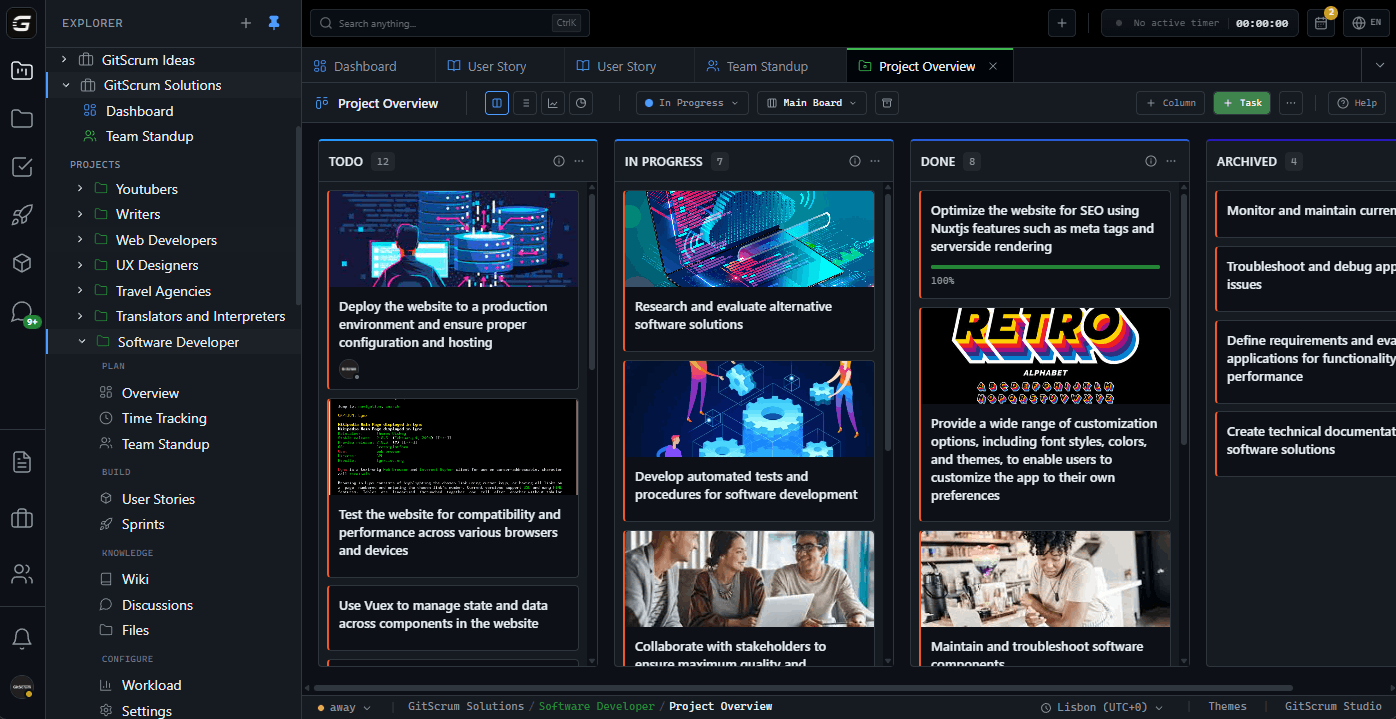
Automation is how GitScrum works. Column-Status Sync: Drag task to 'In Progress' column.
Status automatically updates to 'In Progress'. No second click.
Drag to 'Done'. Status: Done.
Completion percentage: 100%. Automatic.
Git-Triggered Workflows: Push commits referencing task? - Task shows commit activity - Optional: move to 'In Progress' Open PR?
- Task links PR - Optional: move to 'Review' - Reviewers can see context PR merged? - Task can auto-complete - Move to 'Done' or 'Deployed' - Time tracked if timer was running Sprint Automation: Sprint ends: - Completed tasks: auto-archive - Incomplete tasks: prompt for rollover - Reports: auto-generate New sprint: - Board resets - Rolled tasks appear - Velocity calculated from previous Notification Intelligence: Not spam.
Smart alerts. You get notified when: - Assigned to task - Mentioned in discussion - Task you own is blocked - Your review is requested - PR on your task merged You don't get notified: - Every comment on every task - Every status change everywhere - Background activities Configurable per user.
Defaults that make sense. Custom Automation Rules Going further: IF: Priority set to 'Critical' THEN: Notify team lead, add to 'Hot' board IF: Task blocked > 24 hours THEN: Escalate to project manager IF: Estimate exceeded by 50% THEN: Flag for review IF: All subtasks complete THEN: Move parent to 'Ready for Review' Build your workflow.
Let the system execute it. Time Tracking Automation Start timer on task.
Work. Move task to another column.
Timer pauses or continues (your choice). Task completes?
Timer auto-stops. Time auto-logs.
End of sprint? Time reports ready.
No manual compilation. The Developer Experience Your actual workflow: 1.
Morning: Check assignments (automated from sprint planning) 2. Pick task: Start timer (one click) 3.
Create branch: GitScrum suggests name 4. Code: Focus on actual work 5.
Commit: Reference task number 6. Push: Task auto-updates in GitScrum 7.
PR: Opens, task moves to Review 8. Merged: Task completes, timer stops, logged Clicks during coding: Nearly zero.
Status updates: Automatic. Time tracking: Background.
Project Manager View Dashboard updates in real-time. No chasing developers for status.
See: - What's in progress (from Git activity) - What's blocked (from flags) - What's completing (from PR merges) - How time tracks (from automatic logs) Reports generate themselves. You analyze, not compile.
Vs Manual Tools Jira: Workflow engine exists but requires admin setup. Complex rules.
Many still manual. Trello: Butler automation exists.
Limited. Complex rules need premium.
Asana: Rules exist. Per-project setup.
Many workflows still manual. GitScrum: Automation defaults that work.
Git integration automatic. Sprint workflows built-in.
The Compound Effect One automation saves 5 seconds. Sounds small.
50 tasks × 5 seconds = 4+ minutes per sprint. 10 automations × 4 minutes = 40+ minutes per sprint.
Per developer. 5 developers × 40 minutes = 3+ hours per sprint.
Reclaimed for actual development. Plus: Reduced errors.
Consistent data. Reliable reports.
Setup Time Most automation: Zero setup. - Column-status sync: default - Git linking: authorize once - Sprint workflows: built-in - Notifications: smart defaults Custom rules: Minutes to create.
- Visual builder - IF-THEN logic - Test before deploy
The GitScrum Advantage
One unified platform to eliminate context switching and recover productive hours.