VS Code

GitScrum for VS Code, Google Antigravity, Cursor and Windsurf!

GitScrum logo
Solution

Managing Feature Creep in Software Development Workflow

Features multiply faster than developers can build them. GitScrum controls feature requests with voting, prioritization, and backlog management.

Managing Feature Creep in Software Development Workflow

Feature creep happens when product ideas outpace development capacity.

Every stakeholder has 'just one more feature' that's absolutely critical. The backlog grows infinitely, sprint commitments become impossible, and developers drown in competing priorities.

GitScrum provides feature request control: the Voting Board lets team and stakeholders vote on feature priority, surfacing what actually matters most. User Story Epics group related features for coherent roadmap planning.

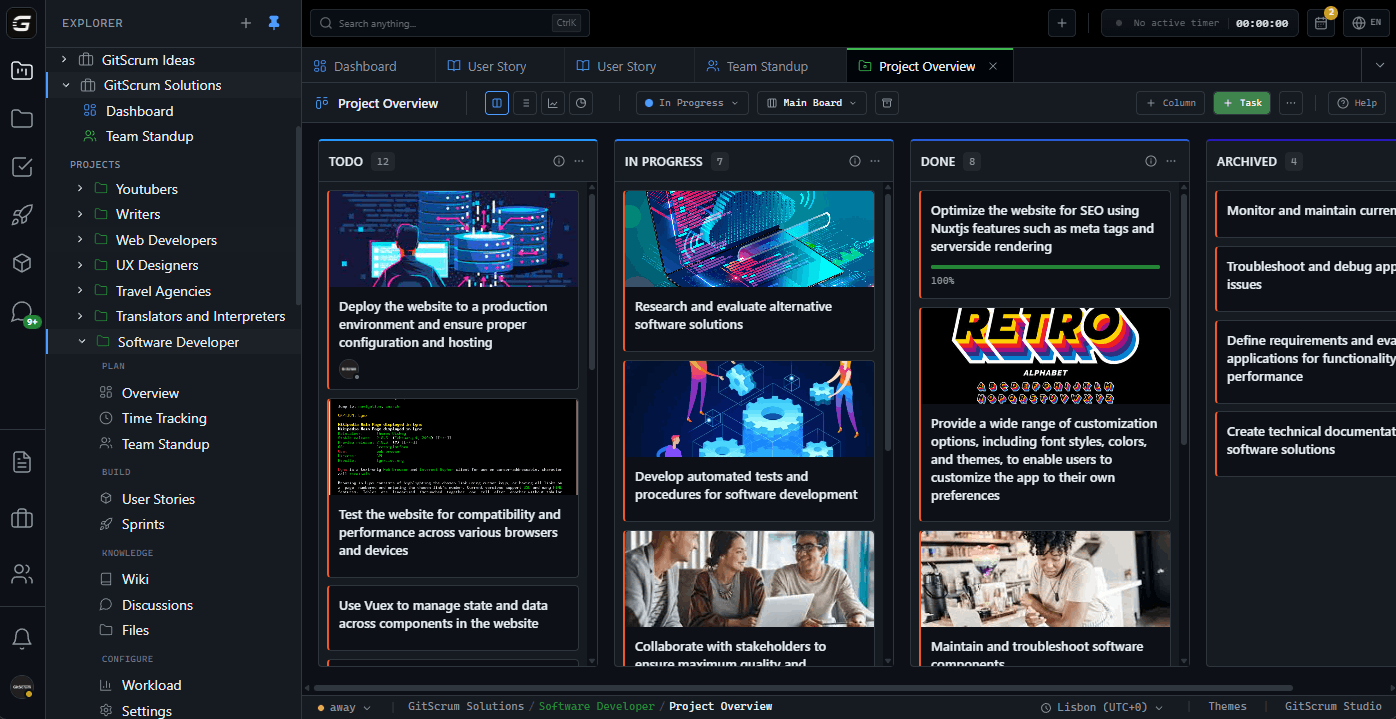
Backlog prioritization with drag-and-drop ordering makes relative importance visible. Sprint capacity planning shows exactly how many story points fit, preventing overcommitment before it happens.

The GitScrum Advantage

One unified platform to eliminate context switching and recover productive hours.

01

problem.identify()

The Problem

Every stakeholder has 'critical' features that must ship immediately

Backlog grows infinitely with no clear prioritization

No data-driven way to decide which features to build first

Features get added faster than team can deliver

Developers switch between competing feature priorities daily

02

solution.implement()

The Solution

Voting Board lets team and stakeholders vote on feature priority—data-driven prioritization

User Story Epics group related features under named objectives for roadmap clarity

Drag-and-drop backlog ordering makes relative priority visible and adjustable

Sprint capacity planning shows exactly how many story points fit before committing

Labels and task types categorize features for filtered backlog views

03

How It Works

1

Create Feature Backlog

Add all feature requests as user stories in the backlog. Each story has title, description, acceptance criteria, and effort points.

2

Group into Epics

Organize related features under epics like 'Mobile App', 'Payment System', 'User Dashboard'. This creates roadmap-level visibility.

3

Enable Voting

Open the Voting Board for stakeholder input. Team members and stakeholders vote on which features matter most. Vote counts surface true priorities.

4

Prioritize Backlog

Use drag-and-drop to order the backlog by priority. Highest-voted, most critical features move to the top. Lower-priority features sink.

5

Plan Sprint Capacity

During sprint planning, team velocity shows how many points can fit. Pull top-priority features until capacity is full. Everything else stays in backlog.

04

Why GitScrum

GitScrum addresses Managing Feature Creep in Software Development Workflow through Kanban boards with WIP limits, sprint planning, and workflow visualization

Problem resolution based on Kanban Method (David Anderson) for flow optimization and Scrum Guide (Schwaber and Sutherland) for iterative improvement

Capabilities

  • Kanban boards with WIP limits to prevent overload
  • Sprint planning with burndown charts for predictable delivery
  • Workload views for capacity management
  • Wiki for process documentation
  • Discussions for async collaboration
  • Reports for bottleneck identification

Industry Practices

Kanban MethodScrum FrameworkFlow OptimizationContinuous Improvement

Frequently Asked Questions

Still have questions? Contact us at customer.service@gitscrum.com

How does the Voting Board help with feature prioritization?

The Voting Board lets team members and stakeholders vote on user stories. Each person has limited votes to force prioritization. The system tracks total votes, vote participation rate, and can set vote limits per person. Features with the most votes surface as true priorities, replacing opinion-based decision making with data.

How do epics help manage feature roadmaps?

Epics are named groupings of related user stories. Instead of having 50 disconnected features in the backlog, you group them under epics like 'Mobile Launch', 'Enterprise Features', or 'Performance Improvements'. This creates roadmap-level visibility—stakeholders see progress toward major objectives rather than individual tasks.

What happens when the backlog gets too large?

GitScrum provides backlog management tools: archive stories that are no longer relevant, filter by label or epic to focus on specific areas, and use the position field to maintain strict priority ordering. During grooming sessions, review bottom-of-backlog items and decide whether to keep, archive, or merge them.

How do I say no to stakeholder feature requests?

Don't say no—use the Voting Board. Add the feature to the backlog and let it compete for votes. When a feature has 2 votes while others have 20, the data speaks for itself. This shifts the conversation from 'you rejected my idea' to 'the team collectively prioritized differently.'

Can I see how fast features are being added vs completed?

Yes. Sprint analytics show created vs completed tasks over time. If features are being added faster than delivered, the gap grows visually. This data is powerful for stakeholder conversations: 'We're adding 30 points per sprint but delivering 20—either we reduce incoming requests or accept longer timelines.'

Ready to solve this?

Start free, no credit card required. Cancel anytime.

Works with your favorite tools

Connect GitScrum with the tools your team already uses. Native integrations with Git providers and communication platforms.

GitHubGitHub
GitLabGitLab
BitbucketBitbucket
SlackSlack
Microsoft TeamsTeams
DiscordDiscord
ZapierZapier
PabblyPabbly

Connect with 3,000+ apps via Zapier & Pabbly