The GitHub user has specific project management needs that generic tools don't address: 1.
Code-Centric Workflow Work begins with an issue or task. Code happens in branches.
Progress is measured in commits. Completion is marked by merged PRs.
This is the natural rhythm of software development. Generic PM tools treat code as metadata—something that might be linked to a task if you remember to paste the URL.
GitHub-native PM tools treat code as the primary signal of work status. 2.
Branch-Task Mapping Every task should have a corresponding branch. Every branch should link to its task.
This mapping should be automatic, not manual. GitHub users want: - Create task → create branch (one click) - Commit to branch → activity on task (automatic) - Open PR → task moves to review (automatic) - Merge PR → task completes (automatic) 3.
Commit Visibility What did the team ship this sprint? The answer should come from git history, not manual status updates.
Commits tell the real story of progress. GitHub users need commit activity visible in the PM tool: - Which tasks have commits today?
- Who contributed to which features? - When was the last activity on stale tasks?
4. PR-Driven Workflow Pull requests are the heartbeat of collaborative development.
They represent: - Code ready for review - Work nearly complete - Quality gates passed - Team collaboration in action PM tools should understand PR lifecycle: - PR opened → task in review - PR approved → task ready to merge - PR merged → task complete - PR closed (not merged) → task needs attention 5. Repository Context Developers work across multiple repositories.
A project might span frontend, backend, and infrastructure repos. PM tools need to aggregate activity across repos while maintaining context.
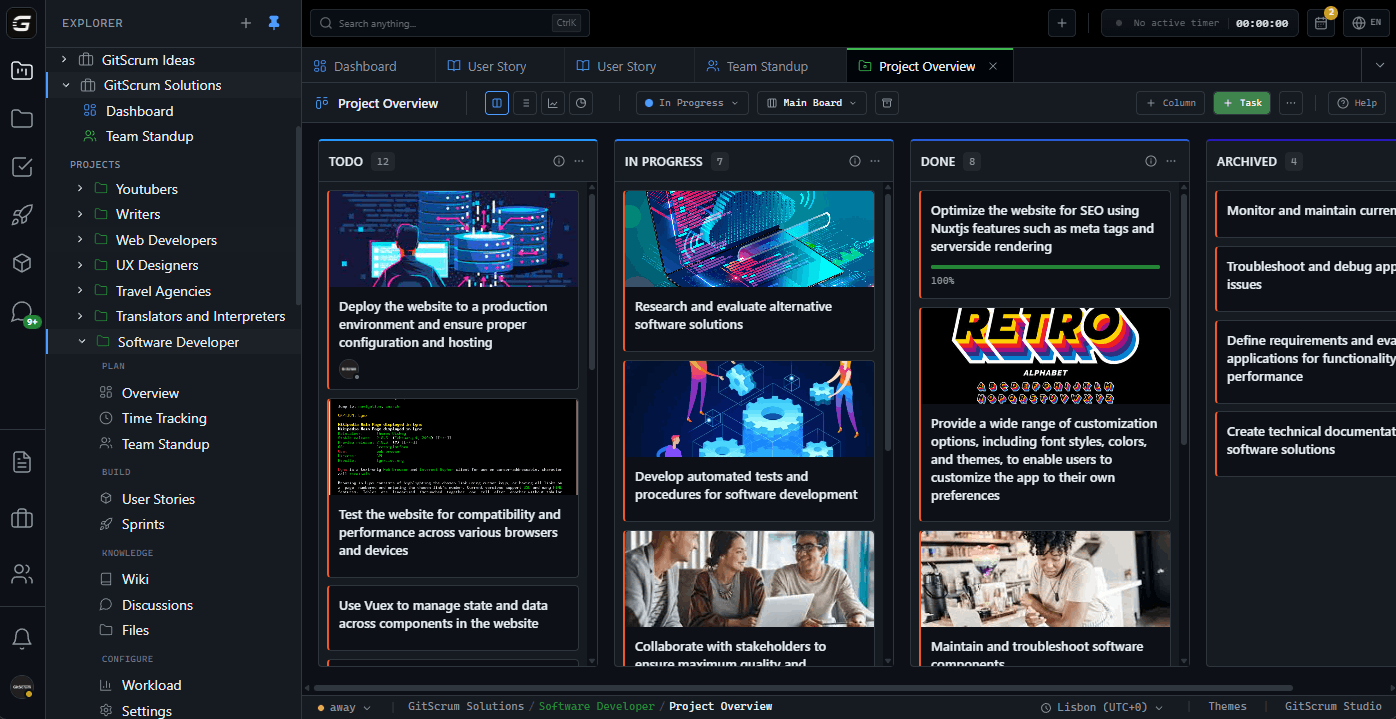
GitHub users want: - Multi-repo projects - Cross-repo task linking - Unified activity feeds - Repository-scoped views when needed Why Generic PM Tools Fail GitHub Users: Jira + GitHub App: - Requires marketplace app installation - Smart commit syntax to learn (PROJ-123 done) - Sync delays (5-15 minutes) - Branch creation requires leaving Jira - PR status not automatically reflected Asana + GitHub Integration: - Third-party connector (Zapier/Unito) - One-way or limited bidirectional sync - No branch-task mapping - Commit activity hidden in comments - Integration maintenance overhead Monday + GitHub: - Manual linking for each item - Limited automation triggers - No native git understanding - Webhook complexity - Sync reliability issues What GitScrum Delivers for GitHub Users: 1. Native GitHub Connection - OAuth authentication (no tokens to manage) - Real-time webhooks (not polling) - Bidirectional sync (changes flow both ways) - Zero configuration maintenance 2.
Automatic Branch-Task Mapping - Create branch from task (one click) - Existing branches auto-link by naming convention - Branch activity flows to task timeline - Stale branch detection 3. PR Lifecycle Integration - PR opened → task status change - PR reviews visible on task - PR merge → task completion - Multi-PR support for complex tasks 4.
Commit Activity Stream - Commits appear on linked tasks - Commit messages in activity feed - Contributor attribution - Code velocity visible in reports 5. Multi-Repository Support - Connect multiple repos per project - Cross-repo task linking - Repo-scoped views when needed - Unified project activity The GitHub-Native Advantage: When your PM tool understands GitHub natively: - No manual status updates (code activity tells the truth) - No context switching (branch creation from task view) - No sync delays (real-time webhooks) - No integration maintenance (built-in, not bolted-on) - No learning curve (works like GitHub users expect) $8.90/user/month for GitHub-native project management.
2 users free forever. Built for developers, not adapted for developers.
The GitScrum Advantage
One unified platform to eliminate context switching and recover productive hours.