VS Code

GitScrum for VS Code, Google Antigravity, Cursor and Windsurf!

GitScrum logo
Solution

Best PM Tool Agile Scrum Teams 2026 | Auto Burndown

Most project management tools claim Scrum support. Few actually understand it. You get 'sprint views' that are just date-filtered task lists. Burndown charts that require manual calculation. Velocity tracking as a paid addon. GitScrum builds Scrum into the foundation: sprint planning with capacity estimation, automatic burndown generation, velocity history that informs future planning. Not Scrum-flavored task management—actual Scrum tooling.

Best PM Tool Agile Scrum Teams 2026 | Auto Burndown

The Scrum certification industry has created a precise vocabulary: sprints, backlog grooming, story points, velocity, burndown, retrospectives.

Most PM tools slap these labels on features that don't actually implement Scrum methodology. The test: Can you see your team's historical velocity when planning sprint capacity?

Do story points automatically calculate sprint load? Does the burndown update in real-time as tasks complete?

Can you compare planned vs actual across sprints? Most tools fail this test.

They offer 'sprint functionality' that's just a date range filter on tasks. You're responsible for calculating velocity manually.

Burndowns require spreadsheet exports. Sprint retrospectives happen in a different tool entirely.

GitScrum passes the test: velocity calculated from completed sprints feeds into capacity planning. Burndown charts generate automatically from task completion.

Sprint health visible at a glance. Story points aggregate per team member to prevent overcommitment.

This is Scrum tooling built by teams who actually practice Scrum.

The GitScrum Advantage

One unified platform to eliminate context switching and recover productive hours.

01

problem.identify()

The Problem

Sprint views that are just date-filtered task lists

Burndown charts requiring manual spreadsheet work

Velocity tracking as expensive addon or missing entirely

No connection between historical velocity and sprint planning

Story point totals must be calculated manually

Sprint health requires external reporting tools

Retrospective data scattered across different tools

02

solution.implement()

The Solution

True sprint planning with backlog drag-and-drop

Automatic burndown chart generation from task completion

Velocity calculated from sprint history automatically

Capacity estimation based on team availability and velocity

Story point aggregation per team member visible during planning

Sprint health dashboard showing commitment vs completion

Built-in retrospective tracking with action item follow-up

03

How It Works

1

Backlog Grooming

Stories in the backlog get story point estimates. Team discusses during grooming sessions. Points saved on cards. Backlog prioritized by product owner. Ready for sprint planning.

2

Sprint Planning with Data

Open sprint planning. See team's average velocity from last 3 sprints. See individual capacity based on availability (vacations, meetings). Drag stories from backlog to sprint. Watch story point total update in real-time. Stop when reaching capacity.

3

Sprint Execution with Visibility

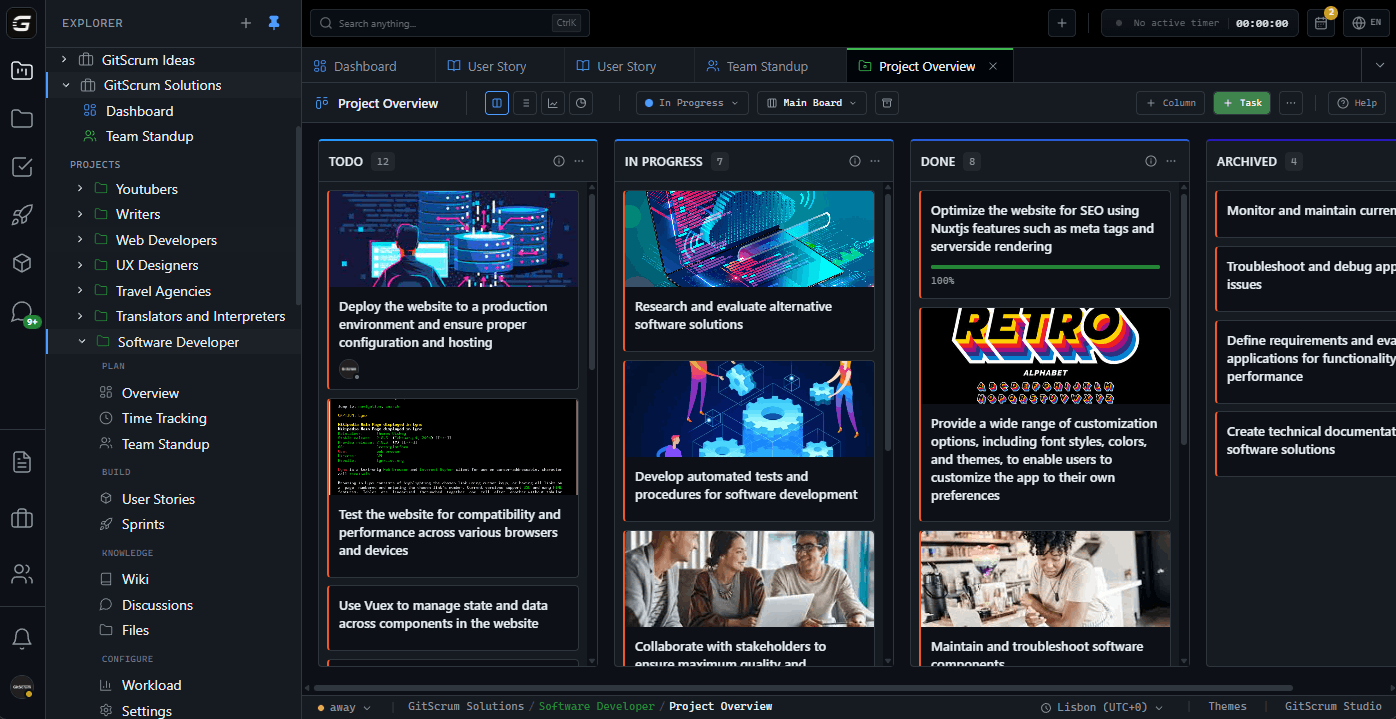
Board shows sprint tasks. Burndown updates automatically as cards move to Done. Daily standup references the board. Blockers flagged visually. Sprint health visible: on track, at risk, behind.

4

Sprint Review and Retro

Sprint ends. Velocity calculated automatically. Incomplete stories return to backlog. Retro captures what worked, what didn't, action items. Action items become tasks for next sprint. Cycle continues with better data each time.

04

Why GitScrum

GitScrum addresses Best Project Management Tool for Agile Scrum Teams through Kanban boards with WIP limits, sprint planning, and workflow visualization

Problem resolution based on Kanban Method (David Anderson) for flow optimization and Scrum Guide (Schwaber and Sutherland) for iterative improvement

Capabilities

  • Kanban boards with WIP limits to prevent overload
  • Sprint planning with burndown charts for predictable delivery
  • Workload views for capacity management
  • Wiki for process documentation
  • Discussions for async collaboration
  • Reports for bottleneck identification

Industry Practices

Kanban MethodScrum FrameworkFlow OptimizationContinuous Improvement

Frequently Asked Questions

Still have questions? Contact us at customer.service@gitscrum.com

We use Kanban, not Scrum—does GitScrum work for us?

Absolutely. GitScrum supports pure Kanban with WIP limits, flow metrics, and continuous delivery. Scrum features are available but not mandatory. Use what fits your process.

Our Scrum Master is concerned about adoption—how steep is the learning curve?

If your team knows Scrum, GitScrum feels familiar. The terminology matches. The workflows align. Most teams are productive within their first sprint. The tool gets out of the way of the process.

Can we customize story point scales (Fibonacci, powers of 2, etc.)?

Yes. Configure your estimation scale: Fibonacci, linear, powers of 2, custom values. The scale you choose flows through velocity calculations and capacity planning.

How does GitScrum handle distributed Scrum teams?

Async standups for timezone-distributed teams. Real-time board updates via WebSocket. Sprint ceremonies can be supported with video call integrations. The board serves as the single source of truth regardless of where team members work.

Ready to solve this?

Start free, no credit card required. Cancel anytime.

Works with your favorite tools

Connect GitScrum with the tools your team already uses. Native integrations with Git providers and communication platforms.

GitHubGitHub
GitLabGitLab
BitbucketBitbucket
SlackSlack
Microsoft TeamsTeams
DiscordDiscord
ZapierZapier
PabblyPabbly

Connect with 3,000+ apps via Zapier & Pabbly