VS Code

GitScrum for VS Code, Google Antigravity, Cursor and Windsurf!

GitScrum logo
Solution

Cognitive Load Burnout Fix 2026 | Unified Workspace PM

Brain has 7-item working memory. Tool navigation consumes it before work begins. Exhausted by 5pm without accomplishing anything meaningful. One unified platform frees cognitive resources for actual problem-solving. Free trial.

Cognitive Load Burnout Fix 2026 | Unified Workspace PM

Cognitive load burnout is one of the most insidious costs of tool fragmentation because it is invisible until it manifests as serious problems—turnover, disengagement, declining quality of work, mental health issues.

The human brain has limited working memory capacity. When that capacity is consumed by navigating infrastructure rather than doing work, people become mentally exhausted without producing proportional output.

In fragmented environments, workers must constantly context-switch between tools with different interfaces, different navigation patterns, different terminology. They must remember where information lives across multiple systems.

They must maintain mental models of how data flows between tools. They must track conversations across multiple communication platforms.

Each of these demands consumes cognitive resources. The cumulative effect is exhaustion.

A unified platform directly addresses cognitive load burnout. When everything is in one place with consistent interface patterns, the cognitive overhead of navigation drops dramatically.

People can direct their mental energy toward the work itself rather than the logistics of accessing the work. The cognitive simplicity translates directly into reduced stress, improved focus, and sustainable productivity.

Organizations report not just efficiency gains but genuine improvements in employee wellbeing after consolidating to unified platforms.

The GitScrum Advantage

One unified platform to eliminate context switching and recover productive hours.

01

problem.identify()

The Problem

Mental exhaustion from navigating multiple tools

Constant context-switching drains cognitive resources

Working memory consumed by tool logistics

End-of-day fatigue without proportional output

Stress from managing fragmented infrastructure

Burnout symptoms attributed to work volume not tool complexity

02

solution.implement()

The Solution

Single interface eliminates navigation overhead

Consistent patterns reduce context-switching

Mental energy directed toward work not logistics

Productive days with accomplishment feeling

Reduced stress from simplified infrastructure

Sustainable productivity preserves wellbeing

03

How It Works

1

Unified Interface

All work accessible through single consistent platform

2

Reduced Navigation

No need to remember where things live

3

Focus on Work

Cognitive resources directed toward actual tasks

4

Sustainable Energy

Employees maintain energy throughout the day

04

Why GitScrum

GitScrum addresses Burnout From Cognitive Load of Managing Fragmented Digital Workspace through Kanban boards with WIP limits, sprint planning, and workflow visualization

Problem resolution based on Kanban Method (David Anderson) for flow optimization and Scrum Guide (Schwaber and Sutherland) for iterative improvement

Capabilities

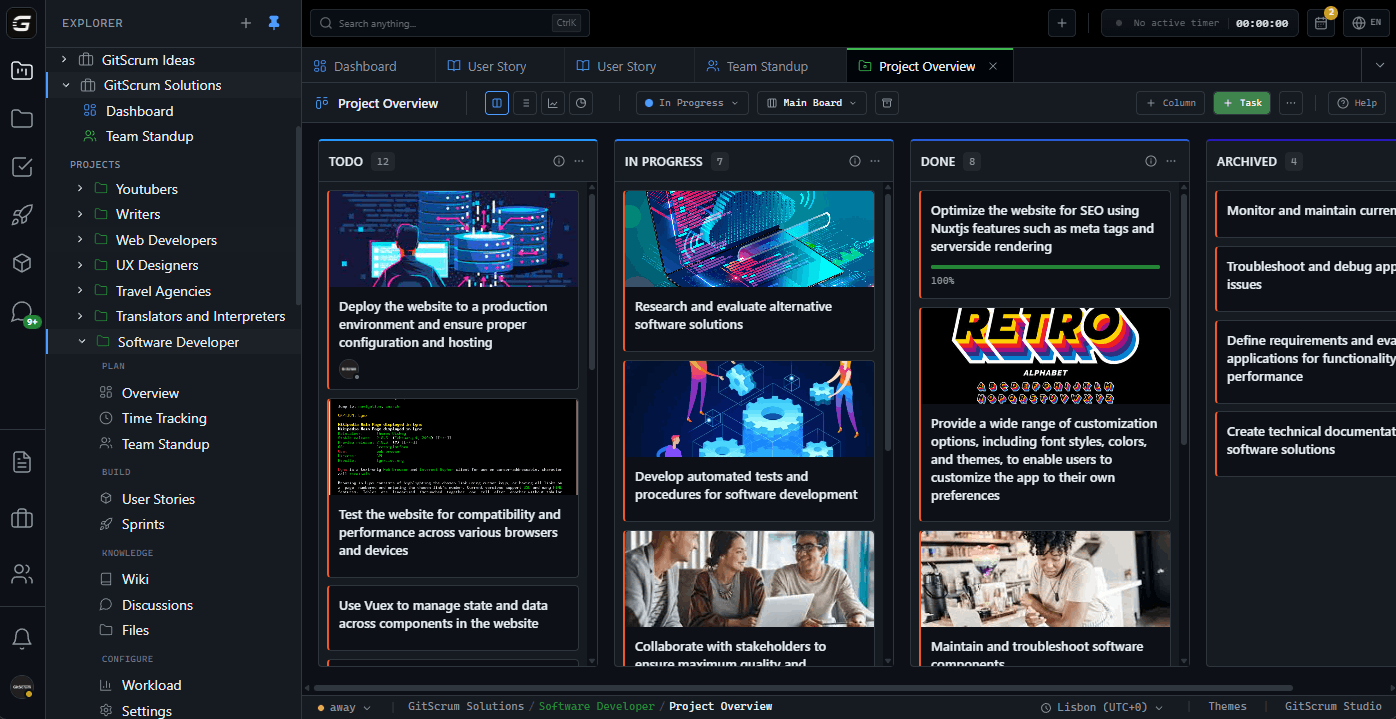
  • Kanban boards with WIP limits to prevent overload
  • Sprint planning with burndown charts for predictable delivery
  • Workload views for capacity management
  • Wiki for process documentation
  • Discussions for async collaboration
  • Reports for bottleneck identification

Industry Practices

Kanban MethodScrum FrameworkFlow OptimizationContinuous Improvement

Frequently Asked Questions

Still have questions? Contact us at customer.service@gitscrum.com

How does tool fragmentation contribute to burnout?

Tool fragmentation contributes to burnout through cognitive load accumulation. The human brain has limited working memory capacity—typically about seven items. When people must constantly remember which tool contains which information, track conversations across multiple platforms, navigate different interfaces with different patterns, and mentally translate data between systems, this capacity is consumed by infrastructure navigation rather than productive work. The result is mental exhaustion without proportional output, a core characteristic of burnout. Research shows that context-switching costs approximately 25 minutes of recovery time per switch. In fragmented environments with dozens of daily tool switches, these costs compound into hours of cognitive drain.

Why is cognitive load burnout often unrecognized?

Cognitive load burnout is often unrecognized because it is attributed to work volume rather than work infrastructure. When employees report exhaustion, the assumption is that they have too much work. Organizations respond by hiring more people or reducing scope. But the actual cause—cognitive overhead from tool fragmentation—remains unaddressed. The new hires experience the same fragmentation-induced exhaustion. Additionally, cognitive load is invisible. Unlike physical workload, which can be measured in tasks completed or hours worked, cognitive load from tool navigation is not tracked. People simply feel tired without being able to articulate why.

How does a unified platform reduce cognitive load burnout?

A unified platform reduces cognitive load burnout by eliminating the mental overhead of tool navigation. When everything is in one place with consistent interface patterns, people do not need to remember where information lives—it is all in the same place. They do not need to context-switch between different tools—it is all one tool. They do not need to mentally translate between different data models—there is one consistent model. This cognitive simplicity means mental energy goes toward actual work rather than logistics. Organizations report dramatic improvements in employee wellbeing, not just productivity metrics, after consolidating to unified platforms. People end their days feeling accomplished rather than merely exhausted.

Ready to solve this?

Start free, no credit card required. Cancel anytime.

Works with your favorite tools

Connect GitScrum with the tools your team already uses. Native integrations with Git providers and communication platforms.

GitHubGitHub
GitLabGitLab
BitbucketBitbucket
SlackSlack
Microsoft TeamsTeams
DiscordDiscord
ZapierZapier
PabblyPabbly

Connect with 3,000+ apps via Zapier & Pabbly