
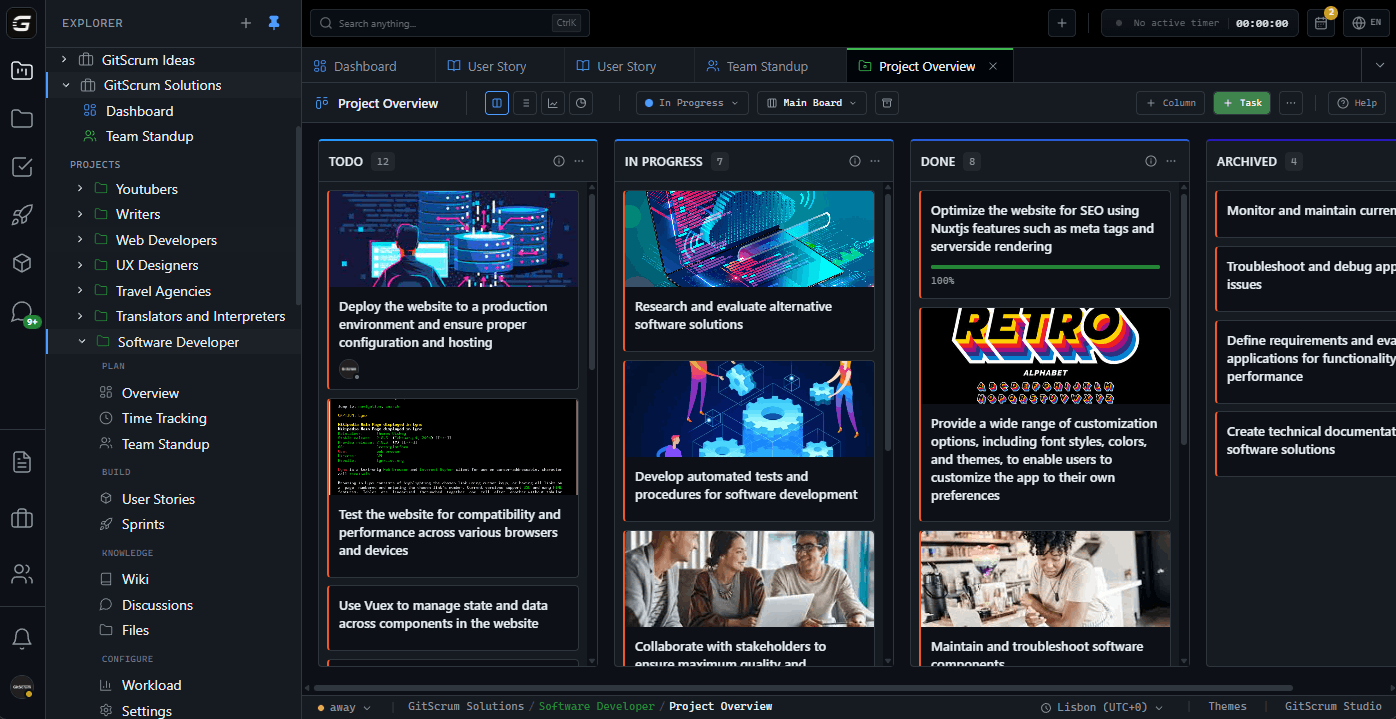
VS Code

GitScrum for VS Code, Google Antigravity, Cursor and Windsurf!

GitScrum logo
Solution

Sustainable Pace PM 2026 | Workload & Burnout Alerts

Sprint 23. Another 'critical' deadline. Team at 110% for 8 months. Best performers leave first—they have options. Workload visibility shows who's overloaded. Capacity-based planning prevents overcommit. Burnout alerts before the crash. Free trial.

Sustainable Pace PM 2026 | Workload & Burnout Alerts

The pattern is depressingly familiar.

The team successfully ships under pressure. Leadership notices.

'See? They can do it when they push.' So the next deadline is tighter.

And the next. The 'stretch' becomes the baseline.

What was once an exceptional effort becomes the expectation. The team adapts—not by becoming more productive, but by cutting corners.

Code quality drops. Testing becomes cursory.

Documentation disappears. Knowledge sharing stops because there's no time.

Then people leave. Not the underperformers—the best people leave first.

They have options. They don't have to work like this.

The remaining team is smaller, so the pressure increases. More people leave.

The cycle accelerates until you're left with a skeleton crew of people who can't leave, shipping low-quality work under constant deadline pressure.

The GitScrum Advantage

One unified platform to eliminate context switching and recover productive hours.

01

problem.identify()

The Problem

Exceptional effort becomes baseline expectation

Quality drops as team cuts corners to survive

Best performers leave first—they have options

Knowledge loss accelerates as departures compound

Remaining team smaller, pressure higher, cycle continues

02

solution.implement()

The Solution

Workload visibility across team members

Sustainable pace metrics and alerts

Overtime tracking and trend analysis

Capacity-based sprint planning

Burnout risk indicators

03

How It Works

1

Workload Visibility

GitScrum shows the actual workload distribution across the team. Not just assigned tasks, but hours committed, work in progress, and historical patterns. When one person is at 150% while others are at 80%, it's visible.

2

Sustainable Pace Metrics

Track velocity over time—not to maximize it, but to find the sustainable level. Teams that sprint at 120% for six months then crash are less productive than teams maintaining 80% indefinitely. The data shows this.

3

Overtime Alerts

When patterns indicate unsustainable work: 'Team has worked >45 hours/week for 6 consecutive weeks. Historical data shows productivity decline begins at week 8.' The warning comes before the crash.

4

Capacity-Based Planning

Sprint planning includes actual capacity, not wishful thinking: 'Available capacity: 120 hours. Committed work: 180 hours. This sprint is overcommitted by 50%.' The conversation happens before the sprint starts, not during the postmortem.

04

Why GitScrum

GitScrum addresses Burnout from Unsustainable Pace through Kanban boards with WIP limits, sprint planning, and workflow visualization

Problem resolution based on Kanban Method (David Anderson) for flow optimization and Scrum Guide (Schwaber and Sutherland) for iterative improvement

Capabilities

  • Kanban boards with WIP limits to prevent overload
  • Sprint planning with burndown charts for predictable delivery
  • Workload views for capacity management
  • Wiki for process documentation
  • Discussions for async collaboration
  • Reports for bottleneck identification

Industry Practices

Kanban MethodScrum FrameworkFlow OptimizationContinuous Improvement

Frequently Asked Questions

Still have questions? Contact us at customer.service@gitscrum.com

Won't this data be used to track individual performance?

The goal is team health, not individual surveillance. Data is aggregated at team level by default. Individual patterns are only visible to that person and their direct manager, and only for identifying support needs—not performance reviews.

What if leadership ignores the burnout warnings?

GitScrum creates a documented record. When the predicted productivity decline happens, there's data showing: 'Warning issued Week 6, ignored. Productivity declined 40% Week 10, as predicted.' The pattern becomes undeniable.

How do you measure 'sustainable pace' when every team is different?

By tracking each team's own baseline. Sustainable pace for Team A might be different than Team B. The metrics compare current pace to that team's historical sustainable performance, not an arbitrary standard.

Can't people game the metrics by logging less time?

Yes, and that's actually useful data. If people are logging 40 hours but clearly working 60, the gap between logged time and deliverables reveals the problem. The system works even when people underreport.

Ready to solve this?

Start free, no credit card required. Cancel anytime.

Works with your favorite tools

Connect GitScrum with the tools your team already uses. Native integrations with Git providers and communication platforms.

GitHubGitHub
GitLabGitLab
BitbucketBitbucket
SlackSlack
Microsoft TeamsTeams
DiscordDiscord
ZapierZapier
PabblyPabbly

Connect with 3,000+ apps via Zapier & Pabbly