VS Code

GitScrum for VS Code, Google Antigravity, Cursor and Windsurf!

GitScrum logo
Solution

ClickUp vs Monday vs Asana Devs 2026 | None Are Git-Native

ClickUp, Monday, Asana: powerful for general work. Dev teams? Sprints bolted-on, GitHub needs plugins. Git-native alternative built for software teams. $8.90/user. Free trial.

ClickUp vs Monday vs Asana Devs 2026 | None Are Git-Native

The comparison trap: you're evaluating ClickUp vs Monday vs Asana because they dominate search results.

They're excellent tools—for marketing teams managing campaigns, operations teams tracking processes, HR teams handling onboarding. But software development?

That's an afterthought. ClickUp has sprints, but they're a feature buried in their everything-for-everyone approach.

Monday.com has automations, but they're optimized for sales workflows, not code workflows. Asana has beautiful design, but developer-specific features like burndown charts require workarounds.

None of them have native GitHub integration that actually works. PRs don't automatically link to tasks.

Commits don't update card status. Branch names don't sync with task IDs.

You're paying for general-purpose features while hacking together the development-specific workflows you actually need. GitScrum is different: built for software teams, by software teams.

Every feature—from sprint planning to time tracking to client portals—is designed for development workflows. No marketing campaign features inflating your bill.

No sales pipeline automations you'll never use.

The GitScrum Advantage

One unified platform to eliminate context switching and recover productive hours.

01

problem.identify()

The Problem

ClickUp/Monday/Asana built for general work, not development

Sprint features feel bolted-on, not native

GitHub integration requires third-party plugins

PRs don't automatically link to project tasks

Burndown charts need workarounds or integrations

Paying for marketing/sales features developers don't use

02

solution.implement()

The Solution

Purpose-built for software development teams

Sprint planning as a core feature, not an addon

Native GitHub integration—PRs link automatically

Commit messages update task status

Burndown charts generated from sprint data

Pay only for development features you actually use

03

How It Works

1

Developer-First Setup

Connect GitHub during onboarding. Select repos. Invite team. No template selection—the default is already optimized for development: Backlog, To Do, In Progress, Done. Sprints enabled by default. Time tracking ready.

2

GitHub as Source of Truth

Create a branch: task links automatically. Open a PR: card moves to 'In Review'. Merge: card moves to Done. Your code workflow updates your project board. No Zapier. No manual status updates. Native.

3

Real Sprint Planning

Not 'sprint view' as a filter. Actual sprint planning: drag from backlog, see capacity based on velocity history, track burndown as work completes. Velocity calculates automatically. Sprint health visible at a glance.

4

Development-Specific Features

Time tracking for client billing. Client portals for stakeholder visibility. Burndown and velocity charts. Branch and PR tracking on cards. These aren't plugins—they're core features built for how software gets made.

04

Why GitScrum

GitScrum addresses ClickUp vs Monday vs Asana for Software Teams through Kanban boards with WIP limits, sprint planning, and workflow visualization

Problem resolution based on Kanban Method (David Anderson) for flow optimization and Scrum Guide (Schwaber and Sutherland) for iterative improvement

Capabilities

  • Kanban boards with WIP limits to prevent overload
  • Sprint planning with burndown charts for predictable delivery
  • Workload views for capacity management
  • Wiki for process documentation
  • Discussions for async collaboration
  • Reports for bottleneck identification

Industry Practices

Kanban MethodScrum FrameworkFlow OptimizationContinuous Improvement

Frequently Asked Questions

Still have questions? Contact us at customer.service@gitscrum.com

We already have ClickUp/Monday/Asana—is switching worth the friction?

Run parallel for a sprint. Keep your current tool for historical data. Use GitScrum for active work. By sprint 2, your team will tell you which they prefer. Migration is straightforward when you're ready.

ClickUp has a lot of features—doesn't GitScrum have fewer?

Fewer general features, more development-specific features. ClickUp has CRM views, whiteboards, docs—things marketing teams use. GitScrum has GitHub integration, velocity tracking, client portals—things dev teams use. Different focus.

Monday.com's automations are powerful—does GitScrum match that?

Monday's automations optimize for sales/ops workflows. GitScrum automates developer-specific things: PR-to-card linking, commit-based status updates, sprint auto-calculations. Different automation philosophy for different workflows.

Asana's design is beautiful—how does GitScrum compare?

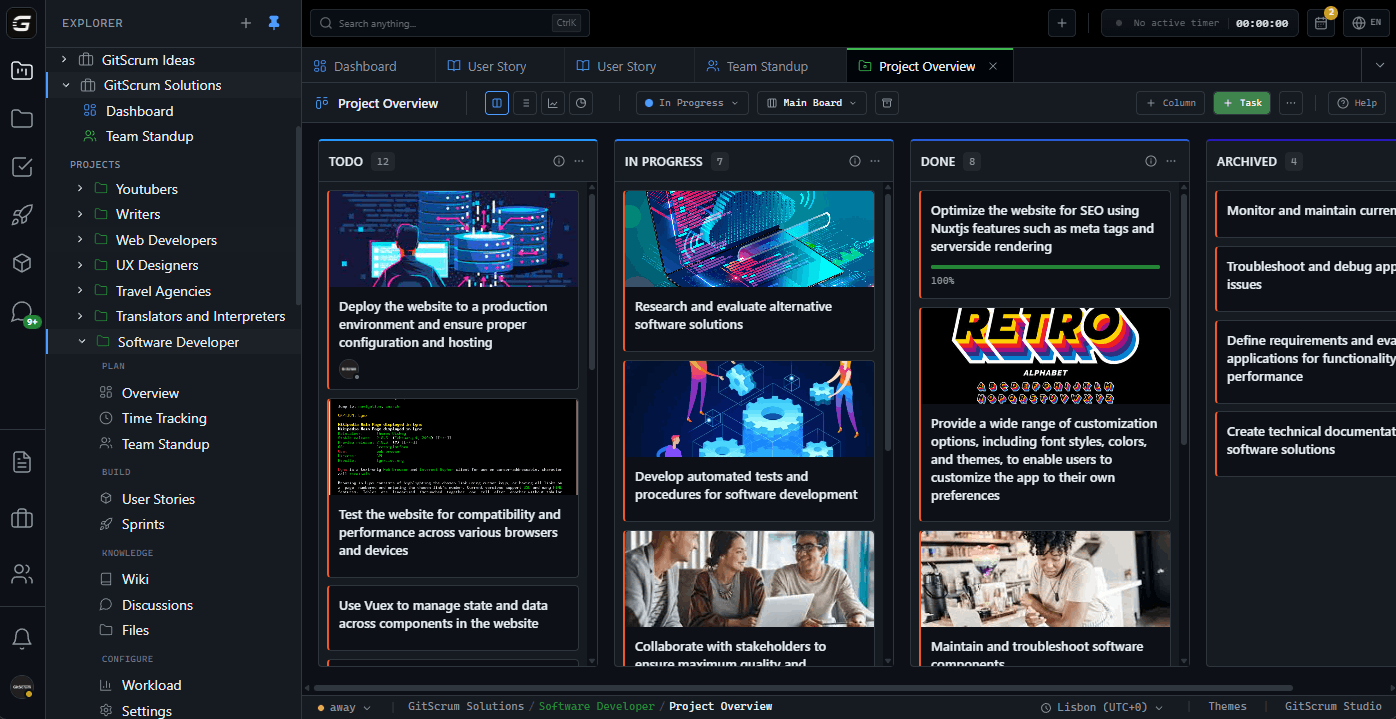
Different aesthetic: Asana is bright, marketing-friendly. GitScrum is dark-mode native, IDE-inspired, information-dense. If you want your PM tool to feel like VS Code instead of a marketing dashboard, GitScrum's design will resonate.

Ready to solve this?

Start free, no credit card required. Cancel anytime.

Works with your favorite tools

Connect GitScrum with the tools your team already uses. Native integrations with Git providers and communication platforms.

GitHubGitHub
GitLabGitLab
BitbucketBitbucket
SlackSlack
Microsoft TeamsTeams
DiscordDiscord
ZapierZapier
PabblyPabbly

Connect with 3,000+ apps via Zapier & Pabbly