VS Code

GitScrum for VS Code, Google Antigravity, Cursor and Windsurf!

GitScrum logo
Solution

Client Status Questions 2026 | Real-Time Self-Service Portal

Status emails take 15 min each to compile. Ten clients means lost Mondays. Client portals give instant self-service visibility—no emails needed, time recovered. Free trial.

Client Status Questions 2026 | Real-Time Self-Service Portal

Monday morning.

Before you can start actual work, there are already five emails waiting: 'Quick question—what's the status on the dashboard feature?' 'Hey, just checking in on progress.' 'When do you think we'll have the API ready?' Each 'quick question' isn't quick. You have to context-switch to that project, check multiple places for status, formulate an update that's honest but not alarming, and send it.

Fifteen minutes each, minimum. Five clients?

That's over an hour of reactive work before you've done anything proactive. And they'll ask again on Thursday.

The problem isn't that clients want to know status—that's reasonable. The problem is that they can't see it themselves, so they have to ask.

Every request is an interruption for you and a wait for them. GitScrum solves this by giving clients direct visibility.

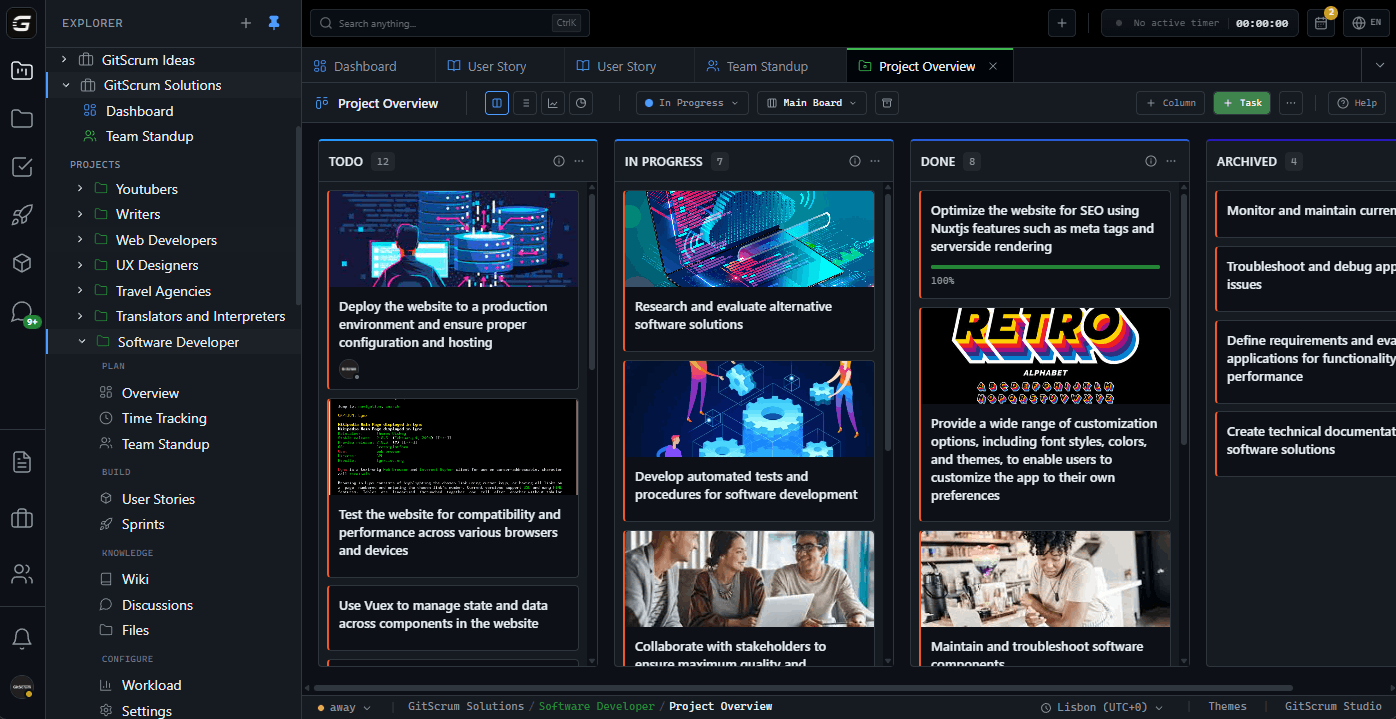
They log into a portal, see the board, check progress—no email required. When they have real-time access, the status questions disappear.

You get your mornings back.

The GitScrum Advantage

One unified platform to eliminate context switching and recover productive hours.

01

problem.identify()

The Problem

Clients send constant status update requests via email

Each response requires 15+ minutes of context-switching and compilation

Multiply by multiple clients and entire mornings are lost

Interruptions break developer focus and productivity

Clients wait for responses when they could have instant visibility

02

solution.implement()

The Solution

Client portals provide real-time project visibility

Status is self-service—clients see it without asking

Developers get mornings back for productive work

Clients get faster answers without waiting for responses

Professional client experience improves relationships

03

How It Works

1

Set Up Client Portals

GitScrum creates dedicated client views for each project. Clients get login credentials with access only to their project—not your internal tools or other clients' work.

2

Configure Visibility

Decide what clients see: progress boards, milestones, timeline views, or simplified dashboards. Show enough for transparency without overwhelming non-technical stakeholders.

3

Enable Self-Service

When clients want status, they log in and see it immediately. No email, no waiting, no interrupting your work. They get faster answers; you get uninterrupted focus.

4

Add Proactive Updates

Automated notifications alert clients when milestones complete or phases change. Proactive communication builds trust and further reduces inbound requests.

04

Why GitScrum

GitScrum addresses Clients Constantly Asking 'What's the Status?' through Kanban boards with WIP limits, sprint planning, and workflow visualization

Problem resolution based on Kanban Method (David Anderson) for flow optimization and Scrum Guide (Schwaber and Sutherland) for iterative improvement

Capabilities

  • Kanban boards with WIP limits to prevent overload
  • Sprint planning with burndown charts for predictable delivery
  • Workload views for capacity management
  • Wiki for process documentation
  • Discussions for async collaboration
  • Reports for bottleneck identification

Industry Practices

Kanban MethodScrum FrameworkFlow OptimizationContinuous Improvement

Frequently Asked Questions

Still have questions? Contact us at customer.service@gitscrum.com

Won't clients misinterpret what they see?

Configure views appropriately. Non-technical clients see milestones and progress percentages, not technical task details. The portal shows what they need to know, not everything internally tracked.

What about sensitive internal discussions?

Client portals show only designated information. Internal comments, private notes, and team discussions remain invisible. You control exactly what's shared.

Will clients stop communicating entirely?

No—they'll communicate about substantive things instead of status checks. Questions become more meaningful when basic status is already visible. Communication quality improves.

How do we handle multiple stakeholders per client?

Each client organization can have multiple users with appropriate permissions. Project sponsors see high-level progress; technical liaisons might see more detail.

Ready to solve this?

Start free, no credit card required. Cancel anytime.

Works with your favorite tools

Connect GitScrum with the tools your team already uses. Native integrations with Git providers and communication platforms.

GitHubGitHub
GitLabGitLab
BitbucketBitbucket
SlackSlack
Microsoft TeamsTeams
DiscordDiscord
ZapierZapier
PabblyPabbly

Connect with 3,000+ apps via Zapier & Pabbly