VS Code

GitScrum for VS Code, Google Antigravity, Cursor and Windsurf!

GitScrum logo
Solution

12 UI Paradigms Daily 2026 | One Interface Ends Overload

Jira, Slack, GitHub, Figma—12 different UIs drain mental energy daily. GitScrum: one interface, one set of shortcuts, deep focus restored. Free trial.

12 UI Paradigms Daily 2026 | One Interface Ends Overload

The human brain excels at pattern recognition and efficiency through repetition.

When you use one interface consistently, actions become automatic—muscle memory takes over. But when you switch between 12 different tools daily, you never develop that automaticity.

Each tool has its own navigation patterns. Where is the settings menu?

Is it a gear icon in the top right, a hamburger menu on the left, a profile dropdown, or buried in some other location? Each tool has its own keyboard shortcuts.

Command-K opens different things in different tools. Each tool has its own terminology.

What Jira calls a board, Asana calls a project. What Slack calls a channel, Teams calls a team.

What one tool calls a comment, another calls a note. Your brain constantly translates between paradigms.

The cognitive load compounds throughout the day. By afternoon, you are mentally exhausted not from solving hard problems but from navigating different interfaces.

Decision fatigue sets in. You avoid using certain tools because the mental overhead is too high.

Important updates get missed because you could not muster the energy to check another system. Deep focus becomes nearly impossible when your brain is constantly readjusting to new visual and interaction patterns.

The creative problem-solving that requires sustained concentration suffers most. A unified platform eliminates paradigm switching.

One interface. One navigation pattern.

One set of shortcuts. One terminology.

Your brain develops efficiency through repetition. Cognitive resources redirect from interface navigation to actual work.

The GitScrum Advantage

One unified platform to eliminate context switching and recover productive hours.

01

problem.identify()

The Problem

12 different UI paradigms require constant mental adjustment

Each tool has unique navigation, shortcuts, and terminology

Cognitive load accumulates throughout the day

Decision fatigue leads to tool avoidance

Deep focus impossible with constant interface switching

Mental energy drains from navigation not work

02

solution.implement()

The Solution

One interface for all work management

Consistent navigation patterns become automatic

Single set of keyboard shortcuts to learn

Unified terminology across all functions

Cognitive load reduces through repetition

Mental energy available for actual problem solving

03

How It Works

1

Single Interface

All work management functions in one consistent UI

2

Learned Patterns

Navigation becomes automatic through daily repetition

3

Reduced Cognitive Load

Brain resources freed from interface translation

4

Sustained Focus

Deep work possible without paradigm switching

04

Why GitScrum

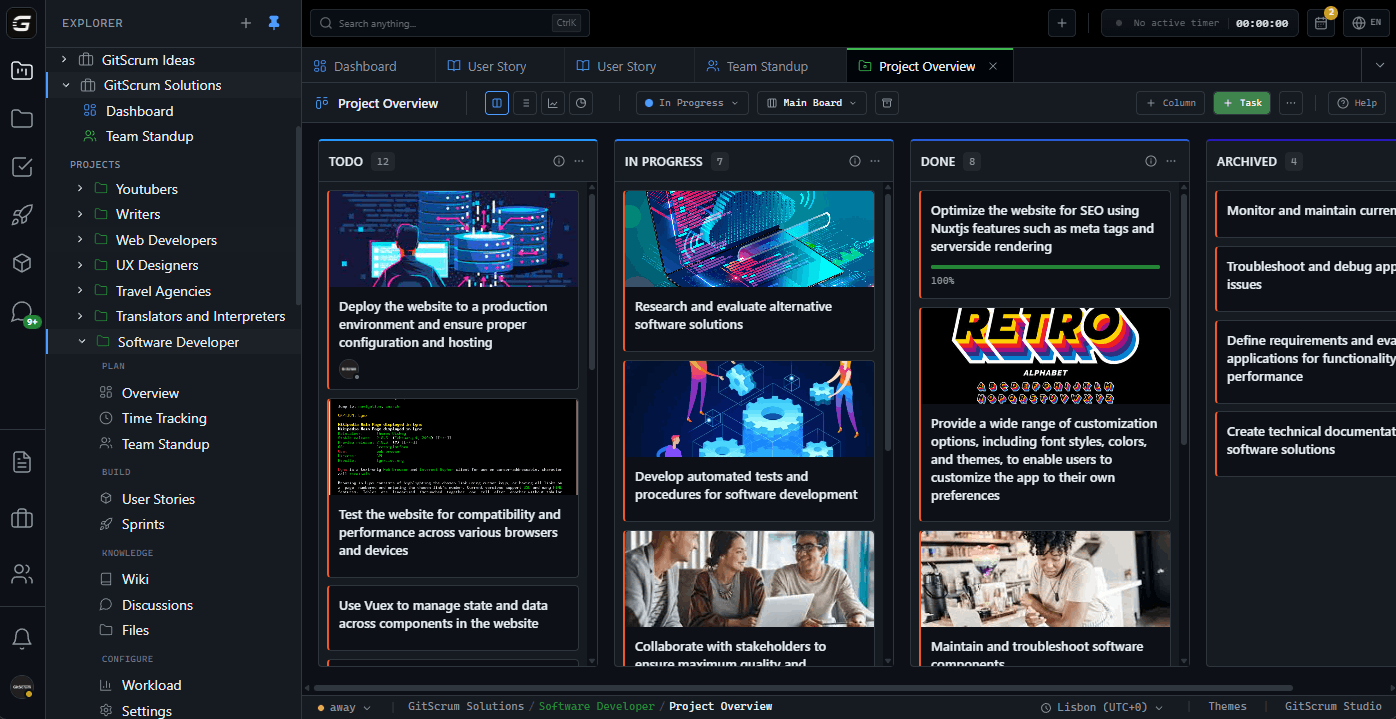
GitScrum addresses Cognitive Overload from 12 Different UI Paradigms Daily through Kanban boards with WIP limits, sprint planning, and workflow visualization

Problem resolution based on Kanban Method (David Anderson) for flow optimization and Scrum Guide (Schwaber and Sutherland) for iterative improvement

Capabilities

  • Kanban boards with WIP limits to prevent overload
  • Sprint planning with burndown charts for predictable delivery
  • Workload views for capacity management
  • Wiki for process documentation
  • Discussions for async collaboration
  • Reports for bottleneck identification

Industry Practices

Kanban MethodScrum FrameworkFlow OptimizationContinuous Improvement

Frequently Asked Questions

Still have questions? Contact us at customer.service@gitscrum.com

How does switching between UI paradigms cause cognitive overload?

Each tool has its own visual language, navigation patterns, and terminology. Your brain must constantly translate between these paradigms—remembering where settings are in each tool, what keyboard shortcuts do in each context, what terms mean in each system. This continuous translation consumes mental energy that should go toward actual work.

Why does cognitive load increase throughout the day?

Cognitive load is cumulative. Each tool switch requires mental adjustment. Early in the day, these adjustments feel manageable. But after dozens of switches, mental fatigue builds. By afternoon, the effort required to switch contexts becomes significant. Decision fatigue sets in—you might avoid certain tools simply because the mental overhead feels too high.

How does a unified platform reduce cognitive overload?

With one platform handling all work management, you learn one interface deeply. Navigation becomes automatic—muscle memory develops. You always know where to find settings, what shortcuts do, what terms mean. This frees cognitive resources for actual problem-solving instead of interface translation. Deep focus becomes possible when your brain is not constantly readjusting.

Ready to solve this?

Start free, no credit card required. Cancel anytime.

Works with your favorite tools

Connect GitScrum with the tools your team already uses. Native integrations with Git providers and communication platforms.

GitHubGitHub
GitLabGitLab
BitbucketBitbucket
SlackSlack
Microsoft TeamsTeams
DiscordDiscord
ZapierZapier
PabblyPabbly

Connect with 3,000+ apps via Zapier & Pabbly