VS Code

GitScrum for VS Code, Google Antigravity, Cursor and Windsurf!

GitScrum logo
Solution

Context Switching Cost 2026 | 23 Min Lost Per Tool Switch

Each context switch costs 23 minutes. Devs switch 28+ times daily. 5+ hours lost to tool navigation. Unified platform cuts switches by 75%. Free trial.

Context Switching Cost 2026 | 23 Min Lost Per Tool Switch

The 23-minute rule comes from UC Irvine research: after a context switch, it takes an average of 23 minutes and 15 seconds to fully return to the original task.

This isn't about discipline or focus techniques—it's how human brains work. For developers, context switching is particularly destructive.

Why Developers Pay a Higher Cost: Code Requires Deep Context: Programming means holding complex mental models—data structures, function relationships, edge cases—in working memory. A context switch flushes this cache.

Rebuilding it takes time proportional to code complexity. Tool Switching is Constant: IDE to Jira to log task progress.

Jira to Confluence to check documentation. Confluence to Slack to ask a question.

Slack to Toggl to log time. Each switch resets the 23-minute clock.

Micro-Switches Compound: Even small switches—clicking from code to a PM tab to update status—trigger context switching costs. A developer updating 10 tasks daily incurs 230+ minutes of context switch overhead.

Flow State Rareness: Deep work requires uninterrupted focus. With constant tool switching, developers rarely achieve flow state.

They spend their days in cognitive limbo—not deeply focused, not fully rested. The Hidden Math: Typical developer day: - 8 switches to Jira (check tasks, update status): 8 × 23 min potential loss - 4 switches to documentation: 4 × 23 min potential loss - 6 switches to time tracking: 6 × 23 min potential loss - 10 switches to Slack/email: 10 × 23 min potential loss Total: 28 switches × 23 minutes = 644 minutes of potential context loss Of course, switches often cluster and recovery isn't always 23 minutes.

But even at 50% efficiency loss, that's 5+ hours of reduced productivity daily. Per developer.

How GitScrum Reduces Context Switches: GitHub-Native Integration: PRs link to tasks automatically. Commits update card status.

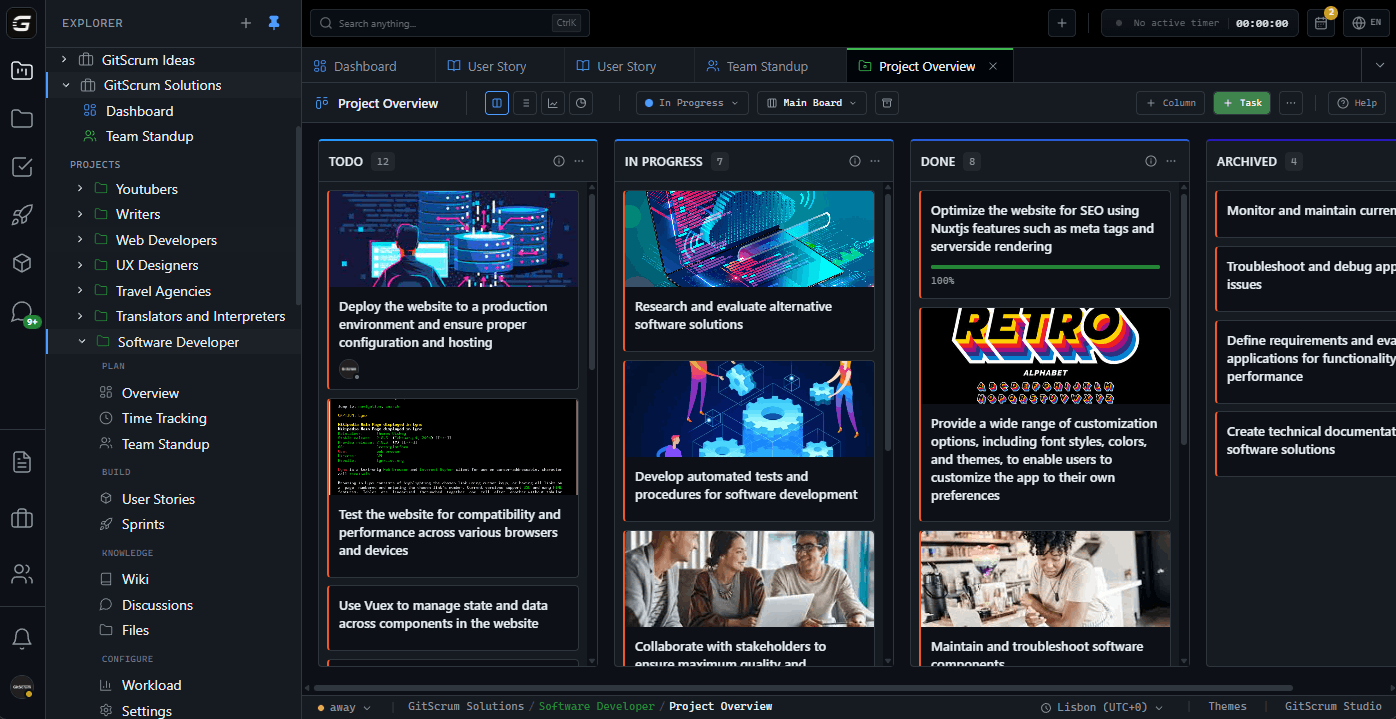
No need to switch from IDE to a separate PM tool—your code actions flow into project management. Unified Platform: Boards, sprints, time tracking, documentation all in one place.

Update a task, log time, check docs—without platform switching. One tab instead of four.

Keyboard-First Design: Cmd+K command palette for any action. Navigate, update, create—all without reaching for the mouse.

Reduced friction means fewer cognitive interruptions. Quick Capture: Time tracking starts with one click on any card.

No separate app. No context switch.

Track time while staying in project context. Information Density: Dashboards show sprint progress, recent activity, and upcoming tasks in unified views.

Get status without hunting across platforms. $8.90/user/month to dramatically reduce context switching.

2 users free forever to experience the productivity difference.

The GitScrum Advantage

One unified platform to eliminate context switching and recover productive hours.

01

problem.identify()

The Problem

Each context switch costs 23 minutes of focus recovery time

Developers switch between tools 28+ times daily

Flow state becomes impossible with constant tool switching

5+ hours of daily productivity lost to context switching

Code complexity requires deep mental models that switches flush

Teams feel busy but ship less than expected

02

solution.implement()

The Solution

GitHub-native integration keeps PM actions in code workflow

Unified platform eliminates platform-to-platform switching

Keyboard-first design reduces friction and micro-interruptions

One-click time tracking without separate app context switch

Information density shows status without platform hunting

All features in one tab—boards, sprints, time, docs

03

How It Works

1

Connect GitHub

GitScrum integrates natively with GitHub. Your code actions—commits, PRs, branches—automatically update project management. No switching to a separate issue tracker.

2

Work in One Platform

Boards, sprints, time tracking, documentation all accessible from one interface. Update tasks, log time, check docs—without platform switching.

3

Use Keyboard Shortcuts

Cmd+K opens command palette. Navigate, create, update—all without mouse. Reduced friction means fewer cognitive interruptions throughout the day.

4

Stay in Flow

With fewer context switches, developers spend more time in focused work. Teams report 4-6 hours weekly productivity gains from reduced switching.

04

Why GitScrum

GitScrum addresses Context Switching Cost for Developers through Kanban boards with WIP limits, sprint planning, and workflow visualization

Problem resolution based on Kanban Method (David Anderson) for flow optimization and Scrum Guide (Schwaber and Sutherland) for iterative improvement

Capabilities

  • Kanban boards with WIP limits to prevent overload
  • Sprint planning with burndown charts for predictable delivery
  • Workload views for capacity management
  • Wiki for process documentation
  • Discussions for async collaboration
  • Reports for bottleneck identification

Industry Practices

Kanban MethodScrum FrameworkFlow OptimizationContinuous Improvement

Frequently Asked Questions

Still have questions? Contact us at customer.service@gitscrum.com

Is the 23-minute figure real?

Yes. Research by Gloria Mark at UC Irvine found it takes an average of 23 minutes and 15 seconds to return to a task after interruption. Context switches between tools create similar interruption effects.

How does GitScrum specifically reduce context switches?

Three ways: (1) GitHub integration means code actions update PM automatically—no switch to update tasks. (2) All PM features in one platform—no switching between Jira, Confluence, Toggl. (3) Keyboard-first design reduces micro-interruptions throughout the day.

What about communication tools like Slack?

GitScrum integrates with Slack/Discord for notifications. You'll still use communication tools, but PM-related context switches (task updates, time logging, documentation) consolidate into GitScrum.

How quickly do teams see productivity improvements?

Most teams notice reduced frustration within the first week. Measurable productivity gains—more features shipped, less overtime—typically appear within 2-4 weeks as new habits form.

Ready to solve this?

Start free, no credit card required. Cancel anytime.

Works with your favorite tools

Connect GitScrum with the tools your team already uses. Native integrations with Git providers and communication platforms.

GitHubGitHub
GitLabGitLab
BitbucketBitbucket
SlackSlack
Microsoft TeamsTeams
DiscordDiscord
ZapierZapier
PabblyPabbly

Connect with 3,000+ apps via Zapier & Pabbly