VS Code

GitScrum for VS Code, Google Antigravity, Cursor and Windsurf!

GitScrum logo
Solution

Multi-Team Coordination 2026 | Shared Projects, No Chaos

Teams Alpha, Beta, Gamma build separately. Integration week = chaos. Shared boards, cross-team epics, dependency links end isolation. Free trial.

Multi-Team Coordination 2026 | Shared Projects, No Chaos

As projects grow, they involve multiple teams: Team Alpha works on the mobile app, Team Beta on the web dashboard, Team Gamma on the backend APIs.

Each team has their own sprint, their own priorities, their own timeline. But they're all building pieces of the same product—and those pieces need to fit together.

Without coordination, integration week is chaos: the mobile team expected API endpoints that backend didn't prioritize; the web team built features that conflict with mobile's implementation; everyone's code merges with conflicts because no one knew what others were changing. GitScrum provides multi-team coordination without losing team autonomy.

Each team can have their own board, their own sprints, their own velocity. But shared project views show cross-team progress.

Dependencies link work across teams. Integration milestones coordinate releases.

Teams stay autonomous but aligned—building pieces that actually fit together.

The GitScrum Advantage

One unified platform to eliminate context switching and recover productive hours.

01

problem.identify()

The Problem

Multiple teams work on the same project with no visibility into each other's work

Integration week reveals incompatible implementations and missing dependencies

Each team plans in isolation, leading to misaligned priorities and timelines

Cross-team dependencies get missed—Team A waits for Team B's work that isn't prioritized

No shared view of project-level progress across all teams

02

solution.implement()

The Solution

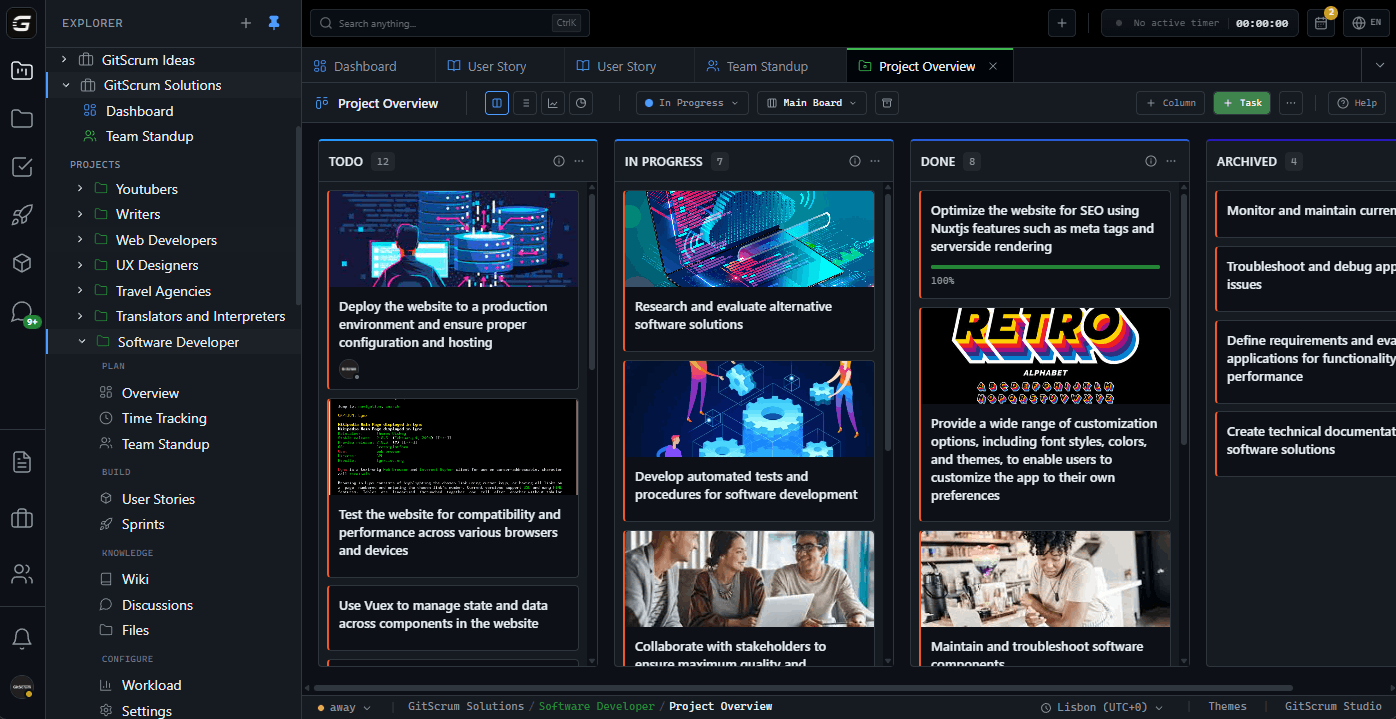
Shared project boards with team filters—see your team's work or everyone's work

Cross-team dependencies explicitly link blocking/blocked work across teams

User Story Epics span multiple teams, showing feature-level progress

Coordinated sprints with visibility into what each team is delivering when

Multi-project dashboards show progress across all teams on shared initiative

03

How It Works

1

Structure Multi-Team Project

Set up a shared project with team labels or assignee filtering. Each team can filter to see their work while maintaining visibility into the whole. Team Alpha filters to see mobile tasks; Team Beta filters to see web; unfiltered shows everything.

2

Create Cross-Team Epics

Use User Story Epics that span multiple teams. The 'User Authentication' epic contains tasks from mobile team, web team, and backend team. Epic progress shows feature-level completion: 'Auth is 60% done—mobile ready, web in progress, backend not started.'

3

Link Cross-Team Dependencies

When Team A's work depends on Team B's delivery, create explicit dependencies. 'Mobile login implementation' depends on 'Backend auth API'. When planning, these dependencies surface during prioritization: 'Can't commit to mobile login if backend API isn't in this sprint.'

4

Coordinate Sprint Boundaries

Align sprint boundaries across teams when integration is needed. If release is at sprint end, all teams should be delivering compatible work. Use sprint planning meetings that include cross-team dependency review: 'What are we expecting from other teams?'

5

Review Cross-Team Progress

Regular cross-team syncs with shared board views. Product owner reviews epic progress across teams. Tech leads review cross-team dependencies and integration points. The shared board is the single source of truth—not team-specific reports that get out of sync.

04

Why GitScrum

GitScrum addresses Coordinating Multiple Development Teams on Shared Projects through Kanban boards with WIP limits, sprint planning, and workflow visualization

Problem resolution based on Kanban Method (David Anderson) for flow optimization and Scrum Guide (Schwaber and Sutherland) for iterative improvement

Capabilities

  • Kanban boards with WIP limits to prevent overload
  • Sprint planning with burndown charts for predictable delivery
  • Workload views for capacity management
  • Wiki for process documentation
  • Discussions for async collaboration
  • Reports for bottleneck identification

Industry Practices

Kanban MethodScrum FrameworkFlow OptimizationContinuous Improvement

Frequently Asked Questions

Still have questions? Contact us at customer.service@gitscrum.com

Should each team have their own board or share one board?

Hybrid approach works best: one shared project with team-based filtering. Each team filters to see their work for daily operations, but the unfiltered view shows everything—essential for cross-team planning and integration. Don't create separate projects unless teams are truly independent; separate projects hide cross-team dependencies.

How do we handle teams with different sprint cadences?

Align integration points even if sprint lengths differ. If Team A has 2-week sprints and Team B has 1-week sprints, coordinate that every 2 weeks they should have compatible deliverables. Use shared milestones for integration dates. The key is explicit coordination at handoff points, not forcing identical processes.

What if teams use different methodologies (Scrum vs Kanban)?

GitScrum supports both. A Scrum team can use sprints while a Kanban team uses continuous flow—both on the same project. The shared board shows all work; the methodology differences are in how each team organizes their portion. Cross-team epics and dependencies work regardless of individual team methodology.

How do cross-team dependencies affect sprint planning?

Include cross-team dependency review in every sprint planning. Before committing to work, check: 'What do we need from other teams? What are other teams expecting from us?' If Team A needs Team B's API, and Team B isn't prioritizing it, that dependency must be resolved before planning is complete. No surprises mid-sprint.

How do we track project-level progress across multiple teams?

Use User Story Epics that span teams. The epic 'Customer Dashboard v2' contains tasks from all teams working on it. Epic completion percentage shows true project progress: 'We're 70% done—mobile complete, web at 80%, backend at 50%.' This is the metric stakeholders need, not individual team velocity.

Ready to solve this?

Start free, no credit card required. Cancel anytime.

Works with your favorite tools

Connect GitScrum with the tools your team already uses. Native integrations with Git providers and communication platforms.

GitHubGitHub
GitLabGitLab
BitbucketBitbucket
SlackSlack
Microsoft TeamsTeams
DiscordDiscord
ZapierZapier
PabblyPabbly

Connect with 3,000+ apps via Zapier & Pabbly