VS Code

GitScrum for VS Code, Google Antigravity, Cursor and Windsurf!

GitScrum logo
Solution

Handover Friction 2026 | 3-Day Work → 9-Day Delivery Ends

Design in Figma, tasks in Jira, code in GitHub. Each handover = context recreation meetings. 3-day implementation, 9-day delivery. Unified platform, no friction. Free trial.

Handover Friction 2026 | 3-Day Work → 9-Day Delivery Ends

Software development is inherently cross-functional.

Designers create mockups and specifications. Product managers define requirements and acceptance criteria.

Developers write code. QA engineers test and validate.

DevOps deploys and monitors. Each function has evolved its own preferred tools—and those tools do not naturally communicate with each other.

When a feature moves from design to development, the designer's context in Figma must be translated into developer tasks in Jira. When development completes, the code context in GitHub must be communicated to QA who works in a testing tool.

When QA finds issues, those must route back to development with proper context linkage. Each of these handovers introduces friction.

The receiving team lacks the context the sending team had. Meetings are scheduled to walk through what should have been obvious from the work artifact itself.

Documentation is written to bridge what the tools cannot connect. Links are shared in Slack because the systems do not link natively.

The friction is not in the work itself—it is in the tool boundaries. A feature that takes three days to implement might take another three days in handover overhead across the delivery pipeline.

Teams develop workarounds—elaborate handover documents, standing sync meetings, dedicated handover roles—all to compensate for tools that do not share context naturally. GitScrum eliminates tool boundaries by unifying project management across the entire delivery lifecycle.

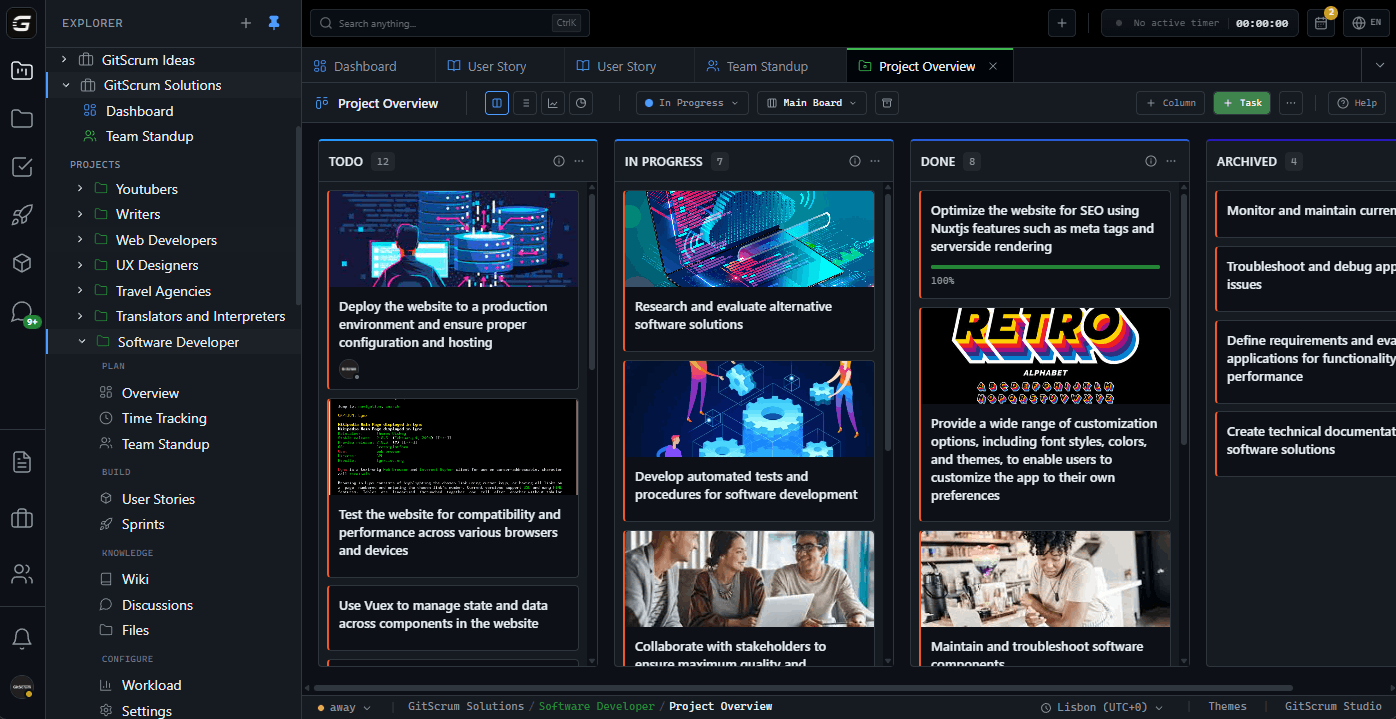
Design specs, tasks, code references, testing, and deployment connect in one platform. Context flows with the work, not across tool boundaries.

The GitScrum Advantage

One unified platform to eliminate context switching and recover productive hours.

01

problem.identify()

The Problem

Work crossing from design to development to QA hits tool boundaries

Each handover requires context recreation and explanation meetings

Receiving teams lack context that sending teams had

Handover friction adds days to every feature cycle

Elaborate workarounds compensate for non-communicating tools

Dedicated handover documentation required to bridge tool gaps

02

solution.implement()

The Solution

Unified platform eliminates tool boundaries

Context flows with work across entire delivery lifecycle

No handover documentation needed between connected phases

Design specs, tasks, code, and testing in one place

Cross-functional collaboration without tool friction

Seamless workflow from concept to deployment

03

How It Works

1

Unified Lifecycle

All phases from design to deployment in single connected platform

2

Context Preservation

Work context carries forward through every phase automatically

3

Cross-Team Visibility

All teams see complete context without tool switching

4

Seamless Handovers

Work transitions between phases without friction or context loss

04

Why GitScrum

GitScrum addresses Cross-Team Handover Friction From Disconnected Project Tools through Kanban boards with WIP limits, sprint planning, and workflow visualization

Problem resolution based on Kanban Method (David Anderson) for flow optimization and Scrum Guide (Schwaber and Sutherland) for iterative improvement

Capabilities

  • Kanban boards with WIP limits to prevent overload
  • Sprint planning with burndown charts for predictable delivery
  • Workload views for capacity management
  • Wiki for process documentation
  • Discussions for async collaboration
  • Reports for bottleneck identification

Industry Practices

Kanban MethodScrum FrameworkFlow OptimizationContinuous Improvement

Frequently Asked Questions

Still have questions? Contact us at customer.service@gitscrum.com

Why do cross-team handovers create so much friction?

Each team optimized for their function by selecting specialized tools—designers chose Figma, developers chose Jira, QA chose TestRail. But these tools were not designed to communicate with each other. When work crosses team boundaries, it also crosses tool boundaries. The context that was obvious in one tool must be recreated or explained for the next tool. This translation overhead accumulates at every handover point in the delivery pipeline.

How much time does handover friction typically waste?

Studies show that handover friction can double or triple the total cycle time for features. A three-day implementation becomes a nine-day delivery when you include handover meetings, documentation, context recreation, and back-and-forth clarifications. Teams often do not measure this waste because it is distributed across the pipeline and normalized as 'just how things work.'

How does a unified platform eliminate handover friction?

When all phases of work live in one platform, there are no tool boundaries to cross. Design specifications connect directly to development tasks. Development tasks link to testing requirements. Testing results reference the original requirements and design. Context flows with the work rather than requiring translation at each boundary. Handovers become status changes rather than information transfer exercises.

Ready to solve this?

Start free, no credit card required. Cancel anytime.

Works with your favorite tools

Connect GitScrum with the tools your team already uses. Native integrations with Git providers and communication platforms.

GitHubGitHub
GitLabGitLab
BitbucketBitbucket
SlackSlack
Microsoft TeamsTeams
DiscordDiscord
ZapierZapier
PabblyPabbly

Connect with 3,000+ apps via Zapier & Pabbly