VS Code

GitScrum for VS Code, Google Antigravity, Cursor and Windsurf!

GitScrum logo
Solution

Backend Fragmentation Errors 2026 | 3 Systems, 3 Answers

Portal says processing, support sees shipped, tracker shows nothing. Silent sync failures erode customer trust. One data source ends 3-system contradictions. Free trial.

Backend Fragmentation Errors 2026 | 3 Systems, 3 Answers

Customer-facing errors from backend tool fragmentation represent the most visible and damaging consequence of internal system complexity.

When internal operations run across disconnected tools, synchronization failures eventually manifest as inconsistent information presented to customers. Order status may differ between the customer portal, support tools, and fulfillment systems.

Service availability may show differently in booking systems than in actual capacity management. Project timelines communicated to clients may not match internal project tracking.

These inconsistencies erode customer trust because they reveal internal disorganization. Customers do not care about integration complexity or synchronization challenges—they expect consistent, accurate information regardless of how the company manages operations internally.

When customers receive conflicting information from different touchpoints, they lose confidence in the company's ability to deliver on its promises. The damage extends beyond individual interactions.

Customers share negative experiences, creating reputational impact. Support costs increase as representatives spend time investigating discrepancies rather than solving problems.

Employee morale suffers when they cannot provide accurate information to customers. A unified platform prevents these customer-facing errors by ensuring that all customer touchpoints—portals, support tools, communication systems—draw from the same data source.

There are no synchronization delays or failures to create inconsistencies. The customer experience reflects a well-organized operation because the operation truly is well-organized.

The GitScrum Advantage

One unified platform to eliminate context switching and recover productive hours.

01

problem.identify()

The Problem

Customers receive conflicting information from different touchpoints

Silent integration failures create data inconsistencies

Support representatives cannot provide accurate status updates

Customer portals show different data than internal systems

Trust erodes when internal complexity becomes visible to customers

Negative experiences spread through customer reviews and referrals

02

solution.implement()

The Solution

Single data source ensures consistent customer information

No integration failures to create discrepancies

Support sees same data as customer-facing portals

Customer experience reflects organized operations

Trust maintained through consistent communication

Professional image preserved across all touchpoints

03

How It Works

1

Unified Data Source

All customer-relevant data stored in single integrated platform

2

Consistent Touchpoints

Customer portals, support tools, and internal systems share same data

3

Real-Time Accuracy

No synchronization delays mean always-current information

4

Trust Preservation

Customers receive consistent information building confidence

04

Why GitScrum

GitScrum addresses Customer-Facing Errors From Backend Tool Fragmentation through Kanban boards with WIP limits, sprint planning, and workflow visualization

Problem resolution based on Kanban Method (David Anderson) for flow optimization and Scrum Guide (Schwaber and Sutherland) for iterative improvement

Capabilities

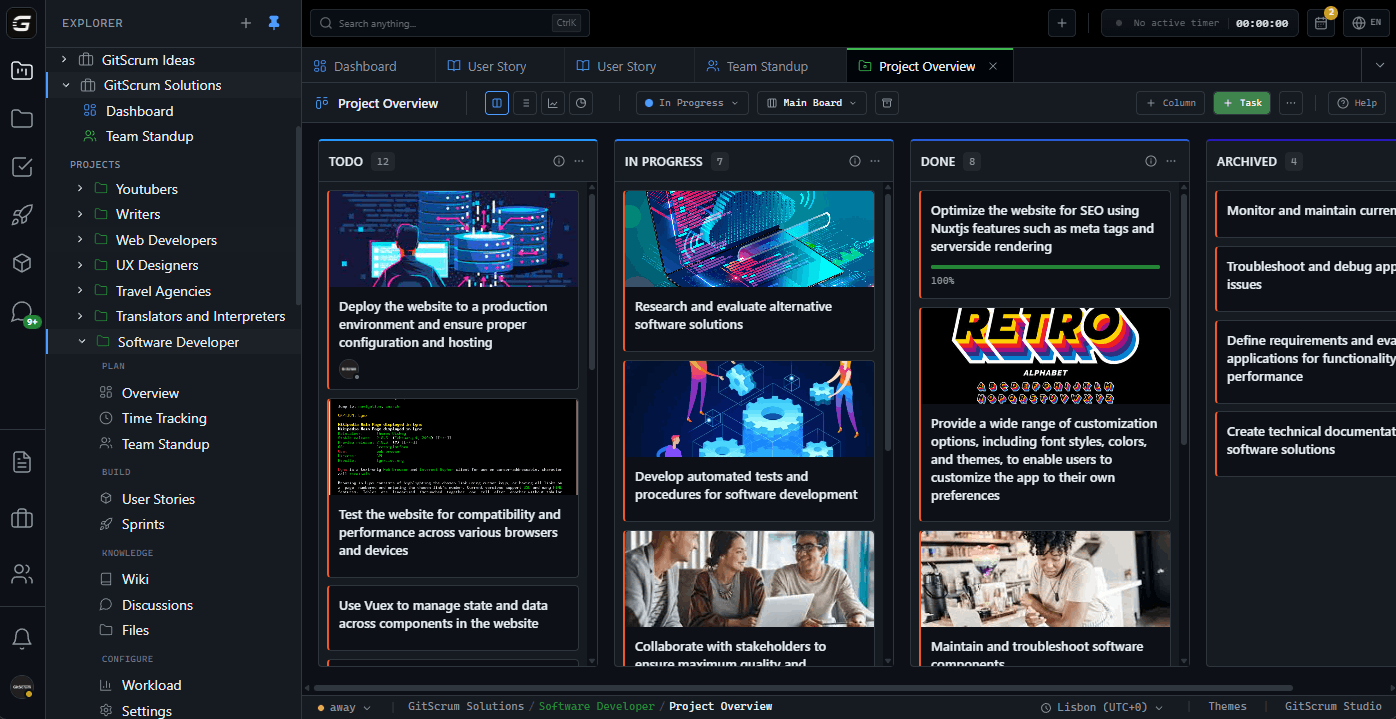
  • Kanban boards with WIP limits to prevent overload
  • Sprint planning with burndown charts for predictable delivery
  • Workload views for capacity management
  • Wiki for process documentation
  • Discussions for async collaboration
  • Reports for bottleneck identification

Industry Practices

Kanban MethodScrum FrameworkFlow OptimizationContinuous Improvement

Frequently Asked Questions

Still have questions? Contact us at customer.service@gitscrum.com

How does backend fragmentation create customer-facing errors?

Backend fragmentation creates customer-facing errors when different systems that should show the same information diverge due to synchronization failures, timing issues, or data inconsistencies. A customer portal may pull data from one system while support tools access another, and if these systems are not perfectly synchronized, customers receive different answers depending on how they ask. These inconsistencies often develop silently—integrations fail without alerting anyone, synchronization processes fall behind during peak times, or edge cases are handled differently across systems. The errors only become visible when customers notice discrepancies, at which point trust has already been damaged and support must spend time investigating rather than helping.

What is the business impact of customer-facing data inconsistencies?

The business impact extends far beyond individual unhappy customers. Customer trust, once damaged, is difficult to rebuild. Customers who experience data inconsistencies question the company's competence in all areas, not just the specific instance they encountered. They share negative experiences through reviews and word-of-mouth, affecting acquisition costs and conversion rates. Support costs increase as representatives spend time investigating discrepancies rather than solving problems. Employee morale suffers when staff cannot provide accurate information and must deal with frustrated customers. In service businesses, data inconsistencies can create contractual issues if promised deliverables do not match tracked work. The cumulative effect on revenue, reputation, and operations can be substantial.

How does a unified platform prevent customer-facing errors?

A unified platform prevents customer-facing errors by eliminating the root cause: multiple disconnected systems containing the same information. When customer portals, support tools, and internal tracking all draw from the same integrated platform, there are no synchronization failures to create discrepancies. The information is inherently consistent because it exists in only one place. Customer-facing displays show the same data that internal teams see, which reflects the actual state of operations. There are no integration points that can fail silently, no timing issues between systems, and no edge cases handled differently across platforms. The customer experience accurately reflects a well-organized operation because the underlying data architecture ensures consistency by design.

Ready to solve this?

Start free, no credit card required. Cancel anytime.

Works with your favorite tools

Connect GitScrum with the tools your team already uses. Native integrations with Git providers and communication platforms.

GitHubGitHub
GitLabGitLab
BitbucketBitbucket
SlackSlack
Microsoft TeamsTeams
DiscordDiscord
ZapierZapier
PabblyPabbly

Connect with 3,000+ apps via Zapier & Pabbly