VS Code

GitScrum for VS Code, Google Antigravity, Cursor and Windsurf!

GitScrum logo
Solution

Department Goal Conflicts 2026 | Invisible Until Blown

Eng wants stability. Sales promised features. Marketing planned launch. Conflict invisible in silos—someone loses when it surfaces. Unified visibility prevents. Free trial.

Department Goal Conflicts 2026 | Invisible Until Blown

When departments set goals independently using different tools, goal conflicts remain invisible until they cause problems.

Each department operates in its own system—Engineering in Jira, Sales in Salesforce, Marketing in Monday.com, Customer Success in Zendesk. Goals defined in these siloed systems cannot be compared or reconciled.

The typical scenario unfolds like this: Engineering commits to reducing system downtime by 50% and paying down technical debt. This requires focused time on infrastructure and refactoring.

But Sales committed to customers that five new features would ship this quarter, deals signed on those promises. Marketing planned a product launch campaign around a feature that Engineering has not prioritized.

Customer Success escalated critical bugs affecting renewal-risk accounts, expecting immediate fixes. Each of these goals made sense when set within its department.

Sales needed features to hit quota. Marketing needed launch material.

Customer Success needed bug fixes to retain accounts. Engineering needed stability to prevent outages.

But collectively, they are impossible. There is not enough engineering capacity to do all of this work simultaneously.

Without visibility across department goals, this conflict stays hidden until execution time. Then teams discover they are being pulled in incompatible directions.

Emergency meetings happen. Escalations go to leadership.

Someone's goals get deprioritized, creating frustration and damaging relationships. A unified platform prevents this by making all department goals visible in one place.

Before conflicts become execution problems, they appear as planning conflicts. Leadership can see that Engineering capacity is overcommitted and facilitate prioritization before teams start conflicting work.

Cross-department resource allocation becomes data-driven rather than political.

The GitScrum Advantage

One unified platform to eliminate context switching and recover productive hours.

01

problem.identify()

The Problem

Departments set goals in isolation using separate tools

Goal conflicts invisible until execution phase

Resources pulled in incompatible directions

Emergency reprioritization damages relationships

No visibility into cross-department resource demands

Planning happens without capacity awareness

02

solution.implement()

The Solution

All department goals visible in unified platform

Conflicts identified at planning stage

Resource demands aggregated across groups

Capacity constraints visible before commitment

Prioritization happens with full visibility

Cross-department alignment through shared data

03

How It Works

1

Unified Goal Setting

All departments define goals in same platform

2

Resource Visibility

See total demand on shared resources across departments

3

Conflict Detection

System highlights incompatible or competing goals

4

Aligned Execution

Teams work on coordinated priorities with full context

04

Why GitScrum

GitScrum addresses Department Goals Conflicting Because No Unified Visibility Across Groups through Kanban boards with WIP limits, sprint planning, and workflow visualization

Problem resolution based on Kanban Method (David Anderson) for flow optimization and Scrum Guide (Schwaber and Sutherland) for iterative improvement

Capabilities

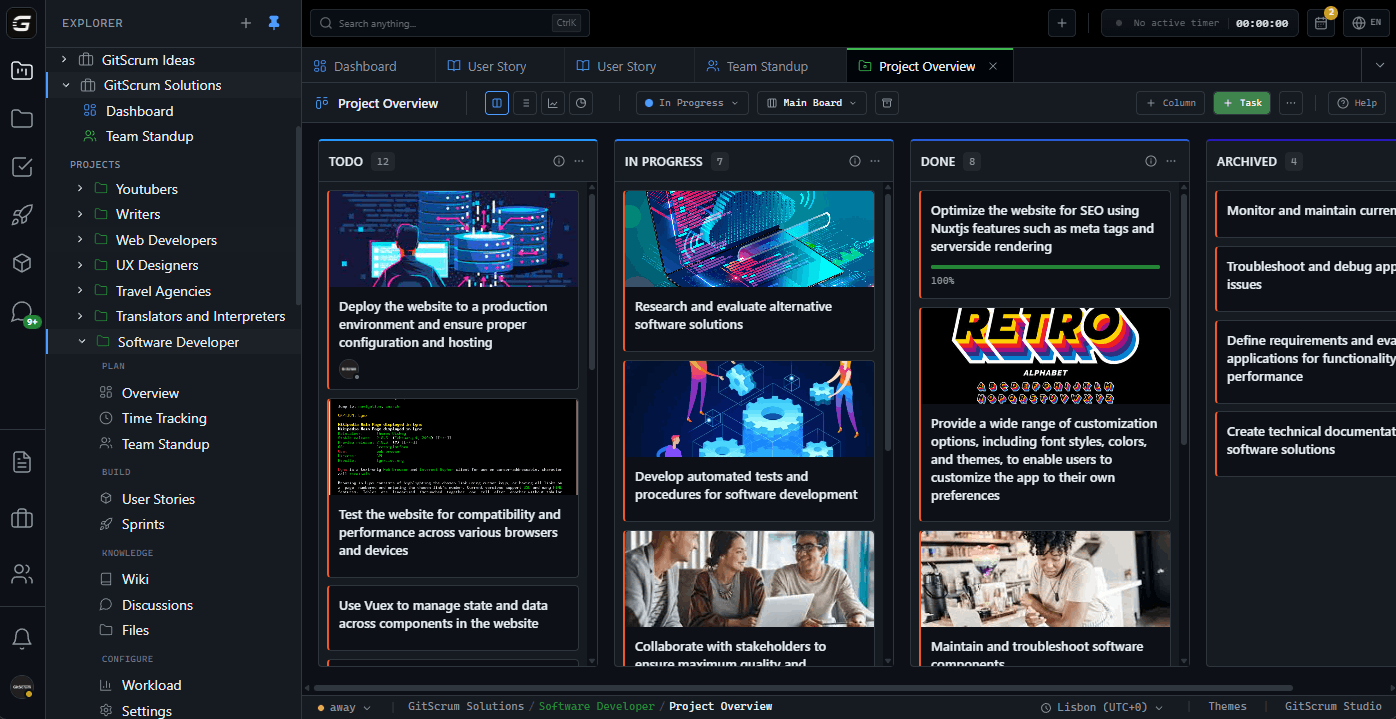
  • Kanban boards with WIP limits to prevent overload
  • Sprint planning with burndown charts for predictable delivery
  • Workload views for capacity management
  • Wiki for process documentation
  • Discussions for async collaboration
  • Reports for bottleneck identification

Industry Practices

Kanban MethodScrum FrameworkFlow OptimizationContinuous Improvement

Frequently Asked Questions

Still have questions? Contact us at customer.service@gitscrum.com

Why do departments set conflicting goals?

Each department optimizes for its own objectives without visibility into other departments' plans. Sales optimizes for revenue, so they promise features. Engineering optimizes for quality, so they want to reduce technical debt. Marketing optimizes for launches, so they plan campaigns. Customer Success optimizes for retention, so they prioritize bug fixes. Each goal makes sense in isolation. The conflict only becomes apparent when these goals compete for the same limited resources, typically engineering capacity.

How much time is lost to goal conflict resolution?

Organizations typically lose 5-10% of execution capacity to conflict resolution activities—emergency meetings, escalations, renegotiations, and context switching when priorities change mid-sprint. Beyond time, there is significant relationship damage. When someone's committed goals get deprioritized, trust erodes between departments. This political friction can persist long after the specific conflict is resolved.

Can conflicts be completely eliminated with unified visibility?

Conflicts cannot be eliminated—resources are always limited relative to ambitions. But unified visibility transforms when and how conflicts are resolved. Instead of discovering conflicts during execution, they surface during planning when they are cheaper to address. Instead of political battles between departments, conflicts become data discussions about capacity and priority. Leadership can make informed trade-offs before anyone commits to impossible goals.

Ready to solve this?

Start free, no credit card required. Cancel anytime.

Works with your favorite tools

Connect GitScrum with the tools your team already uses. Native integrations with Git providers and communication platforms.

GitHubGitHub
GitLabGitLab
BitbucketBitbucket
SlackSlack
Microsoft TeamsTeams
DiscordDiscord
ZapierZapier
PabblyPabbly

Connect with 3,000+ apps via Zapier & Pabbly