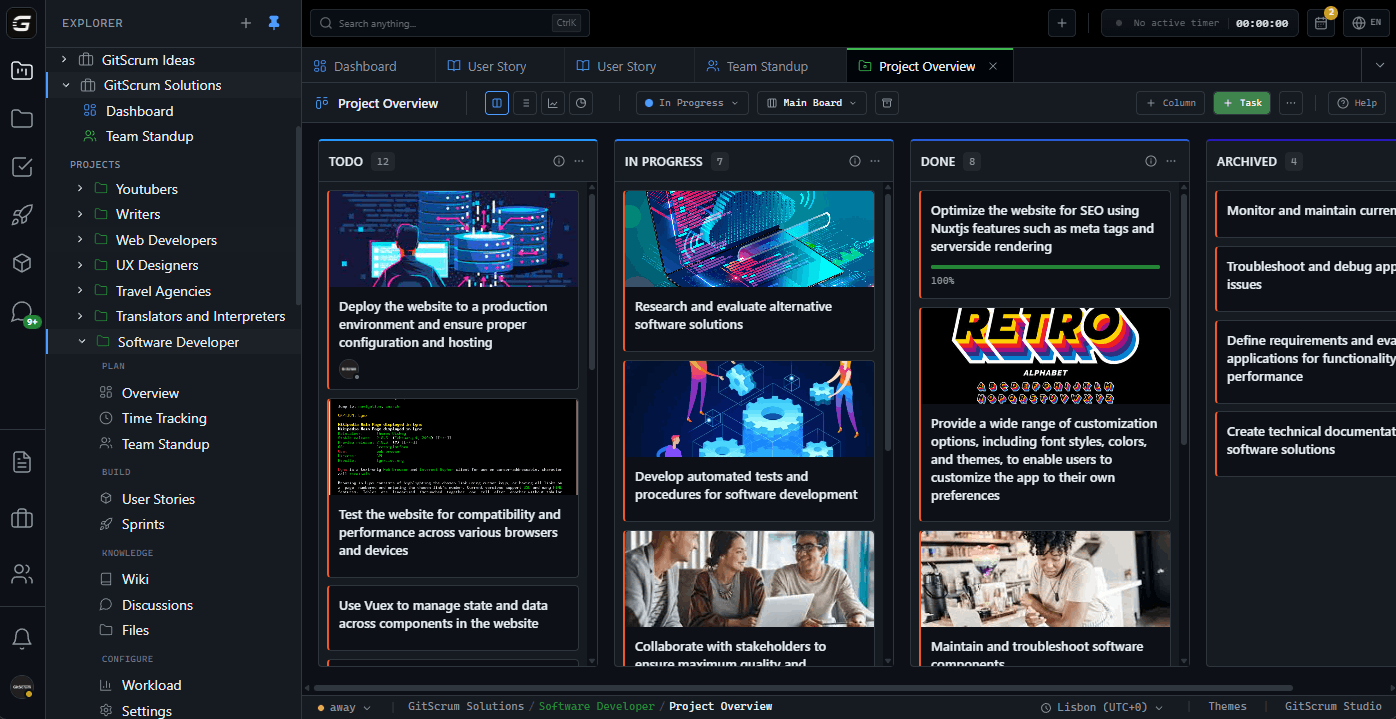
VS Code

GitScrum for VS Code, Google Antigravity, Cursor and Windsurf!

GitScrum logo
Solution

Orphan Dependencies 2026 | 80% Done 3 Weeks Blocked

Feature 80% done, needs API from Team B. 'On backlog'—47 items, priority unknown. 3 weeks blocked. Dependencies need owners and visibility. Free trial.

Orphan Dependencies 2026 | 80% Done 3 Weeks Blocked

You've been making great progress on the feature.

Authentication: done. UI: done.

Business logic: done. You're feeling good—just need to connect to the inventory API and you're finished.

You ping Team B, who owns the inventory service. They respond after a day: 'That endpoint isn't built yet.

We have it on our backlog.' You ask when it might be ready. 'Hard to say—we have a lot of priorities right now.' You escalate to your manager.

Your manager talks to Team B's manager. Team B's manager says they'll 'try to fit it in.' A week passes.

The endpoint still doesn't exist. Your feature is technically 'almost done' but has been sitting blocked.

You've started other work but your brain is still half-thinking about the blocked feature. Standup becomes awkward: 'Still blocked on Team B.' After two weeks, you get a Slack message: 'We started on the endpoint.' Another week for them to build and test it.

Three weeks of blocked time because a dependency had no owner and no priority.

The GitScrum Advantage

One unified platform to eliminate context switching and recover productive hours.

01

problem.identify()

The Problem

Dependencies identified too late in development

No clear ownership of cross-team dependencies

Blocked work sits in limbo for weeks

Priority of dependencies unclear to providing team

Escalation is the only path to resolution

02

solution.implement()

The Solution

Dependencies declared and visible at planning time

Clear ownership assigned to both sides of dependency

Automatic alerts when dependencies aren't progressing

Priority context flows between teams

Blocked work is visible at organizational level

03

How It Works

1

Early Dependency Declaration

When you create work in GitScrum, you declare dependencies upfront: 'This feature requires inventory-api-endpoint from Team B.' The dependency is visible from day one, not discovered at 80% completion.

2

Dual Ownership

The dependency isn't just on your board—it appears on Team B's board too, linked. They see that their work is blocking your high-priority feature. The priority context transfers automatically.

3

Progress Monitoring

GitScrum monitors the dependency. If it's been 'to do' for a week while your work is blocked, alerts surface: 'Dependency blocking customer-feature has not progressed in 7 days.' Visibility creates urgency.

4

Organizational Visibility

Leaders can see all cross-team dependencies and which ones are blocking high-priority work. Resource allocation decisions can factor in dependency bottlenecks, not just team capacity.

04

Why GitScrum

GitScrum addresses Dependencies Blocking Work Nobody Owns through Kanban boards with WIP limits, sprint planning, and workflow visualization

Problem resolution based on Kanban Method (David Anderson) for flow optimization and Scrum Guide (Schwaber and Sutherland) for iterative improvement

Capabilities

  • Kanban boards with WIP limits to prevent overload
  • Sprint planning with burndown charts for predictable delivery
  • Workload views for capacity management
  • Wiki for process documentation
  • Discussions for async collaboration
  • Reports for bottleneck identification

Industry Practices

Kanban MethodScrum FrameworkFlow OptimizationContinuous Improvement

Frequently Asked Questions

Still have questions? Contact us at customer.service@gitscrum.com

What if Team B legitimately can't prioritize our dependency?

GitScrum makes the tradeoff visible. If Team B can't prioritize your dependency, you know immediately and can plan alternatives: different architecture, temporary workaround, or executive escalation. The visibility enables decision-making.

How do we avoid teams gaming the system by marking everything as dependencies?

Dependencies require acceptance by the providing team. Team B has to acknowledge the dependency on their side. This creates natural friction against frivolous dependency declarations.

What about dependencies outside our organization (third-party APIs, vendors)?

External dependencies can be tracked too—they just don't have an accepting team. You can track progress, blockers, and timelines even for external dependencies.

How does this work with teams using different tools?

GitScrum can integrate with other tools for dependency visibility. Alternatively, the dependency can be managed as an external dependency with manual status updates from the team using different tools.

Ready to solve this?

Start free, no credit card required. Cancel anytime.

Works with your favorite tools

Connect GitScrum with the tools your team already uses. Native integrations with Git providers and communication platforms.

GitHubGitHub
GitLabGitLab
BitbucketBitbucket
SlackSlack
Microsoft TeamsTeams
DiscordDiscord
ZapierZapier
PabblyPabbly

Connect with 3,000+ apps via Zapier & Pabbly