
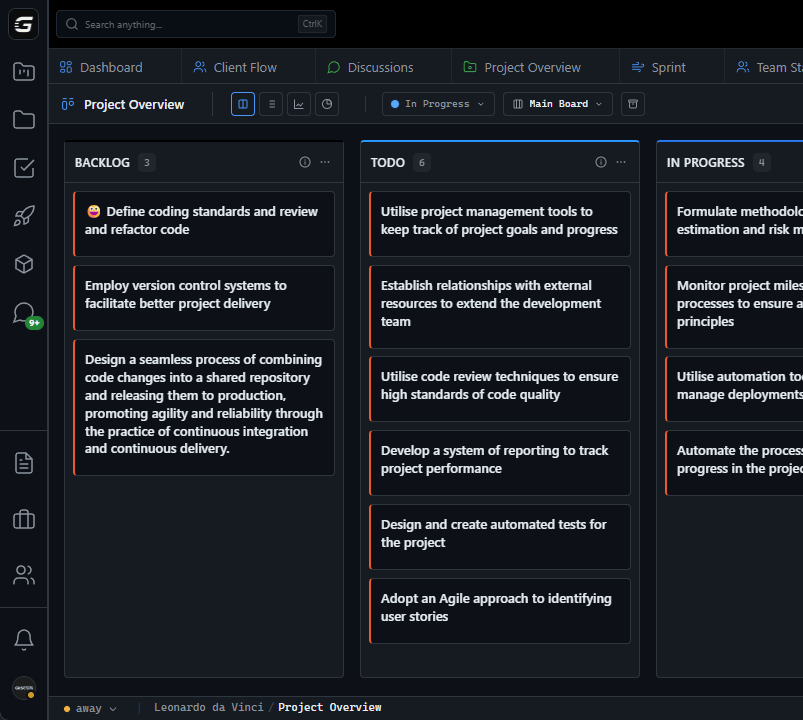








The work lives in one tool, the context in another, and the decisions in a chat that scrolls away Every week the team spends more hours finding things than doing them The status of the day is a rumor until someone rebuilds it in a meeting GitScrum answers: One shared board holds the work, NoteVault holds the context, and standups show who is moving and who is stuck Agents read the same surfaces and log their own work through one MCP link The hub replaces the scatter: work, context, client and time in one place GitScrum’s free plan already includes boards, NoteVault, Wiki, Client Flow, monitoring and agent access through one MCP link.
Pro — Git integrations and API & webhooks — starts at $106.80/year at launch, 87% off the $854.40 list price.
The GitScrum Advantage
One unified platform to eliminate context switching and recover productive hours.