The Developer Productivity Crisis Research shows: - Average developer: 2-4 hours of actual coding per day - Rest: meetings, context switching, tool friction, interruptions - One interruption: 23 minutes to return to flow state - Developers interrupted: Every 3-5 minutes on average The math: - 4 interruptions per hour - 4 x 23 = 92 minutes lost per hour - That's impossible, which means: never reaching flow state Productivity isn't about speed.
It's about protecting focus time. Flow State Economics Flow state characteristics: - Deep concentration - High-quality output - Time feels different - Problem-solving mode - Creative connections Flow state requirements: - 15-20 minutes to enter - Zero interruptions - Low cognitive overhead - Clear current task - No decision fatigue Every tool interaction: - Is it interrupting or enabling?
- Does it require context switch? - Does it add cognitive load?
GitScrum: Designed to enable flow, not interrupt it. The Tool Tax Every tool interaction costs: Slow load time: - Wait for page - Context broken - Focus fragments Required fields: - Think about metadata - Not about code - Cognitive load up Mouse navigation: - Hand leaves keyboard - Eyes leave code - Flow interrupted Notification noise: - Every update alerts - Attention fragmented - Deep work impossible Total tax: Hours per week lost to tool friction.
GitScrum tax: Near zero. Built for speed.
Minimal Interaction Design Create task: - Cmd+K - Type title - Enter - Done (2 seconds) Find task: - Cmd+K - Type search - Enter - Found (2 seconds) Update status: - M (move) - Select column - Done (1 second) Add comment: - C - Type - Enter - Done (3 seconds) No: - Page loads - Form navigations - Required fields - Confirmation dialogs Speed is productivity. Maker Schedule vs Manager Schedule Manager schedule: - Hour blocks - Meetings okay - Context switching expected Maker schedule: - Half-day blocks - Meetings are expensive - Context switching kills output Most tools built for managers: - Meeting scheduling features - Real-time collaboration - Constant notifications GitScrum built for makers: - Async-first communication - Batch notifications - Long focus periods protected Cognitive Load Reduction Every decision depletes energy: - What to work on?
(Decision) - Where to find info? (Decision) - How to track?
(Decision) - What fields to fill? (Decision) - Who to notify?
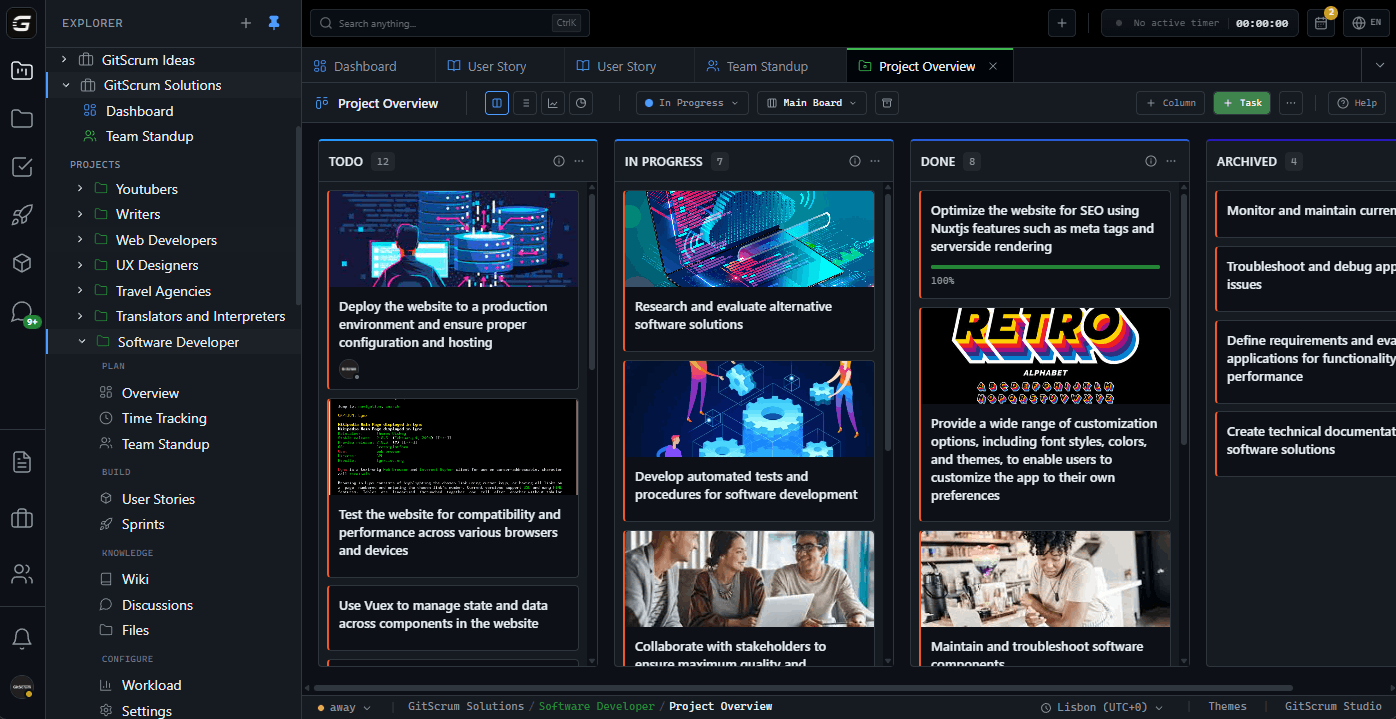
(Decision) Decision fatigue = reduced productivity. GitScrum approach: - Clear priority visible - One source of truth - Minimal required input - Smart defaults - Automated notifications Save decisions for code, not tools.
Context Preservation Mid-task interruption: - Phone rings - Meeting starts - Urgent bug appears Without context preservation: - Come back: 'Where was I?' - Re-read code - Re-understand problem - Re-enter flow state - 30+ minutes lost With GitScrum: - Task notes capture thinking - Git branch shows last state - Quick return to context - Minimal re-entry time Context saved = time saved. Time Blocking Integration Productive developer day: 9:00-12:00: Deep work block - No meetings - No Slack - One major task 12:00-13:00: Shallow work - Code reviews - Quick tasks - Communication 14:00-17:00: Deep work block - No meetings - No Slack - Major task continued GitScrum supports this: - Batch review tasks - Plan day's focus - Track time per task - No interrupting notifications Built-in Time Tracking Why time tracking matters for productivity: - See where time goes - Identify time sinks - Improve estimates - Protect focus time GitScrum time tracking: - One-click start/stop - Per-task granularity - No separate tool - Reports for analysis Know your time.
Improve your productivity. Notification Philosophy Most tools: Notify everything - Every comment - Every status change - Every commit - Every update GitScrum: Notify what matters - Assigned to you - Mentioned directly - Blocker resolved - PR needs review Batch optional: - Daily digest - Weekly summary - Check when ready Your focus, protected.
Keyboard Productivity Typing speed: 60+ WPM Mouse navigation: Interrupts flow Keyboard-first means: - Hands stay positioned - Eyes stay on work - Flow unbroken - Speed maintained GitScrum shortcuts: - Cmd+K: Global command - J/K: Navigate - E: Edit - M: Move - C: Comment - 1-5: Priority No mouse required. Flow preserved.
Metrics That Matter Vanity metrics (avoid): - Tasks created - Comments added - Time in tool Productivity metrics (track): - Tasks completed - Cycle time - Blocked time - Focus time ratio GitScrum provides: - Completion rates - Time tracking data - Blocked item visibility - Throughput trends Measure output, not activity. Team Productivity Individual productivity multiplied: - Everyone has focus time - Async communication default - Blockers visible fast - Information findable Team coordination: - Who's working on what - What's blocked - What's shipping soon - No status meetings needed GitScrum board = team status.
Dark Mode for Extended Sessions Long coding sessions: - Eye strain accumulates - Bright screens fatigue - Productivity drops Dark interface: - Reduced eye strain - Extended comfortable work - Matches IDE environment - Productivity sustained Dark mode isn't preference. It's productivity protection.
Pricing That Doesn't Tax Productivity 2 users FREE forever: - All features - No limits - No friction - Start immediately $8.90/user/month for teams: - Still affordable - No procurement process - No enterprise sales call - Just start working Tool decision overhead: Zero. Why Productive Developers Choose GitScrum Time savings: - Fast interface (2-second interactions) - Keyboard-first (no mouse breaks) - Minimal fields (no metadata overhead) - Smart notifications (no interruption flood) Focus protection: - Async-first design - Batch updates - Clear priorities - Context preservation Result: - More coding time - Better focus - Higher output - Sustainable pace Productivity isn't working harder.
It's removing friction.
The GitScrum Advantage
One unified platform to eliminate context switching and recover productive hours.