VS Code

GitScrum for VS Code, Google Antigravity, Cursor and Windsurf!

GitScrum logo
Solution

Dev Overallocation 2026 | 40 Hrs to 12 Hrs Coding

40 hrs/week calendar: 15 hrs meetings, 8 hrs Slack/email, 5 hrs context switching = 12 hrs actual coding. Everyone thinks they have 100% of dev time. Nobody does. GitScrum shows real capacity, not fantasy allocation. Free trial.

Dev Overallocation 2026 | 40 Hrs to 12 Hrs Coding

The resource allocation spreadsheet says each developer has capacity for 40 hours per week.

The reality: meetings consume 15 hours. Slack and email consume 8 hours.

Context switching between projects consumes 5 hours of overhead. That leaves maybe 12 hours of actual coding time.

But the allocation spreadsheet doesn't know about meetings, communication overhead, or context switching. It just shows 40 hours available, so it assigns 40 hours of project work.

Then everyone wonders why nothing ships on time. The problem is compounded by shared resources.

The senior developer who knows the legacy system is on three projects because she's the only one who can help. The DevOps engineer is allocated to five teams because 'it's just infrastructure stuff, doesn't take much time.' The tech lead is expected to code, mentor, review, meet, and plan—all simultaneously.

Nobody has a clear picture of where their time actually goes. Leadership sees green allocation numbers while developers drown.

When everything is a priority, nothing is. When everyone is overallocated, everything takes longer.

The GitScrum Advantage

One unified platform to eliminate context switching and recover productive hours.

01

problem.identify()

The Problem

Developers assigned to multiple projects simultaneously

Each project thinks it has 100% of developer time

Meeting and communication overhead not accounted for

Context switching costs invisible in allocation

Everything gets partial attention, nothing gets completed

02

solution.implement()

The Solution

Realistic capacity accounting including overhead

Visible allocation across all projects

Single project focus when possible

Protected time for deep work

Conscious trade-off decisions about priorities

03

How It Works

1

Realistic Capacity Calculation

GitScrum accounts for real capacity, not calendar hours. Meetings, communication, and context switching are factored in. 40 hours on calendar might mean 20 hours of actual project capacity.

2

Cross-Project Allocation Visibility

See where every team member is allocated across all projects. When Sarah is shown at 150% capacity, someone has to make a choice—not pretend the problem doesn't exist.

3

Single Project Focus Periods

Where possible, assign developers to one project at a time for focused periods. Two weeks of dedicated focus beats two months of fragmented attention.

4

Explicit Trade-Off Decisions

When someone must work on multiple projects, the trade-offs are explicit. 'If Sarah spends 20 hours on Project A, Project B slips by X days.' Leadership makes informed choices.

04

Why GitScrum

GitScrum addresses Developers Pulled in Too Many Directions at Once through Kanban boards with WIP limits, sprint planning, and workflow visualization

Problem resolution based on Kanban Method (David Anderson) for flow optimization and Scrum Guide (Schwaber and Sutherland) for iterative improvement

Capabilities

  • Kanban boards with WIP limits to prevent overload
  • Sprint planning with burndown charts for predictable delivery
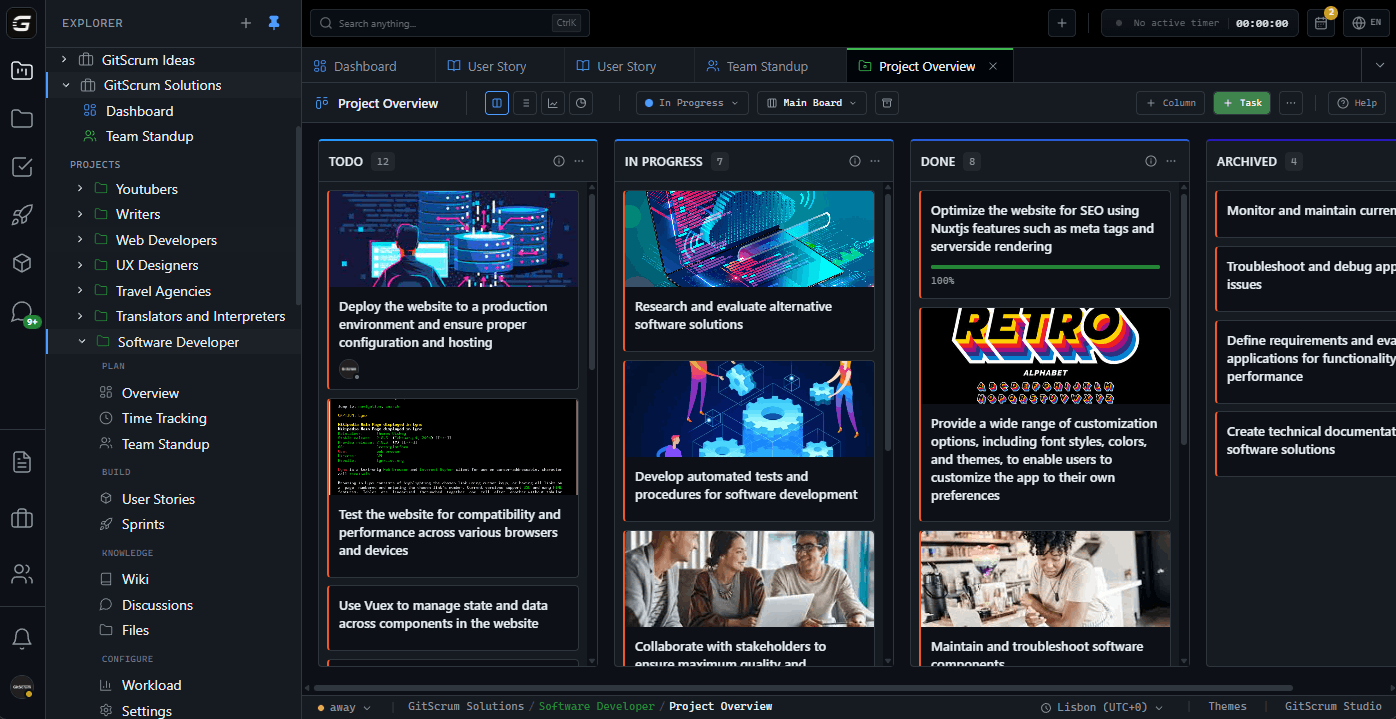
  • Workload views for capacity management
  • Wiki for process documentation
  • Discussions for async collaboration
  • Reports for bottleneck identification

Industry Practices

Kanban MethodScrum FrameworkFlow OptimizationContinuous Improvement

Frequently Asked Questions

Still have questions? Contact us at customer.service@gitscrum.com

What's a realistic capacity calculation?

Start with available hours, subtract regular meetings, estimate communication overhead (typically 20-30%), and factor in context switching costs for multi-project work. Most developers have 50-60% of their time available for focused project work.

Our company requires people to work on multiple projects. What can we do?

If multi-project is unavoidable, minimize context switching. Dedicate certain days to certain projects rather than switching constantly. And be honest about the overhead—don't pretend it doesn't exist.

How do we convince leadership that developers have less capacity than expected?

Track where time actually goes for a few weeks. Show the data: 'Developers spent 35% of their time in meetings, 20% on communication, and 45% on actual project work.' Numbers are more convincing than complaints.

What if we genuinely don't have enough people for the work?

Then make that explicit. 'We have capacity for 2 of these 4 projects this quarter. Which 2?' Overallocating people doesn't create more capacity; it just makes everything slower and worse.

Ready to solve this?

Start free, no credit card required. Cancel anytime.

Works with your favorite tools

Connect GitScrum with the tools your team already uses. Native integrations with Git providers and communication platforms.

GitHubGitHub
GitLabGitLab
BitbucketBitbucket
SlackSlack
Microsoft TeamsTeams
DiscordDiscord
ZapierZapier
PabblyPabbly

Connect with 3,000+ apps via Zapier & Pabbly