GitScrum PRO Annual — 2,500+ SaaS apps via MCP

GitScrum logo
Solution

Dev 9 Tool Switching 2026 | 1200 Switches, 70% Cut

9+ tools daily: Jira, GitHub, Slack, Confluence, email, calendar, Figma, time trackers. 1,200+ app switches/day, 23 min recovery each. GitScrum consolidates PM in one platform. 70% fewer switches. Free trial.

Dev 9 Tool Switching 2026 | 1200 Switches, 70% Cut

The average developer uses 9+ tools daily just to do their job.

Tasks live in Jira. Code reviews happen in GitHub.

Discussions fragment across Slack channels. Documentation hides in Confluence.

Time gets tracked in Harvest. Design feedback lives in Figma.

Each tool demands attention, creates notifications, and requires context switching. Research shows developers make 1,200+ application switches per day—and each switch costs cognitive resources.

The 23-minute recovery time isn't just inconvenient; it's destroying deep work capacity. When you're constantly toggling between tabs, you never achieve flow state.

The mental overhead of remembering 'which tool has this information?' compounds throughout the day. GitScrum addresses this by being a unified hub.

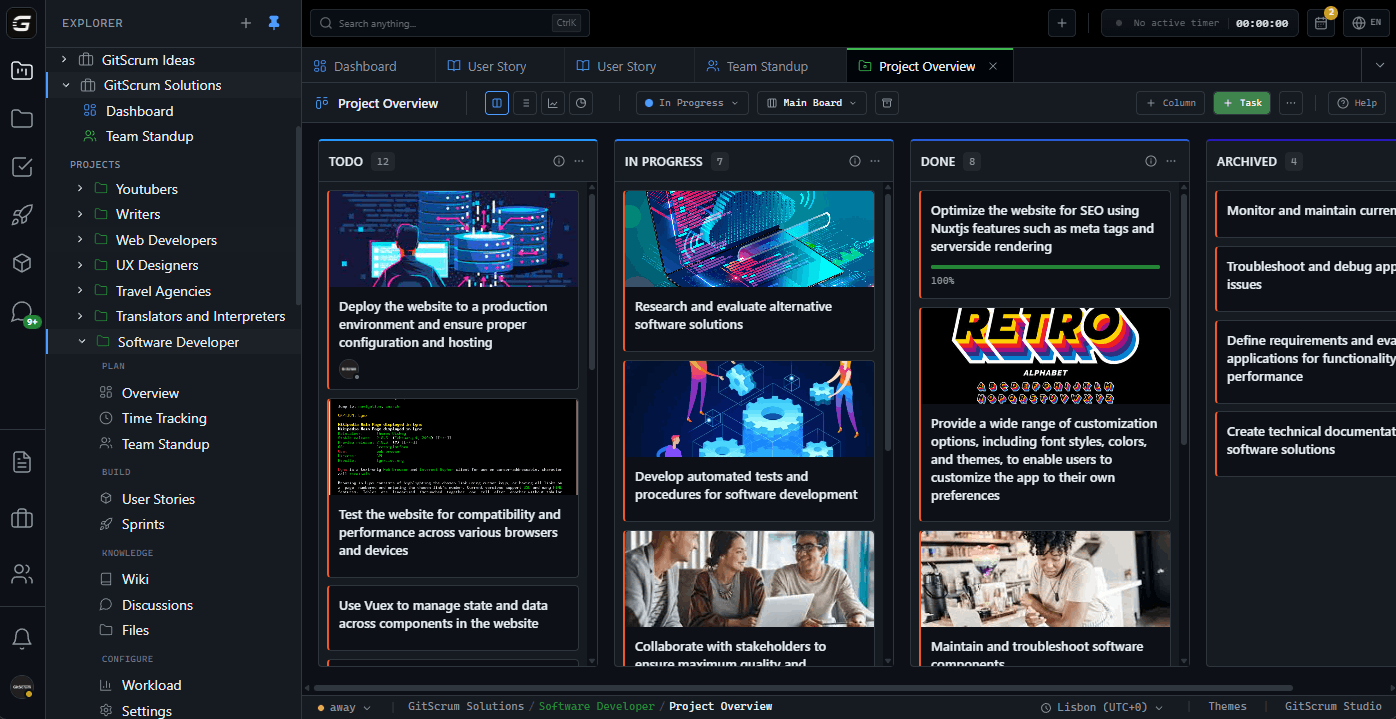
Tasks, sprints, boards—project management lives here. GitHub integration means PRs link automatically to tasks; branch creation happens from task cards.

Discussion Channels replace scattered Slack threads with project-attached conversations. Built-in time tracking eliminates the separate time tracker.

The IDE Sidebar brings tasks directly into VS Code. You don't eliminate all tools—GitHub stays for code, Figma stays for design—but you eliminate the constant switching between project management tools.

The GitScrum Advantage

One unified platform to eliminate context switching and recover productive hours.

01

problem.identify()

The Problem

Developers use 9+ different tools daily—each requiring login, context, and attention

1,200+ application switches per day fragment focus and destroy flow state

23 minutes to regain deep focus after each context switch

Information scattered across Jira, GitHub, Slack, Confluence, and more

Mental overhead of remembering which tool contains which information

02

solution.implement()

The Solution

Unified platform for tasks, sprints, boards, and project management

GitHub integration links PRs and branches directly to tasks—no tab switching

Discussion Channels keep project conversations in context, not scattered in Slack

Built-in time tracking eliminates need for separate time tracking tool

IDE Sidebar brings tasks into VS Code—manage work without leaving editor

03

How It Works

1

Consolidate Project Management

Move tasks, sprints, and backlogs to GitScrum. One platform for all project work instead of juggling Jira, Trello, and spreadsheets. Search finds everything in one place.

2

Connect GitHub Integration

Link repositories to projects. Create branches from task cards with auto-generated naming. PRs automatically link back to tasks. Merge events can auto-update workflow status.

3

Replace Slack Fragmentation

Use Discussion Channels for project conversations. Unlike Slack threads that disappear, discussions stay attached to projects. Searchable, persistent, contextual.

4

Eliminate Time Tracker Switching

Track time directly on tasks with built-in time tracking. No more switching to Harvest or Toggl. Time data lives with the work it's tracking.

5

Work from IDE Sidebar

Install GitScrum's VS Code extension. See assigned tasks, start timers, update status—all without leaving your editor. The context stays where you code.

04

Why GitScrum

GitScrum addresses Developers Switching Between 9 Tools Daily Kills Focus through Kanban boards with WIP limits, sprint planning, and workflow visualization

Problem resolution based on Kanban Method (David Anderson) for flow optimization and Scrum Guide (Schwaber and Sutherland) for iterative improvement

Capabilities

  • Kanban boards with WIP limits to prevent overload
  • Sprint planning with burndown charts for predictable delivery
  • Workload views for capacity management
  • Wiki for process documentation
  • Discussions for async collaboration
  • Reports for bottleneck identification

Industry Practices

Kanban MethodScrum FrameworkFlow OptimizationContinuous Improvement

Frequently Asked Questions

Still have questions? Contact us at customer.service@gitscrum.com

How does GitScrum reduce the 9-tool problem?

GitScrum consolidates project management (replacing Jira), discussions (reducing Slack dependency), time tracking (replacing Harvest/Toggl), and integrates with GitHub so code activity flows into project tracking. You still use GitHub for code and Figma for design, but project management becomes one unified platform instead of 4-5 disconnected tools.

What about specialized tools we can't replace?

GitScrum doesn't aim to replace everything—GitHub stays for code, Figma stays for design, your IDE stays for coding. The goal is consolidating project management tools and reducing the 'which tool has this info?' problem. Integrations bring context from essential tools into one view.

How does the VS Code sidebar help with tool switching?

The IDE Sidebar brings your tasks directly into VS Code. See assigned work, start time tracking, update task status—all without opening a browser tab. Since developers spend most time in their editor, keeping project context there eliminates the most frequent switches.

Can we measure the improvement in focus time?

Yes. Track deep work blocks before and after consolidation. Monitor how many tool switches happen daily. Time tracking data shows whether developers log more uninterrupted coding time. The reduction in 'where is this?' searches is immediately noticeable.

Ready to solve this?

Start free, no credit card required. Cancel anytime.

Works with your favorite tools

Connect GitScrum with the tools your team already uses. Native integrations with Git providers and communication platforms.

GitHubGitHub
GitLabGitLab
BitbucketBitbucket
SlackSlack
Microsoft TeamsTeams
DiscordDiscord
ZapierZapier
PabblyPabbly

Connect with 3,000+ apps via Zapier & Pabbly