The DevOps Visibility Problem DevOps teams do critical work: ├─ Infrastructure provisioning ├─ CI/CD pipeline maintenance ├─ Security patching ├─ Monitoring setup ├─ Disaster recovery ├─ Cost optimization ├─ Compliance automation All invisible in traditional PM tools.
Why DevOps Work Disappears Traditional PM tools track: ├─ Features (user stories) ├─ Bugs (customer visible) ├─ Epics (business value) DevOps reality: ├─ 'Upgrade Kubernetes' - No user story ├─ 'Improve deploy time' - No ticket ├─ 'Security patch' - Emergency ├─ 'Cost optimization' - Background work Result: DevOps team looks 'unproductive' while keeping everything running. Infrastructure-as-Code Tracking Your infra repos: ├─ terraform/ ├─ kubernetes/ ├─ ansible/ ├─ helm-charts/ ├─ ci-cd-configs/ These ARE code.
Commits happen. But PM tools don't track them.
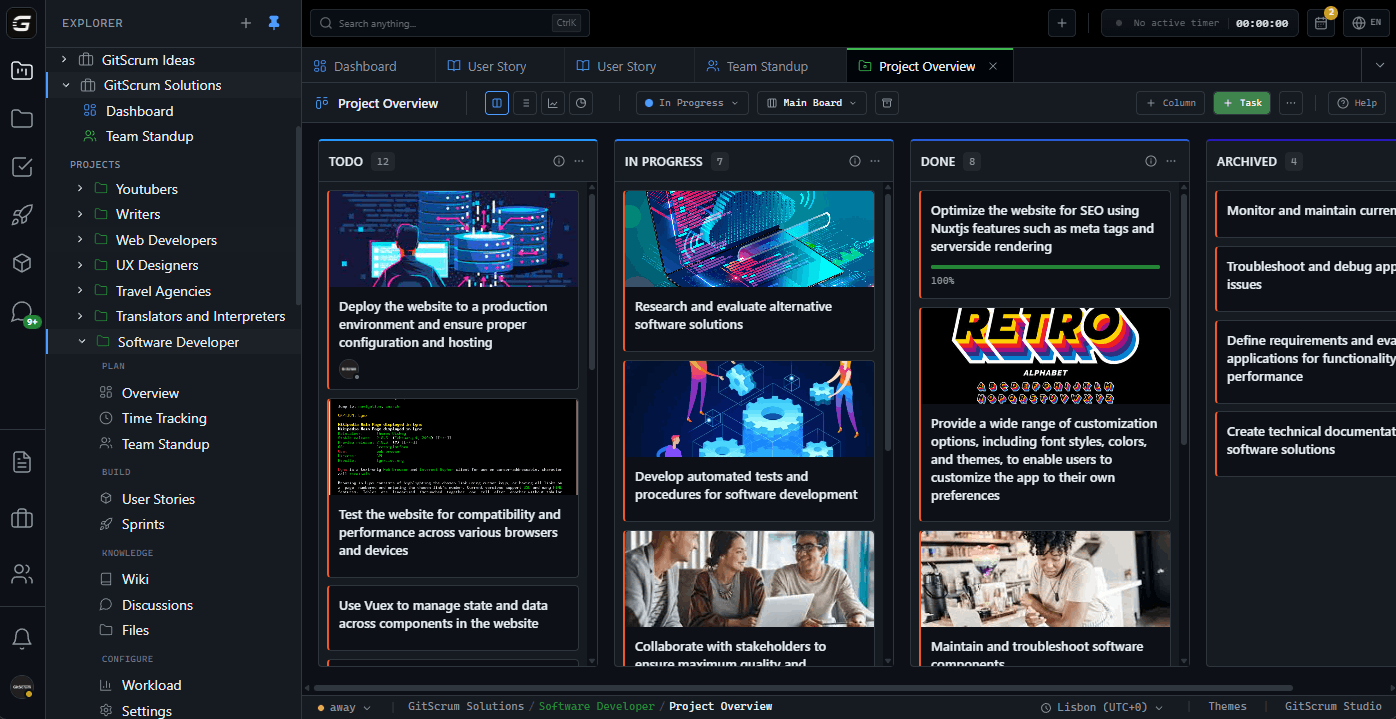
GitScrum approach: ├─ Connect infra repos (same as app repos) ├─ Create tasks: 'Upgrade K8s to 1.28' ├─ Commits to terraform/ → task updates ├─ PR merged → task done ├─ Same visibility as feature work Infrastructure changes become visible work. CI/CD Pipeline as PM Work Pipeline improvements: ├─ Reduce build time (20 min → 5 min) ├─ Add security scanning ├─ Improve test parallelization ├─ Add deployment environments ├─ Fix flaky tests All worth tracking: ├─ Task: 'Reduce build time' ├─ Effort: 2 story points ├─ Commits: GitHub Actions updates ├─ PR: Config changes ├─ Done: Measurable improvement DevOps velocity includes pipeline work.
Incident Response Tracking Incident workflow: ├─ Alert fires ├─ DevOps responds ├─ Root cause found ├─ Fix implemented ├─ Post-mortem documented ├─ Prevention task created GitScrum supports: ├─ Incident task created (urgent) ├─ Fix commits linked ├─ Resolution documented in task ├─ Post-mortem in Wiki ├─ Prevention task in backlog ├─ Time tracked (for analysis) Incidents become data, not just firefighting. Security Work Visibility Security tasks: ├─ Vulnerability scanning setup ├─ Secret rotation ├─ Certificate renewal ├─ Access audit ├─ Compliance reporting ├─ Penetration test remediation All trackable: ├─ Task: 'Implement Trivy scanning' ├─ Commits: Pipeline config changes ├─ Documentation: Wiki article ├─ Recurring: Sprint backlog item Security work counts in velocity.
On-Call and Interrupt Work DevOps reality: ├─ 30% planned work ├─ 40% interrupt-driven ├─ 30% maintenance Traditional sprint planning fails because interrupts destroy velocity predictions. GitScrum approach: ├─ Plan 60% capacity (realistic) ├─ Track interrupts as tasks (visibility) ├─ Measure interrupt ratio (data) ├─ Adjust future sprints (learning) Time tracking captures reality: ├─ 'K8s upgrade' - 4 hours planned ├─ 'Production incident' - 3 hours unplanned ├─ 'Developer question' - 30 min interrupt ├─ Week reality visible Platform Engineering View If you're building internal platform: ├─ Developer experience features ├─ Self-service infrastructure ├─ Internal tooling ├─ Documentation ├─ Onboarding automation GitScrum tracks platform work: ├─ Feature: 'Add database self-service' ├─ Epic: 'Developer onboarding' ├─ Sprint: Platform team cadence ├─ Velocity: Platform delivery speed Platform engineering is product development.
Track it that way. Multi-Environment Workflow Typical DevOps progression: ├─ Dev environment ├─ Staging environment ├─ Production environment ├─ (Maybe: QA, UAT, Preview) GitScrum custom statuses: ├─ Development ├─ In Dev Env ├─ In Staging ├─ In Production ├─ Verified Infrastructure changes track through environments.
Cost Optimization Projects Cloud cost work: ├─ Right-sizing instances ├─ Reserved instance planning ├─ Spot instance implementation ├─ Storage optimization ├─ Network cost reduction Trackable with business value: ├─ Task: 'Implement spot instances for batch' ├─ Estimated savings: $X/month ├─ Commits: Terraform changes ├─ Result: Measurable cost reduction DevOps work has ROI. Show it.
Pricing for DevOps Teams Small DevOps team (3 people): ├─ 2 free + 1 × $8.90 = $8.90/month ├─ All infra repos connected ├─ Full visibility Platform team (8 people): ├─ 2 free + 6 × $8.90 = $53.40/month ├─ Platform + infra work tracked ├─ Time tracking for capacity DevOps org (15 people): ├─ 2 free + 13 × $8.90 = $115.70/month ├─ Multiple teams ├─ Sprint planning across teams Vs enterprise DevOps tools: ├─ ServiceNow: $$$$ (enterprise only) ├─ Jira + plugins: $150+/month ├─ GitScrum: $115.70/month Features DevOps Teams Need | Need | GitScrum | |------------------------|---------------------------| | IaC repo tracking | Full Git integration | | Pipeline work visibility| Same as feature work | | Incident tracking | Task + time tracking | | Multi-env workflow | Custom statuses | | Interrupt tracking | Unplanned task capture | | Velocity measurement | Includes all work types | Real DevOps Experience 'We're a 5-person DevOps team supporting 40 developers. Before GitScrum, leadership thought we just 'kept the lights on.' After tracking our work: 847 Terraform changes, 156 pipeline improvements, 23 security patches in one quarter.
All visible. All measured.
We went from 'cost center' to 'enablement team' in leadership's eyes.' - DevOps Lead Integration with GitOps If you practice GitOps: ├─ Infrastructure defined in Git ├─ Changes via PR ├─ Automated reconciliation ├─ Git is source of truth GitScrum amplifies GitOps: ├─ Git activity already drives GitOps ├─ Same Git activity updates PM ├─ PR approved → task progresses ├─ Merge → deployed (GitOps) ├─ Merge → done (GitScrum) Double benefit from same Git workflow. Pricing Summary 3 DevOps engineers: $8.90/month 8 DevOps engineers: $53.40/month 15 DevOps engineers: $115.70/month 25 DevOps engineers: $204.70/month $8.90/user/month.
2 users free forever. Start Free Today 1.
Sign up (30 seconds) 2. Connect infrastructure repos 3.
Create first infra sprint 4. Make DevOps work visible Infrastructure-as-code deserves infrastructure-as-trackable-work.
The GitScrum Advantage
One unified platform to eliminate context switching and recover productive hours.