Every tool measures completion differently.
Jira counts closed issues regardless of size—100 small bugs closed counts more than 10 major features in progress. The time tracking system measures hours against budget, but hours do not equal progress—debugging can consume hours while a dashboard shows zero advancement.
Sprint boards measure story points, but point estimation varies wildly by team and sprint. Gantt charts track milestone dates, but milestones can complete while underlying work remains.
Resource allocation tools show assignment percentages that have no relationship to actual completion. This creates parallel realities.
A project manager checking Jira sees one story. The finance team checking time budgets sees another.
The executive checking the Gantt chart sees a third. A client checking the deliverables portal sees a fourth.
When these stakeholders meet, they discover they are not discussing the same project. Each has internalized their tool's definition of progress.
Arguments ensue about which number is correct. The answer is none of them capture actual project health comprehensively.
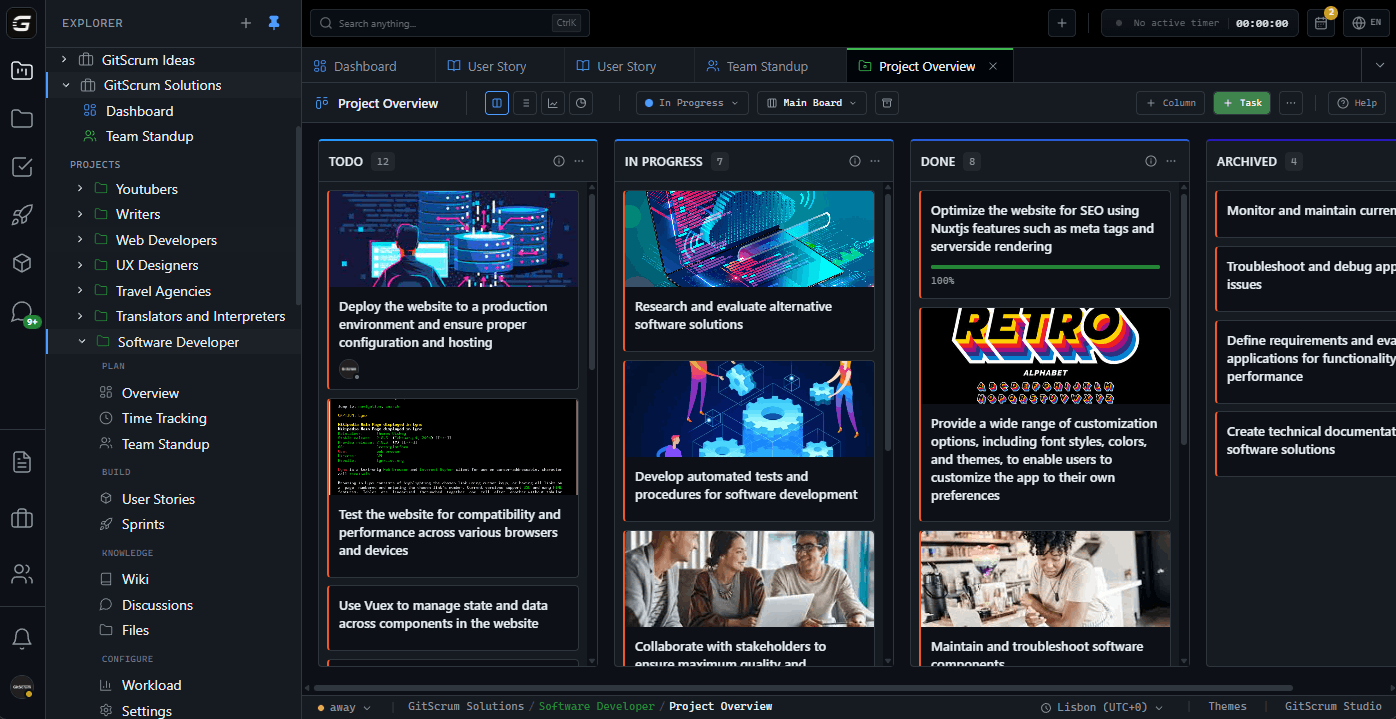
They each illuminate one facet while obscuring others. A unified platform establishes a single source of truth for completion.
All metrics—tasks, time, effort, milestones—calculate from the same underlying data using consistent definitions. Stakeholders see the same numbers.
Progress means the same thing to everyone. Trust in project data is restored because contradictory signals disappear.
The GitScrum Advantage
One unified platform to eliminate context switching and recover productive hours.