VS Code

GitScrum for VS Code, Google Antigravity, Cursor and Windsurf!

GitScrum logo
Solution

Duplicated Workflows 2026 | Configure Once vs 4 Tools

Same workflow in 4 tools: tracker, dev tool, docs, deployment. Configs diverge, team confused by different rules. GitScrum: configure once, applies everywhere. Free trial.

Duplicated Workflows 2026 | Configure Once vs 4 Tools

Organizations build workflow configurations multiple times because each tool requires its own setup.

The project management tool has status workflows: To Do, In Progress, Review, Done. The code repository has similar concepts: Draft, Ready for Review, Approved, Merged.

The deployment platform has its own: Staging, Pending Approval, Production. The documentation system has: Draft, Review, Published.

These are conceptually the same workflow—work moving through stages toward completion—but each tool requires separate configuration and maintenance. When the team decides to add a 'Blocked' status, it must be added to multiple systems.

When approval requirements change, multiple workflow configurations must be updated. When a new team member joins, they must learn the workflow variations across each tool.

The duplication creates ongoing maintenance burden. Each workflow configuration requires periodic review.

Each tool update might affect workflow behavior. Each new project requires recreating the workflow setup across all tools.

More problematically, the duplicated workflows inevitably diverge. The project tracker might have 6 statuses while the code review system has 4.

The approval requirements in the deployment platform might not match those in the document system. Team members encounter different rules in different contexts, leading to confusion about the actual process.

GitScrum eliminates workflow duplication by providing one unified workflow system. Configure once, apply everywhere.

Status, approvals, and transitions work consistently across all work types.

The GitScrum Advantage

One unified platform to eliminate context switching and recover productive hours.

01

problem.identify()

The Problem

Same workflow logic configured separately in each tool

Workflow changes require updates across multiple systems

Duplicated configurations inevitably diverge over time

Team members encounter different rules in different tools

Ongoing maintenance burden multiplied by tool count

Process inconsistencies cause confusion and errors

02

solution.implement()

The Solution

One unified workflow system for all work types

Configure once, apply everywhere automatically

Workflow changes propagate to all contexts

Consistent rules regardless of work type or view

Single maintenance point for all workflow logic

Process consistency enforced by design

03

How It Works

1

Unified Workflow Definition

Define workflow stages and transitions once for the organization

2

Universal Application

Workflow applies consistently to all work items and contexts

3

Centralized Updates

Changes to workflow propagate everywhere automatically

4

Consistent Experience

Team members encounter same rules regardless of view

04

Why GitScrum

GitScrum addresses Duplicated Workflows Across Disconnected Project Systems through Kanban boards with WIP limits, sprint planning, and workflow visualization

Problem resolution based on Kanban Method (David Anderson) for flow optimization and Scrum Guide (Schwaber and Sutherland) for iterative improvement

Capabilities

  • Kanban boards with WIP limits to prevent overload
  • Sprint planning with burndown charts for predictable delivery
  • Workload views for capacity management
  • Wiki for process documentation
  • Discussions for async collaboration
  • Reports for bottleneck identification

Industry Practices

Kanban MethodScrum FrameworkFlow OptimizationContinuous Improvement

Frequently Asked Questions

Still have questions? Contact us at customer.service@gitscrum.com

How much effort does workflow duplication actually require?

Initial setup multiplies across tools—configuring a 6-stage workflow in 4 tools means doing essentially the same work 4 times. But the ongoing cost is larger. Each workflow change—adding a status, modifying a transition, adjusting permissions—must be applied across all systems. When tools update, workflow configurations may need review. When teams onboard, they must learn the variations. Organizations typically underestimate this cost because it is distributed across many small tasks rather than visible as one large effort.

Why do duplicated workflows inevitably diverge?

Different tools have different workflow capabilities. One tool might support conditional transitions while another does not. One might have 'Blocked' as a built-in status while another requires custom configuration. Over time, teams adapt workflows to each tool's strengths and limitations. Additionally, different administrators may make updates to different systems at different times. Without explicit effort to maintain synchronization—which itself is overhead—divergence is inevitable.

How does a unified workflow system work in practice?

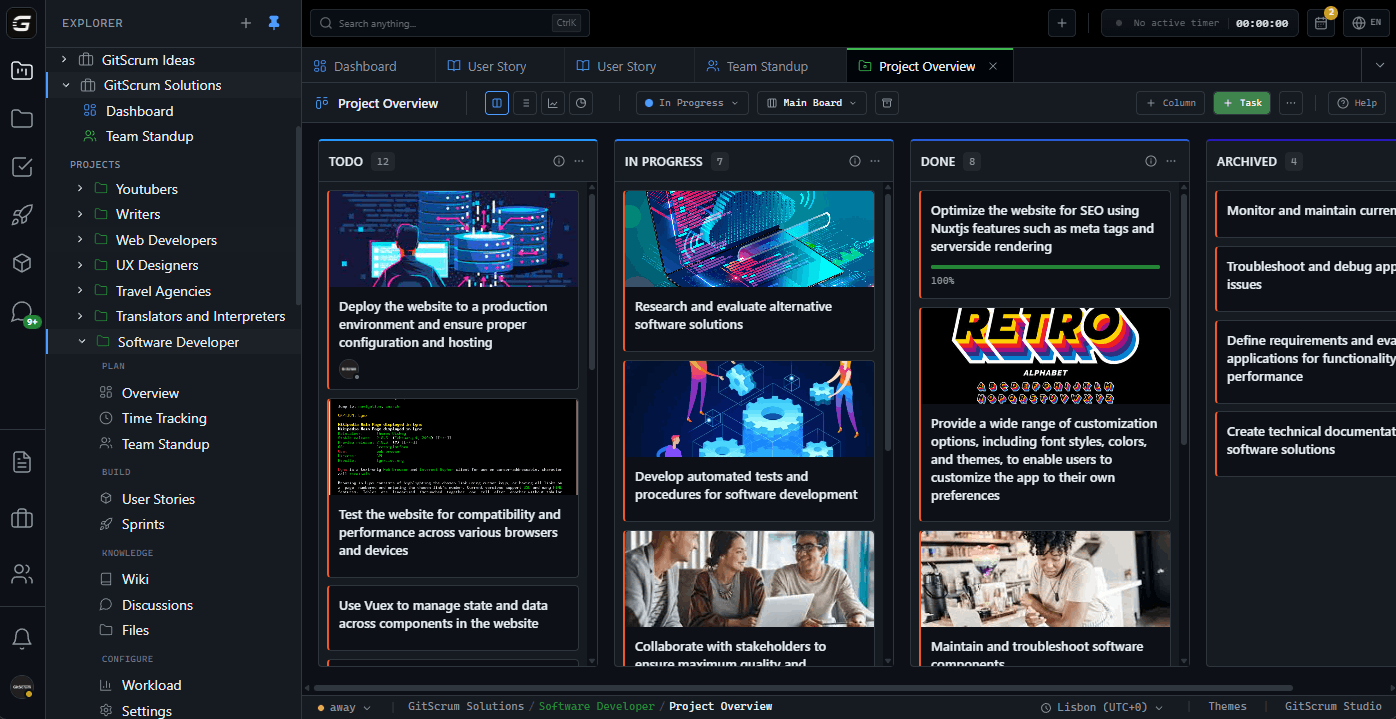
In GitScrum, workflow stages and transitions are defined once at the organizational or project level. All work items—regardless of type—follow these consistent stages. The Kanban board reflects the same stages as the sprint view as the backlog as the reporting system. When you add a new status, it appears everywhere. When you modify a transition rule, it applies everywhere. Team members learn one workflow and encounter it consistently across all contexts.

Ready to solve this?

Start free, no credit card required. Cancel anytime.

Works with your favorite tools

Connect GitScrum with the tools your team already uses. Native integrations with Git providers and communication platforms.

GitHubGitHub
GitLabGitLab
BitbucketBitbucket
SlackSlack
Microsoft TeamsTeams
DiscordDiscord
ZapierZapier
PabblyPabbly

Connect with 3,000+ apps via Zapier & Pabbly