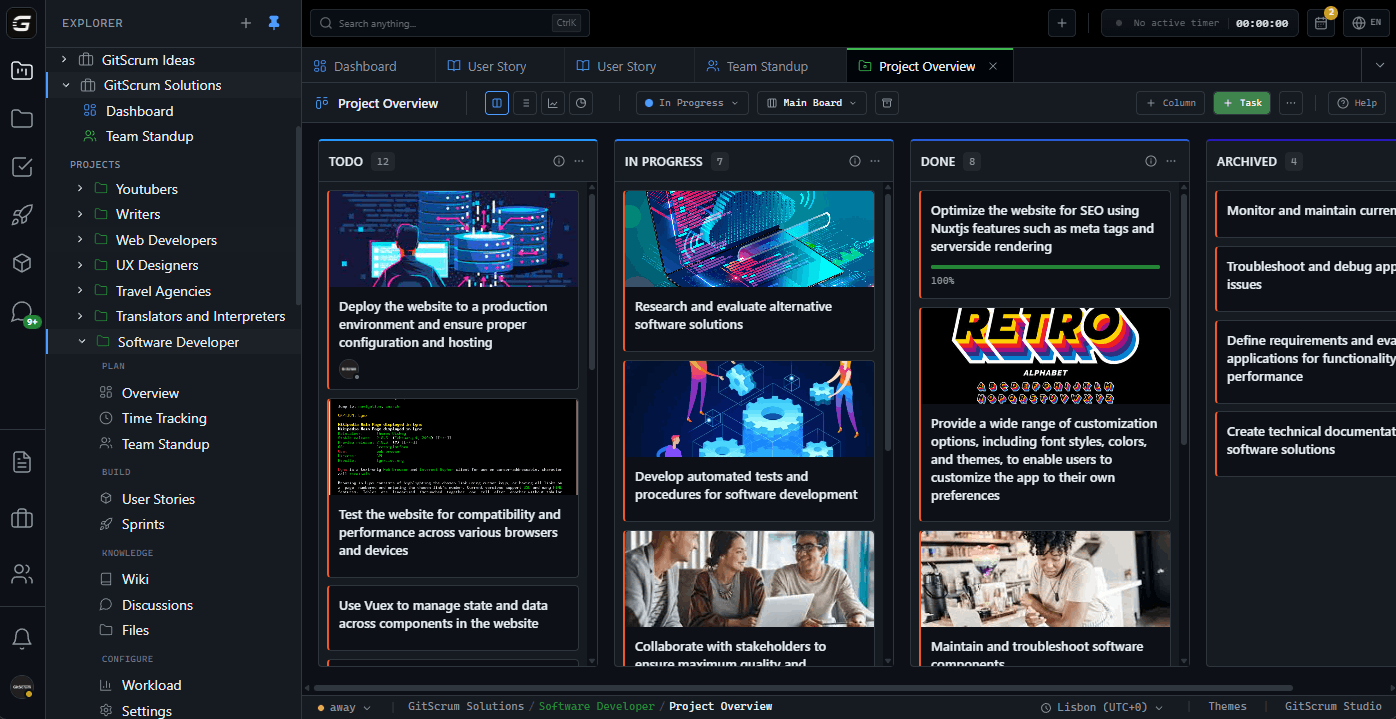
VS Code

GitScrum for VS Code, Google Antigravity, Cursor and Windsurf!

GitScrum logo
Solution

Approval Blockers 2026 | Sprints Burn While Tasks Wait

Approval columns fill while sprints burn. Stakeholders unaware they're blocking. GitScrum: blocker flags, days_waiting metrics, pending dashboard sorts by wait. Free trial.

Approval Blockers 2026 | Sprints Burn While Tasks Wait

Approval bottlenecks are sprint killers that hide in plain sight.

Tasks sit in 'Waiting for Approval' columns while sprints burn down. Stakeholders are unaware their response is blocking an entire team.

The cost accumulates invisibly until sprint commitments fail. GitScrum surfaces these hidden blockers through multiple mechanisms.

The isblocker flag marks tasks as explicitly blocked, triggering visibility in Manager Health dashboards. Blocked tasks display with daysblocked calculations showing exactly how long work has been stalled.

The standup blocker view surfaces tasks 'Waiting for API credentials from client' or 'Dependency on design team for assets' with duration tracking. Client Flow's pending approvals dashboard tracks proposals, change requests, and invoices awaiting client action—each with dayswaiting metrics and status (draft, sent, viewed, approved, rejected).

When items sit in 'sent' or 'viewed' status without action, they surface with avgWaitingDays calculations. The system sorts pending items by dayswaiting (highest first), ensuring the longest-waiting approvals get immediate attention.

Expiring soon filters catch approvals approaching deadline. Integration notifications can alert when approval wait times exceed thresholds.

Workflow columns specifically for approval states enable WIP limit enforcement—when 'Awaiting Approval' exceeds its limit, no new items can enter until stakeholders respond.

The GitScrum Advantage

One unified platform to eliminate context switching and recover productive hours.

01

problem.identify()

The Problem

Teams lack visibility into bottlenecks and delays

Manual coordination wastes time and creates errors

No unified view of work across teams and stages

Blockers remain hidden until they cause major delays

Metrics and reporting require manual data gathering

02

solution.implement()

The Solution

Automated workflows eliminate manual coordination overhead

Real-time dashboards provide instant visibility into work status

Unified boards show all work across teams in one place

Blocker tracking surfaces hidden delays before they escalate

Built-in metrics provide automatic reporting without manual effort

03

How It Works

1

Mark Blockers

Use is_blocker flag on tasks explicitly waiting for stakeholder approval

2

Track Wait Time

days_blocked and days_waiting metrics quantify approval queue duration

3

Standup Visibility

Blocked tasks surface in standup views with duration badges showing wait time

4

Pending Dashboard

Client Flow pending approvals sorted by longest waiting ensures oldest get attention

04

Why GitScrum

GitScrum addresses Eliminating Waiting for Approval States Blocking Sprints through Kanban boards with WIP limits, sprint planning, and workflow visualization

Problem resolution based on Kanban Method (David Anderson) for flow optimization and Scrum Guide (Schwaber and Sutherland) for iterative improvement

Capabilities

  • Kanban boards with WIP limits to prevent overload
  • Sprint planning with burndown charts for predictable delivery
  • Workload views for capacity management
  • Wiki for process documentation
  • Discussions for async collaboration
  • Reports for bottleneck identification

Industry Practices

Kanban MethodScrum FrameworkFlow OptimizationContinuous Improvement

Frequently Asked Questions

Still have questions? Contact us at customer.service@gitscrum.com

How does GitScrum help with eliminating waiting for approval states blocking sprints?

GitScrum provides integrated tools including dashboards, workflows, team-standups, client-flow that work together to address this challenge. The unified platform eliminates the need for multiple disconnected tools and manual coordination.

How quickly can teams see results?

Most teams see immediate improvements in visibility and coordination within the first sprint. Quantifiable productivity gains typically appear within 2-4 weeks as teams adapt to the streamlined workflows.

Ready to solve this?

Start free, no credit card required. Cancel anytime.

Works with your favorite tools

Connect GitScrum with the tools your team already uses. Native integrations with Git providers and communication platforms.

GitHubGitHub
GitLabGitLab
BitbucketBitbucket
SlackSlack
Microsoft TeamsTeams
DiscordDiscord
ZapierZapier
PabblyPabbly

Connect with 3,000+ apps via Zapier & Pabbly