Executive reporting in fragmented tool environments is a manual craft.
Somewhere in every organization is a person—often a project manager, operations lead, or dedicated analyst—whose Friday is consumed by report building. They have perfected the ritual.
Open Jira, run the saved queries, export to CSV. Open Toggl, filter by date range, export summary.
Open the velocity spreadsheet maintained in Google Sheets. Check the finance portal for budget actuals.
Scan email threads for risk updates that never made it into any system. Import everything into Excel, normalize the data formats, create pivot tables and charts.
Copy-paste into the PowerPoint template that executives expect. Format, align, add commentary.
Send by end of day. This process takes three to five hours weekly.
That is 150 to 250 hours annually—roughly six to ten weeks of full-time work—spent on manual data aggregation that adds no analytical value. The person is a human ETL pipeline, transforming and loading data that should flow automatically.
The reports themselves are outdated by the time they are presented. Data extracted Friday morning reflects status through Thursday.
By Monday's executive review, the numbers are three days stale. Decisions are made on historical snapshots rather than current reality.
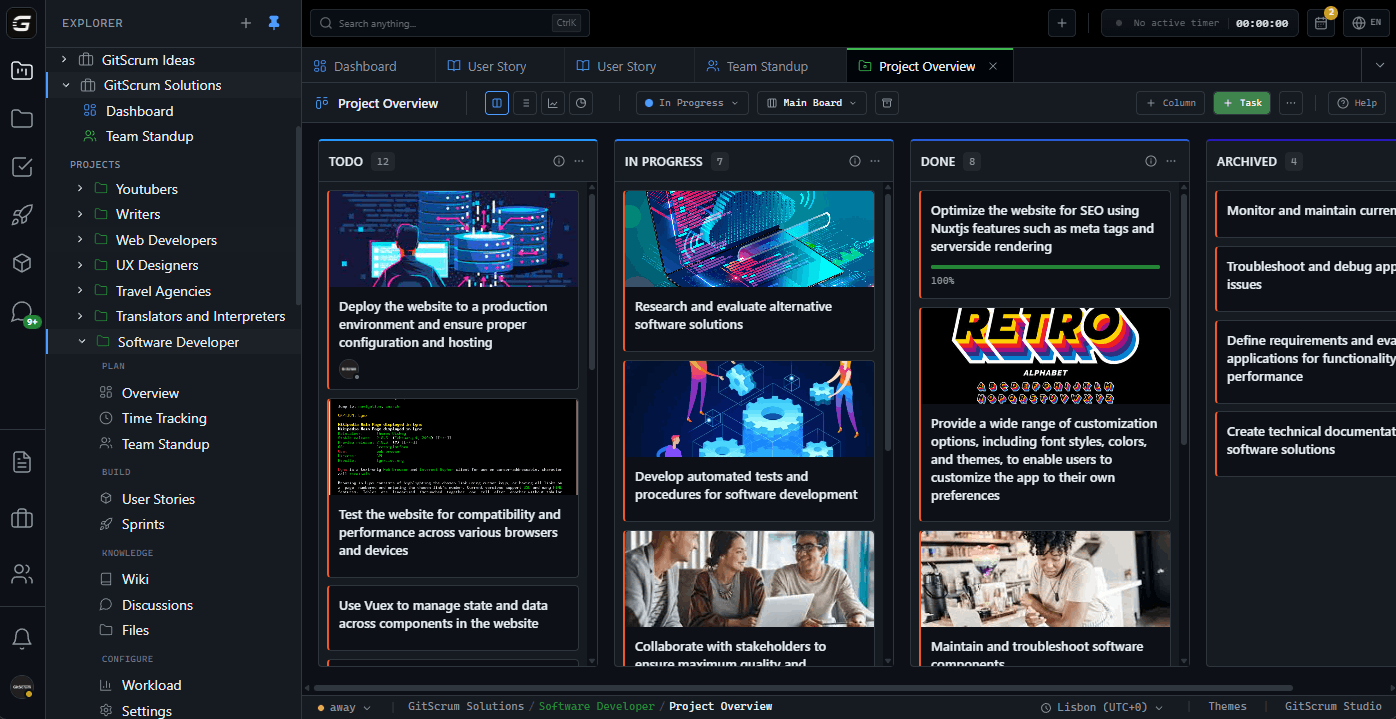
A unified platform transforms executive reporting. When all project data lives in one system, executive dashboards generate automatically.
Real-time visibility replaces weekly snapshots. The reporting ritual disappears, and the person who performed it can focus on actual analysis rather than data aggregation.
The GitScrum Advantage
One unified platform to eliminate context switching and recover productive hours.