
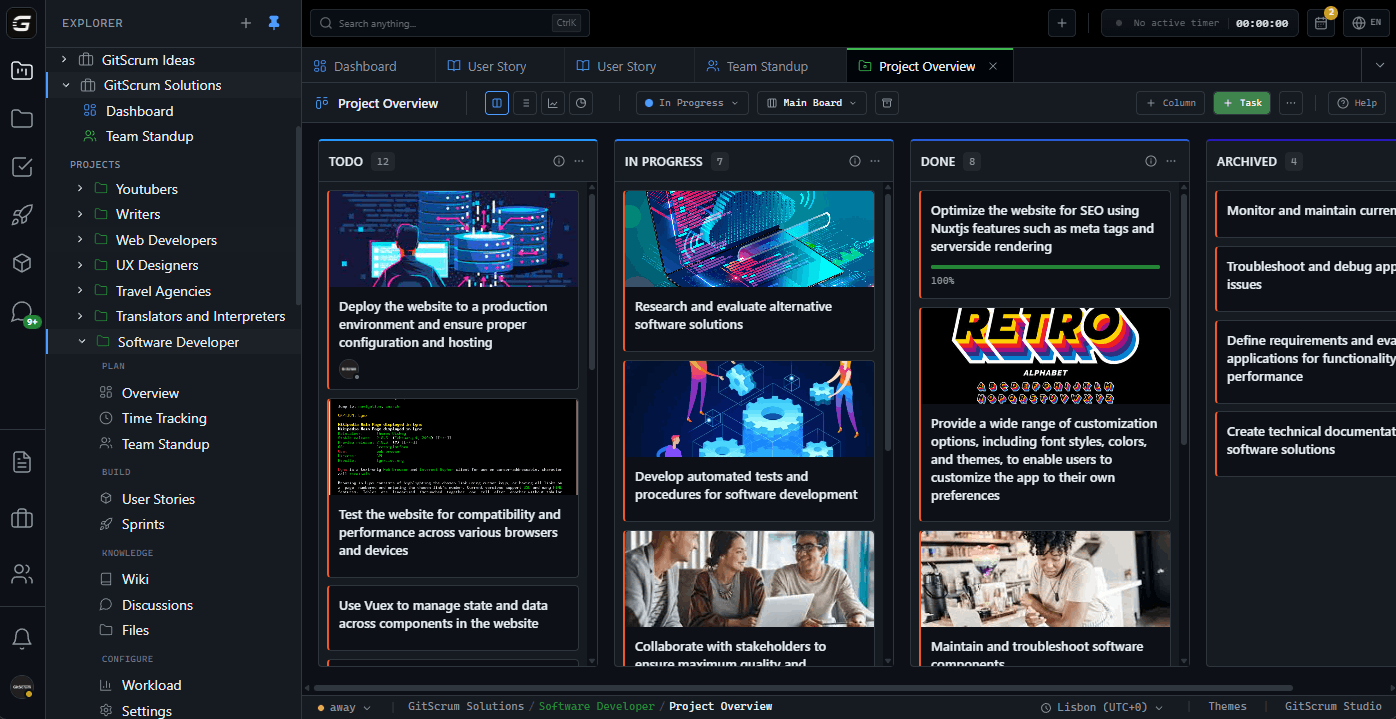
VS Code

GitScrum for VS Code, Google Antigravity, Cursor and Windsurf!

GitScrum logo
Solution

Jira vs Reality Gap 2026 | Auto Status from Git Activity

Jira 'In Progress' 3 weeks while PR merged yesterday. Status = memory. GitScrum: auto status from Git—branch, PR, merge = real progress. Free trial.

Jira vs Reality Gap 2026 | Auto Status from Git Activity

The Jira-reality gap exists because status updates are manual and disconnected from actual work.

Developers context-switch into Jira to update tickets, interrupting flow. Updates get postponed, then forgotten.

Status becomes what-someone-last-remembered-to-set. The PM trusts Jira; reality differs.

Sprint planning relies on status that's days stale. The gap creates friction, distrust, and endless 'can you update your tickets?' reminders.

The GitScrum Advantage

One unified platform to eliminate context switching and recover productive hours.

01

problem.identify()

The Problem

Status depends on developer memory

Updates forgotten during deep work

PM sees different reality than code shows

Standups become status reconciliation

Planning based on stale information

02

solution.implement()

The Solution

Status derived from code activity

No manual updates required

PM sees what code shows

Standups focus on blockers, not status

Planning based on real-time progress

03

How It Works

1

Branch Creation → In Progress

Work starts automatically: 'Developer creates branch AUTH-45-oauth-implementation. GitScrum task AUTH-45 automatically moves to 'In Development'. No manual status change. The branch creation is the signal—work has begun.'

2

PR Created → In Review

Review stage detected: 'PR opened for AUTH-45 branch. GitScrum task automatically moves to 'In Review'. Reviewers assigned from task or PR. Status reflects reality: the code is now being reviewed, regardless of whether anyone remembered to update a ticket.'

3

PR Merged → Done

Completion is automatic: 'PR merged to main. GitScrum task moves to 'Done'. Timestamp recorded. No forgetting to close tickets. The merge is the source of truth—when code ships, task ships. Perfect alignment between repository and project status.'

4

Override When Needed

Manual control available: 'Automatic status not fitting the situation? Override manually. Some tasks need design review after code review—manual 'In Design Review' status. The system suggests from code activity but doesn't lock you into rigid automation.'

04

Why GitScrum

GitScrum addresses Fixing Gaps Between What Jira Says and Actual Development Progress through Kanban boards with WIP limits, sprint planning, and workflow visualization

Problem resolution based on Kanban Method (David Anderson) for flow optimization and Scrum Guide (Schwaber and Sutherland) for iterative improvement

Capabilities

  • Kanban boards with WIP limits to prevent overload
  • Sprint planning with burndown charts for predictable delivery
  • Workload views for capacity management
  • Wiki for process documentation
  • Discussions for async collaboration
  • Reports for bottleneck identification

Industry Practices

Kanban MethodScrum FrameworkFlow OptimizationContinuous Improvement

Frequently Asked Questions

Still have questions? Contact us at customer.service@gitscrum.com

What about tasks that don't involve code?

Design tasks, documentation, research—these still use manual status updates. The automatic Git-based status only applies to development tasks. But even then, you can link design files (Figma) or documents (Google Docs) and track their completion status. The principle: automate where possible, manual where necessary.

What if developers work on multiple branches for one task?

GitScrum tracks all branches linked to a task. First branch creation → In Progress. Additional branches don't re-trigger. All associated PRs must merge before → Done. The task aggregates activity from all related Git work.

How do you handle branches that aren't linked to tasks?

GitScrum can auto-detect task references in branch names (AUTH-45-feature) or PR descriptions. For unlinked work, developers can manually link. Over time, teams develop the habit of task-first development—creating task, then branch from task, ensuring automatic linkage.

Does this eliminate the need for standups?

Not eliminate—improve. Standups shift from 'what's your status?' (now visible in dashboard) to 'what's blocking you?' and 'what help do you need?' The status-sharing part of standup becomes unnecessary; the problem-solving part gets more time.

Ready to solve this?

Start free, no credit card required. Cancel anytime.

Works with your favorite tools

Connect GitScrum with the tools your team already uses. Native integrations with Git providers and communication platforms.

GitHubGitHub
GitLabGitLab
BitbucketBitbucket
SlackSlack
Microsoft TeamsTeams
DiscordDiscord
ZapierZapier
PabblyPabbly

Connect with 3,000+ apps via Zapier & Pabbly