VS Code

GitScrum for VS Code, Google Antigravity, Cursor and Windsurf!

GitScrum logo
Solution

MoSCoW Prioritization 2026 | Must/Should/Could/Won't Categories

Most tools lack native MoSCoW support. GitScrum: custom priorities Must-Have (red), Should-Have (orange), Could-Have (yellow), Won't-Have (gray). Priorities donut widget. Filter by Must-Have in crunch. Free trial.

MoSCoW Prioritization 2026 | Must/Should/Could/Won't Categories

MoSCoW prioritization helps teams distinguish between essential and nice-to-have features, but many tools lack native support.

GitScrum's customizable priority system lets you create the classic MoSCoW categories—Must-Have (critical for release), Should-Have (important but not vital), Could-Have (desirable if time permits), and Won't-Have (explicitly deferred)—with distinct colors for instant visual recognition. The priorities donut widget shows the distribution across categories, while user story filtering lets teams focus on must-haves during crunch time.

The GitScrum Advantage

One unified platform to eliminate context switching and recover productive hours.

01

problem.identify()

The Problem

Teams lack visibility into bottlenecks and delays

Manual coordination wastes time and creates errors

No unified view of work across teams and stages

Blockers remain hidden until they cause major delays

Metrics and reporting require manual data gathering

02

solution.implement()

The Solution

Automated workflows eliminate manual coordination overhead

Real-time dashboards provide instant visibility into work status

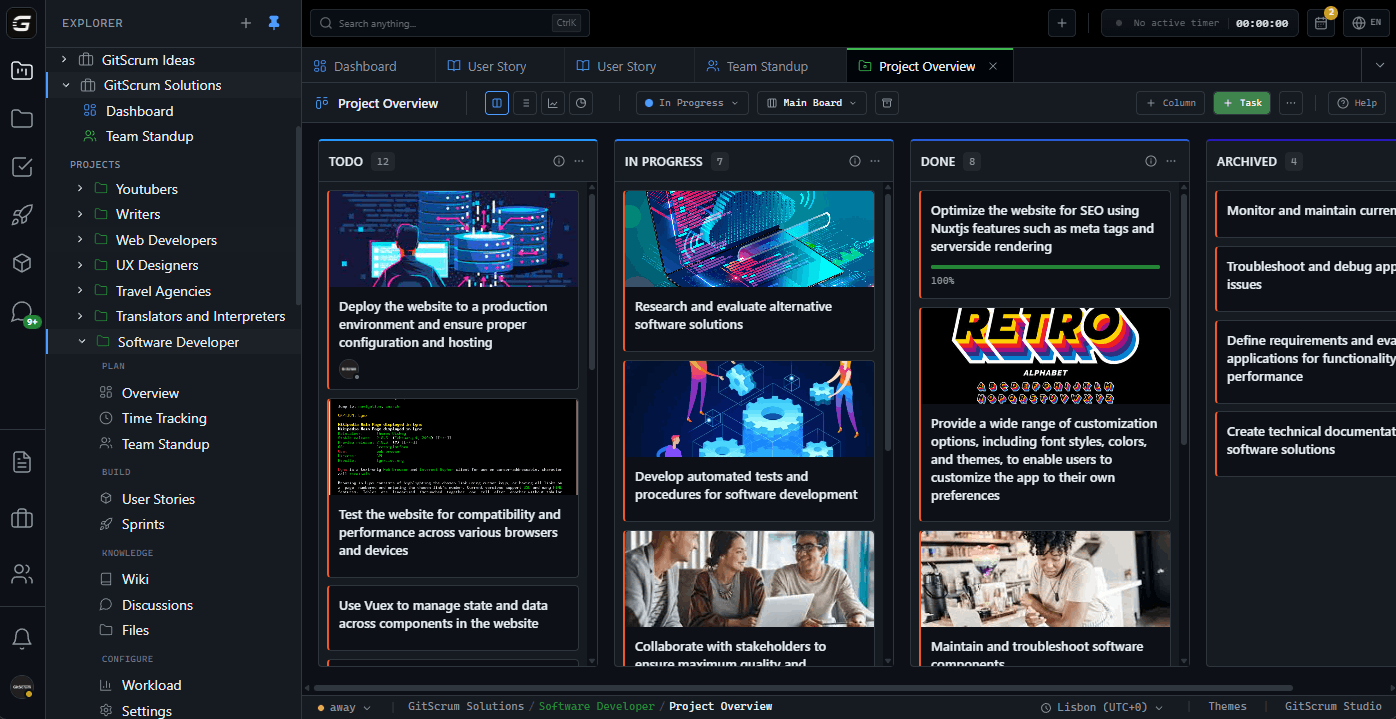
Unified boards show all work across teams in one place

Blocker tracking surfaces hidden delays before they escalate

Built-in metrics provide automatic reporting without manual effort

03

How It Works

1

Create MoSCoW Priorities

Set up four priority levels: Must-Have (red), Should-Have (orange), Could-Have (yellow), Won't-Have (gray)

2

Categorize User Stories

Assign MoSCoW categories to each user story based on stakeholder and team input

3

Visualize Distribution

Use the priorities donut widget to see the percentage of work in each MoSCoW category

4

Filter for Focus

Filter backlog by Must-Have during sprint planning to ensure critical items are addressed first

04

Why GitScrum

GitScrum addresses Implementing MoSCoW Method for Agile Prioritization through Kanban boards with WIP limits, sprint planning, and workflow visualization

Problem resolution based on Kanban Method (David Anderson) for flow optimization and Scrum Guide (Schwaber and Sutherland) for iterative improvement

Capabilities

  • Kanban boards with WIP limits to prevent overload
  • Sprint planning with burndown charts for predictable delivery
  • Workload views for capacity management
  • Wiki for process documentation
  • Discussions for async collaboration
  • Reports for bottleneck identification

Industry Practices

Kanban MethodScrum FrameworkFlow OptimizationContinuous Improvement

Frequently Asked Questions

Still have questions? Contact us at customer.service@gitscrum.com

How does GitScrum help with implementing moscow method for agile prioritization?

GitScrum provides integrated tools including user-stories, dashboards, project-management, workflow-builder, board that work together to address this challenge. The unified platform eliminates the need for multiple disconnected tools and manual coordination.

How quickly can teams see results?

Most teams see immediate improvements in visibility and coordination within the first sprint. Quantifiable productivity gains typically appear within 2-4 weeks as teams adapt to the streamlined workflows.

Ready to solve this?

Start free, no credit card required. Cancel anytime.

Works with your favorite tools

Connect GitScrum with the tools your team already uses. Native integrations with Git providers and communication platforms.

GitHubGitHub
GitLabGitLab
BitbucketBitbucket
SlackSlack
Microsoft TeamsTeams
DiscordDiscord
ZapierZapier
PabblyPabbly

Connect with 3,000+ apps via Zapier & Pabbly