
VS Code

GitScrum for VS Code, Google Antigravity, Cursor and Windsurf!

GitScrum logo
Solution

WIP Limits 2026 | Per-Column Enforcement, Stop Starting

Teams start 10 tasks, finish 3. Context switching kills 20-40% productivity. GitScrum: per-column WIP limits 1-15, enforced blocking when full. Stop starting, start finishing. Pull-based flow. Free trial.

WIP Limits 2026 | Per-Column Enforcement, Stop Starting

Work In Progress limits are the single most impactful practice you can adopt from kanban.

Without WIP limits, teams start far more work than they can finish. 'In Progress' becomes a graveyard of half-done tasks.

Developers context-switch between 5-10 items daily, losing 20-40% of productive time to mental gear-shifting. Everyone is 'busy' but actual throughput—tasks crossing the finish line—is abysmal.

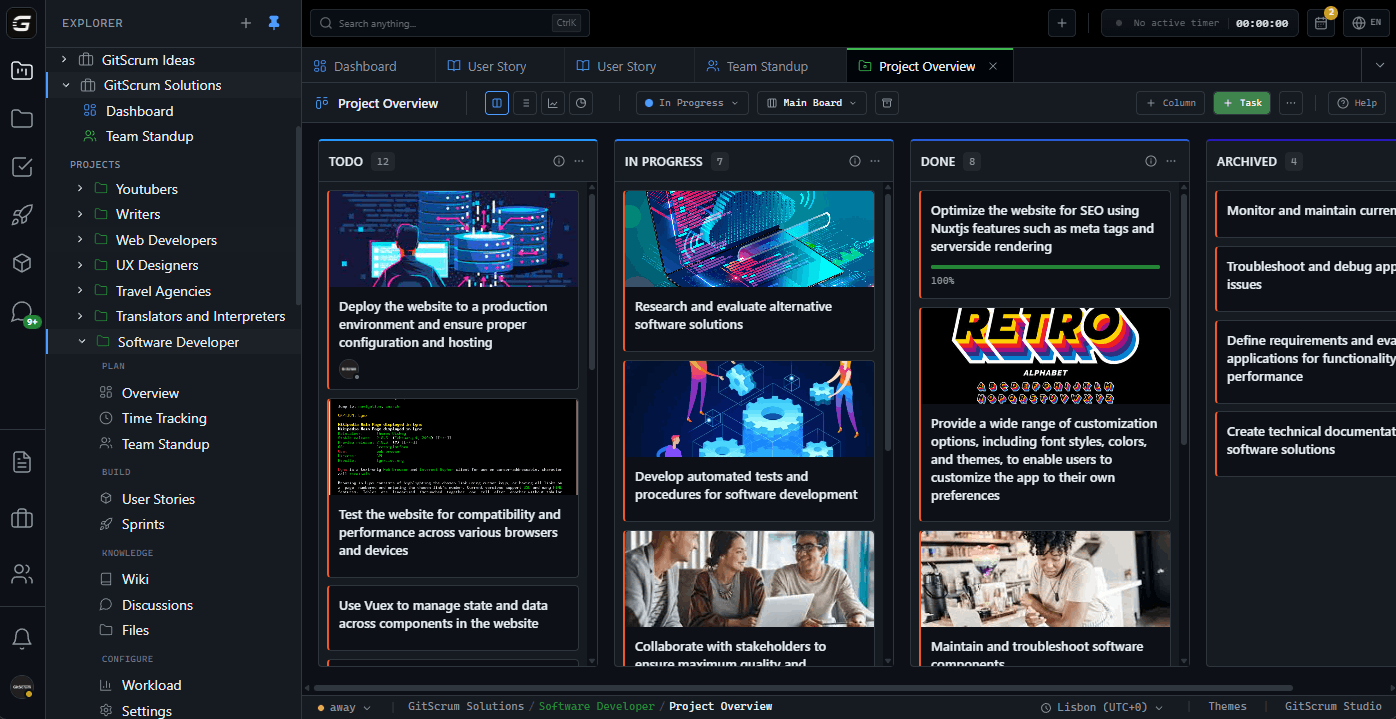
GitScrum implements WIP limits at the column level with true enforcement. Each column can have a limit from 1-15 tasks (or no limit).

When you try to drag a task into a column that's at capacity, the system blocks the move and shows a clear message: 'column.wiplimit reached. Please remove tasks before adding more.' The task returns to its original position.

This isn't optional guidance—it's enforced constraint. The result?

Teams stop starting and start finishing. When 'In Progress' is full, the only option is to complete existing work.

Bottlenecks become visible immediately. If 'Code Review' is always at limit, you know where to focus improvement.

WIP limits create pull-based flow that dramatically improves throughput.

The GitScrum Advantage

One unified platform to eliminate context switching and recover productive hours.

01

problem.identify()

The Problem

Teams start 10 tasks but only finish 3—'In Progress' overflows with half-done work

Context switching between 5-10 concurrent tasks kills developer productivity

No enforcement prevents developers from pulling more work than they can handle

Bottlenecks are invisible until tasks pile up and deadlines are missed

Everyone looks busy but actual throughput (tasks completed) is low

02

solution.implement()

The Solution

Per-column WIP limits from 1-15 tasks with true system enforcement

Drag-and-drop blocked when column reaches capacity—no exceptions

Clear error message: 'column.wip_limit reached' with guidance to complete work first

Independent limits per column: 3 for 'In Progress', 5 for 'Code Review', no limit for 'Done'

Visual indicator when columns approach or reach their limits

03

How It Works

1

Access Column Settings

Click the three-dot menu in any column header to access column options. Select 'Work in Progress Limit' to open the WIP configuration modal. Each column can have its own independent limit.

2

Set Appropriate Limits

Use the slider to set a limit between 1-15 tasks, or check 'No WIP' to disable limits. Start conservative: if you have 5 developers, try a WIP limit of 5-8 for 'In Progress'. Adjust based on actual flow.

3

Limits Enforced Automatically

When someone tries to drag a task into a column at capacity, the system blocks the move. A modal appears: 'error: column.wip_limit reached. Please remove tasks before adding more.' The task returns to its origin.

4

Expose Bottlenecks

When a column is constantly at its limit, that's a bottleneck. If 'Code Review' is always at 5/5, you need more reviewers or faster reviews. WIP limits make process problems visible rather than hidden.

5

Refine Limits Over Time

WIP limits should evolve. If 'In Progress' at 8 creates too much context switching, drop to 5. If 'Testing' at 3 starves QA, raise to 5. The goal is smooth flow, not arbitrary constraints.

04

Why GitScrum

GitScrum addresses Implementing Work in Progress Limits for Better Flow through Kanban boards with WIP limits, sprint planning, and workflow visualization

Problem resolution based on Kanban Method (David Anderson) for flow optimization and Scrum Guide (Schwaber and Sutherland) for iterative improvement

Capabilities

  • Kanban boards with WIP limits to prevent overload
  • Sprint planning with burndown charts for predictable delivery
  • Workload views for capacity management
  • Wiki for process documentation
  • Discussions for async collaboration
  • Reports for bottleneck identification

Industry Practices

Kanban MethodScrum FrameworkFlow OptimizationContinuous Improvement

Frequently Asked Questions

Still have questions? Contact us at customer.service@gitscrum.com

What's a good starting WIP limit?

A common starting point is team size + 1 or 2. A team of 5 developers might start with a WIP limit of 6-7 for 'In Progress'. The goal is to have enough work that no one is idle, but not so much that context switching becomes a problem.

Should 'Done' columns have WIP limits?

Usually no. 'Done' columns represent completed work—there's no benefit to limiting how much gets done. WIP limits are for active work stages where limiting concurrent work improves focus and flow.

What if the limit is too restrictive?

Increase it. WIP limits should create gentle constraint, not gridlock. If the team is constantly blocked and work isn't flowing, the limit is too low. Start conservative and raise until you find the right balance.

Can I bypass WIP limits for urgent tasks?

No—and that's intentional. If urgent tasks constantly bypass limits, every task becomes 'urgent.' The constraint forces real prioritization: if something urgent must enter, something else must exit first.

How do WIP limits help with bottlenecks?

A column constantly at its limit is a bottleneck. If 'Code Review' is always 5/5 while 'Development' has capacity, you know exactly where to improve. Without WIP limits, work just piles up invisibly.

Ready to solve this?

Start free, no credit card required. Cancel anytime.

Works with your favorite tools

Connect GitScrum with the tools your team already uses. Native integrations with Git providers and communication platforms.

GitHubGitHub
GitLabGitLab
BitbucketBitbucket
SlackSlack
Microsoft TeamsTeams
DiscordDiscord
ZapierZapier
PabblyPabbly

Connect with 3,000+ apps via Zapier & Pabbly