VS Code

GitScrum for VS Code, Google Antigravity, Cursor and Windsurf!

GitScrum logo
Solution

Developer Focus 2026 | Async Standups, Self-Service Status

15-30 min to enter flow, 23 min to recover from one interruption. GitScrum: async Team Standups replace sync meetings, self-service board visibility, clear task assignments. Protect deep work. Free trial.

Developer Focus 2026 | Async Standups, Self-Service Status

A developer needs 15-30 minutes to enter flow state—deep concentration where complex work happens efficiently.

A single interruption destroys it: tap on shoulder, Slack notification, 'quick question' from a colleague. Studies show it takes 23 minutes to recover from an interruption.

With constant pings about status updates, clarifying questions, and meeting notifications, many developers never achieve deep focus during the workday. The solution isn't 'work harder'—it's reducing unnecessary interruptions.

GitScrum helps: clear task assignments mean developers know what to work on without asking. Async standups replace interrupt-driven status checks.

Self-service board visibility answers 'what's the status?' questions. Task descriptions with full context reduce clarification requests.

The result: longer uninterrupted focus periods where real work happens.

The GitScrum Advantage

One unified platform to eliminate context switching and recover productive hours.

01

problem.identify()

The Problem

Constant status request interruptions from managers and stakeholders

Unclear task assignments lead to 'what should I work on?' questions

Synchronous meetings fragment the workday into unusable chunks

Lack of context in tasks causes clarification request interruptions

Notifications from multiple tools create continuous distraction

02

solution.implement()

The Solution

Clear task assignments with single owner eliminate ambiguity

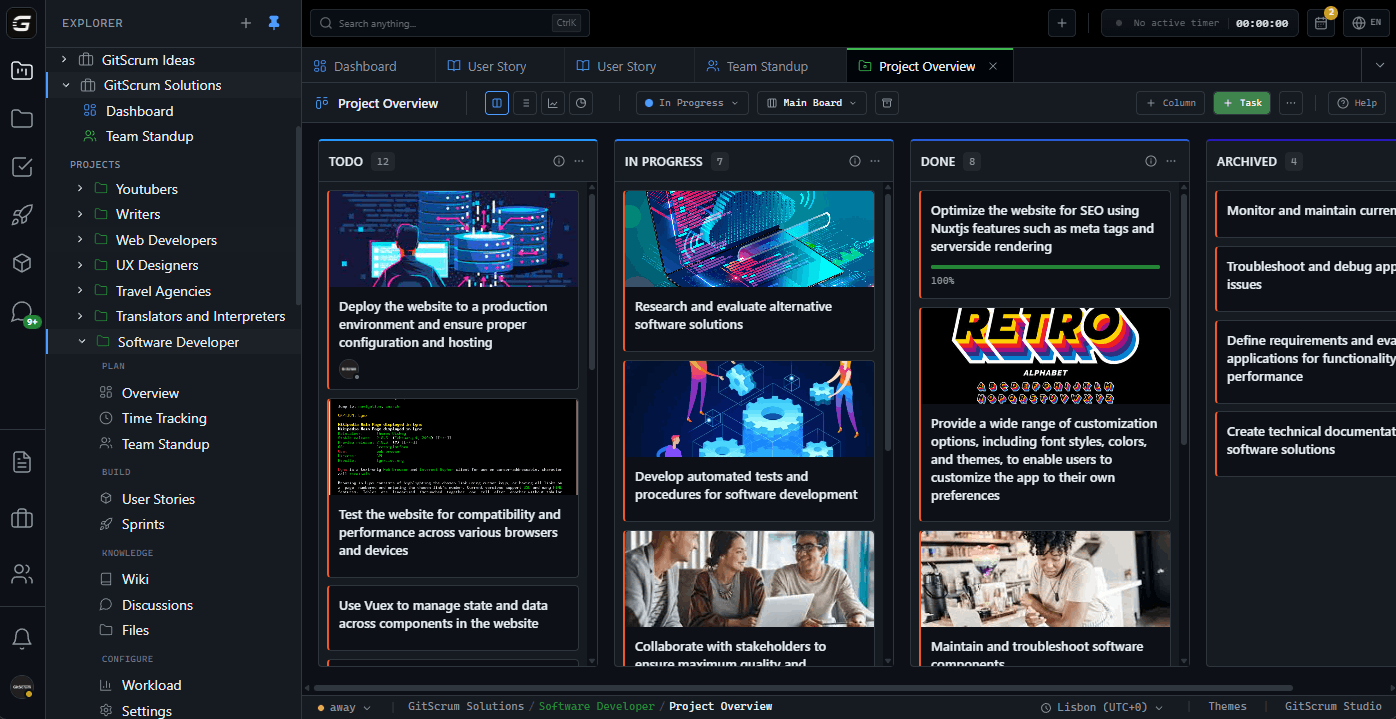
Self-service board visibility answers status questions without interrupting

Async Team Standups replace synchronous status meetings

Task descriptions with full context reduce clarification needs

Centralized work tracking reduces tool-switching and notification sources

03

How It Works

1

Assign Work Clearly

Every task has one assignee—clear ownership. At start of day, developer checks 'My Tasks' filter: these are my priorities. No ambiguity about what to work on. No interruptions to ask 'what should I do?' The board answers the question. Developers start focused immediately.

2

Make Status Self-Service

Train stakeholders: 'Check the board for status.' Board is always current because developers update task status as they work. Status questions don't require interrupting anyone. Filter by assignee, by sprint, by label—any view you need. The board is the single source of truth.

3

Go Async for Updates

Replace daily standup meeting with async Team Standup. Developers post updates when convenient—doesn't interrupt flow. Others read when convenient. Same information, no scheduled interruption. Blocking issues get flagged, discussed asynchronously or in short sync if truly urgent.

4

Front-Load Task Context

Write task descriptions with everything needed to start: requirements, acceptance criteria, relevant links, technical notes. Developers read once, understand fully, start working. No interruptions to ask 'what did you mean by this?' If questions arise, they go in task comments—async, not interrupting.

5

Consolidate Tools

One place for work tracking: GitScrum. Not three different tools with three notification streams. Configure notifications thoughtfully: only what requires attention. Batch non-urgent notifications. The goal: when you're coding, nothing pings you. Check updates between focus blocks, not during.

04

Why GitScrum

GitScrum addresses Improving Developer Focus and Reducing Distractions through Kanban boards with WIP limits, sprint planning, and workflow visualization

Problem resolution based on Kanban Method (David Anderson) for flow optimization and Scrum Guide (Schwaber and Sutherland) for iterative improvement

Capabilities

  • Kanban boards with WIP limits to prevent overload
  • Sprint planning with burndown charts for predictable delivery
  • Workload views for capacity management
  • Wiki for process documentation
  • Discussions for async collaboration
  • Reports for bottleneck identification

Industry Practices

Kanban MethodScrum FrameworkFlow OptimizationContinuous Improvement

Frequently Asked Questions

Still have questions? Contact us at customer.service@gitscrum.com

How do we protect focus time while staying responsive?

Define 'focus blocks'—2-4 hour periods with no meetings, notifications silenced. Check messages between blocks, not during. Communicate this: 'I check Slack at 10am, 1pm, 4pm.' Urgent matters have escape valves (phone call for true emergencies). Most things can wait 2 hours. Focus time isn't antisocial—it's when real work happens.

What about genuinely urgent interruptions?

Define what's truly urgent: production down, customer blocked, security incident. Those deserve immediate interruption. Everything else can wait. Most 'urgent' things aren't—they're just someone else's priority. Create clear escalation paths for real emergencies. Normal questions go async.

How do we reduce clarification request interruptions?

Front-load context in task descriptions. Include: what to build, why it matters, acceptance criteria, technical notes, relevant links. If someone asks a clarifying question, add the answer to the task—don't just reply in Slack. Build up task context over time. Well-written tasks eliminate most clarification needs.

How do managers check status without interrupting?

Train them on the board. Filter by sprint, by assignee, by label. Status is visible: In Progress, Blocked, Done. If more detail needed, check task comments—discussion is there. Only interrupt if something is unclear after checking the board. Most status questions are answered by self-service board access.

What if the team resists async communication?

Start small. Replace one synchronous meeting with async equivalent. Measure: same outcomes, less interruption. Show the math: 30-minute meeting × 6 people = 3 person-hours. Async: 15 minutes total read/write time. Success builds buy-in. Some prefer synchronous—that's okay for complex discussions. But routine updates should be async.

Ready to solve this?

Start free, no credit card required. Cancel anytime.

Works with your favorite tools

Connect GitScrum with the tools your team already uses. Native integrations with Git providers and communication platforms.

GitHubGitHub
GitLabGitLab
BitbucketBitbucket
SlackSlack
Microsoft TeamsTeams
DiscordDiscord
ZapierZapier
PabblyPabbly

Connect with 3,000+ apps via Zapier & Pabbly