VS Code

GitScrum for VS Code, Google Antigravity, Cursor and Windsurf!

GitScrum logo
Solution

Dev-QA Handoff 2026 | Acceptance Criteria, Test Scenarios

Dev throws code over wall. QA gets no context. Reverse-engineer requirements. GitScrum: acceptance criteria define 'done', test scenario checklists, 'Ready for QA' status columns. Structured handoff. Free trial.

Dev-QA Handoff 2026 | Acceptance Criteria, Test Scenarios

The handoff from development to QA is where features go to die—or get delayed.

Developer marks task 'done', throws it to QA, and moves on. QA picks it up with no context: What was implemented?

What should they test? What's the expected behavior?

What environments? They reverse-engineer the task, ask developers questions (interrupting flow), test the wrong things, miss edge cases the developer knew about but didn't document.

Bugs get found, sent back, developer context-switches to remember what they built. Repeat.

GitScrum transforms handoff from 'throw over the wall' to structured transition. Acceptance criteria define what 'done' means—both dev and QA reference the same checklist.

Subtasks for QA scenarios make test scope explicit. Linked test cases connect implementation to verification.

Status transitions ('Ready for QA' → 'In QA' → 'QA Passed') make handoff state visible. Comments preserve context so QA has what they need without interrupting developers.

The GitScrum Advantage

One unified platform to eliminate context switching and recover productive hours.

01

problem.identify()

The Problem

QA receives tasks with no context about what was implemented or how to test

Acceptance criteria are vague or missing—'done' means different things to dev vs QA

Developers move on immediately, losing context when QA has questions

Edge cases and test scenarios aren't documented, leading to missed bugs

Handoff state is invisible—no one knows if something is 'ready for QA' or stuck

02

solution.implement()

The Solution

Acceptance criteria in tasks define exactly what 'done' means for both dev and QA

Checklists for test scenarios make QA scope explicit before development even starts

Task comments preserve implementation context—decisions, edge cases, known limitations

Status columns ('Ready for QA', 'In QA', 'QA Failed') make handoff state visible

Linked subtasks for QA work connect implementation to verification in one task thread

03

How It Works

1

Define Acceptance Criteria Upfront

Before development starts, task has clear acceptance criteria. What exactly should this feature do? What are the success conditions? Both dev and QA reference the same criteria—no ambiguity about 'done'. QA knows what to verify before code is written.

2

Create QA Scenarios as Checklist

Add test scenarios as checklist items or subtasks. 'Test with valid input', 'Test with empty input', 'Test with special characters', 'Test on mobile'. QA scope is explicit. Developers see what will be tested and can ensure coverage.

3

Document Implementation Context

Developer adds comments before handoff: 'Implemented approach X because Y. Edge case Z is handled by... Known limitation: doesn't support scenario W.' QA has context without asking. If questions arise later, the documentation exists.

4

Move to 'Ready for QA' Status

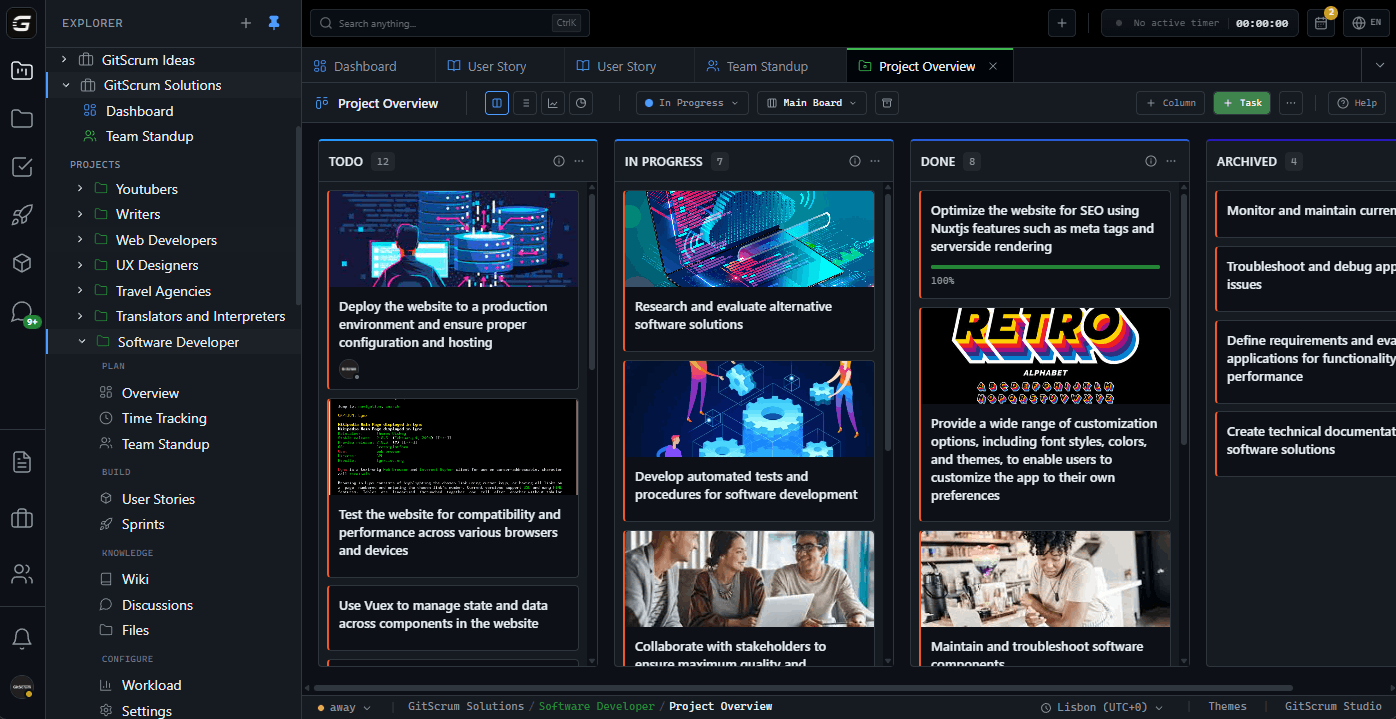
When dev is done, move task to 'Ready for QA' column—not just 'Done'. This signals QA can pick it up. QA moves to 'In QA' when testing starts. Status is visible: everyone knows where every task is in the dev-QA pipeline.

5

Handle QA Feedback in Task

If QA finds issues, they add comments with reproduction steps and move to 'QA Failed'. Developer sees feedback in the same task—no external bug tracker needed. Fix, move back to 'Ready for QA'. The entire conversation stays in one place.

04

Why GitScrum

GitScrum addresses Improving Handoff Between Development and QA Teams through Kanban boards with WIP limits, sprint planning, and workflow visualization

Problem resolution based on Kanban Method (David Anderson) for flow optimization and Scrum Guide (Schwaber and Sutherland) for iterative improvement

Capabilities

  • Kanban boards with WIP limits to prevent overload
  • Sprint planning with burndown charts for predictable delivery
  • Workload views for capacity management
  • Wiki for process documentation
  • Discussions for async collaboration
  • Reports for bottleneck identification

Industry Practices

Kanban MethodScrum FrameworkFlow OptimizationContinuous Improvement

Frequently Asked Questions

Still have questions? Contact us at customer.service@gitscrum.com

How do acceptance criteria help the dev-QA handoff?

Acceptance criteria are the contract between dev and QA. Developer knows exactly what 'done' means; QA knows exactly what to verify. No more 'I thought it should do X' vs 'I built it to do Y.' Write acceptance criteria before development—both parties agree on success conditions upfront.

Should QA scenarios be defined before or during development?

Before, ideally. When QA scenarios are defined upfront (as checklist items or subtasks), developers see what will be tested. This often catches edge cases early: 'Oh, you'll test special characters? I should handle those.' QA involvement in planning prevents 'works on my machine' surprises.

How do we reduce back-and-forth between dev and QA?

Documentation. Before moving to 'Ready for QA', developer adds a comment: 'Implemented this way because... Test data available at... Known edge cases:...' QA has context without asking. When QA finds issues, they document reproduction steps in comments. All communication in one place.

What status columns should we use for dev-QA workflow?

Minimum: 'In Progress' (dev working), 'Ready for QA' (dev done, QA can pick up), 'In QA' (being tested), 'Done' (QA passed). Optional: 'QA Failed' (back to dev) or use same 'In Progress' for rework. The key is visibility—everyone sees where each task is in the pipeline.

How do we handle QA finding issues in a task?

Keep it in the same task. QA adds a comment with bug details, reproduction steps, and expected vs actual behavior. Move task back to 'In Progress' or 'QA Failed' column. Developer fixes, adds comment about the fix, moves to 'Ready for QA'. Same task, complete history. No separate bug tracking needed for sprint work.

Ready to solve this?

Start free, no credit card required. Cancel anytime.

Works with your favorite tools

Connect GitScrum with the tools your team already uses. Native integrations with Git providers and communication platforms.

GitHubGitHub
GitLabGitLab
BitbucketBitbucket
SlackSlack
Microsoft TeamsTeams
DiscordDiscord
ZapierZapier
PabblyPabbly

Connect with 3,000+ apps via Zapier & Pabbly