VS Code

GitScrum for VS Code, Google Antigravity, Cursor and Windsurf!

GitScrum logo
Solution

Jira Too Complex Small Teams 2026 | Ship Not Configure

5-person teams don't need enterprise complexity. GitScrum: boards, sprints, GitHub sync in minutes. Build, don't configure. 2 users free forever. Free trial.

Jira Too Complex Small Teams 2026 | Ship Not Configure

Jira was designed for enterprise scale.

Issue types, workflows, screens, schemes, permissions—layers of configuration that make sense when 2,000 people across 50 departments need governance and compliance. But your team has 5 developers.

You don't need governance. You need to get work done.

The Small Team Jira Experience: Day 1: Create a project. Jira asks about issue types.

Bugs? What scheme do you want?

You pick something. Already overwhelmed.

Day 7: Customize workflow. Your tasks need three states: To Do, In Progress, Done.

Jira offers a workflow editor with transitions, conditions, validators, post functions, triggers. You spend 2 hours on something that should take 2 minutes.

Day 14: Realize you need different field configurations for bugs versus features. Jira introduces you to 'screens' and 'screen schemes.' Three hours later, fields still don't appear where you expect.

Day 30: Someone asks 'why can't I move this task to Done?' You discover transition permissions you didn't know you set. Another configuration rabbit hole.

The hidden cost: weeks of setup, ongoing configuration maintenance, and cognitive overhead that never goes away. Why Enterprise Features Hurt Small Teams: Complexity Tax: Every configuration option is a decision.

Every decision takes mental energy. Multiply by dozens of settings across multiple schemes, and small teams spend more time configuring than building.

Permission Paralysis: Jira's permission system assumes you need fine-grained access control. Most small teams want 'everyone can see and edit everything.' Implementing that simple requirement takes understanding of project roles, permission schemes, and global permissions.

Custom Field Explosion: Jira encourages adding fields for every data point. Small teams end up with 30+ custom fields across different issue types, most never used, all requiring maintenance.

Workflow Complexity Creep: Jira workflows can model any business process. Small teams model simple processes with complex tools, creating maintenance burden and confusion.

Admin Overhead: Someone becomes the 'Jira admin'—a role that shouldn't exist in a 5-person team. They spend hours weekly on configuration nobody asked for.

What Small Teams Actually Need: - Tasks with basic fields (title, description, assignee, status) - A board to visualize work in progress - Sprint planning with velocity tracking - Time tracking attached to tasks - GitHub integration that works automatically - Client visibility without separate tools That's it. No schemes.

No custom workflows. No permission matrices.

GitScrum for Small Teams: Setup: Create project, connect GitHub, invite team. Done in 10 minutes.

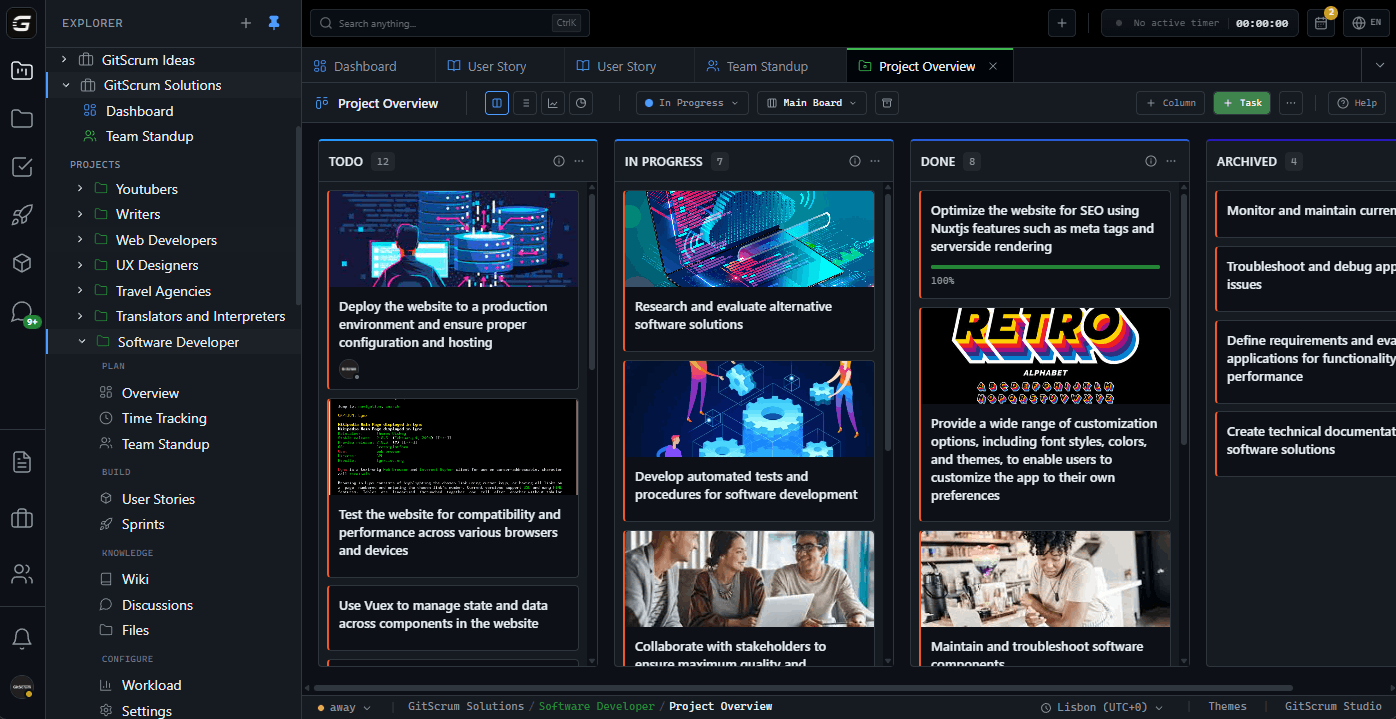
Task Management: Tasks have the fields you need. Status moves by dragging cards.

No workflow configuration required. Sprints: Create sprint, drag tasks in, start sprint.

Velocity calculates automatically. Close sprint, incomplete tasks roll over.

GitHub Sync: Connect repo once. PRs and commits link automatically.

No syntax to memorize, no linking to maintain. Time Tracking: Click timer on task.

Time logged. No separate tool, no export/import.

Client Access: Share project with client. They see what you want them to see.

No separate portal configuration. Pricing reality: - Jira Standard: $7.75/user/month (still includes enterprise complexity) - Jira Premium: $15.25/user/month (even more enterprise features you won't use) - GitScrum: $8.90/user/month, 2 users free forever (only what you need) $8.90/user/month for small-team-optimized project management.

Start building instead of configuring.

The GitScrum Advantage

One unified platform to eliminate context switching and recover productive hours.

01

problem.identify()

The Problem

Enterprise-grade complexity for 5-person teams

Weeks of configuration before productive use

Permission systems designed for Fortune 500 compliance

Custom field explosion across issue types

Workflow complexity that small teams don't need

Dedicated 'Jira admin' role in tiny teams

02

solution.implement()

The Solution

Setup in 10 minutes, not weeks

Sensible defaults that work immediately

Simple permissions—team members can do what they need

Essential fields only, add more if needed

Three-state workflow works out of the box

No admin role required—self-service configuration

03

How It Works

1

Quick Project Setup

Name your project, connect GitHub repository, invite team members. No issue type selection, no workflow configuration, no permission schemes. Ready in 10 minutes.

2

Start Adding Tasks

Create tasks with title, description, assignee. Drag to different columns to change status. No training required—works like every kanban board.

3

Run Your First Sprint

Create a sprint, drag tasks in, set dates, start. Velocity calculates automatically. Close sprint when done. Incomplete work rolls to next sprint.

4

Add Features As Needed

Enable time tracking when you need it. Add client portal when clients need visibility. Each feature activates without complex configuration.

04

Why GitScrum

GitScrum addresses Jira Too Complex for Small Teams through Kanban boards with WIP limits, sprint planning, and workflow visualization

Problem resolution based on Kanban Method (David Anderson) for flow optimization and Scrum Guide (Schwaber and Sutherland) for iterative improvement

Capabilities

  • Kanban boards with WIP limits to prevent overload
  • Sprint planning with burndown charts for predictable delivery
  • Workload views for capacity management
  • Wiki for process documentation
  • Discussions for async collaboration
  • Reports for bottleneck identification

Industry Practices

Kanban MethodScrum FrameworkFlow OptimizationContinuous Improvement

Frequently Asked Questions

Still have questions? Contact us at customer.service@gitscrum.com

Is GitScrum powerful enough for our needs?

For development teams under 25 people, almost certainly yes. GitScrum covers task management, sprint planning, time tracking, documentation, client portals, and GitHub integration. The 'missing' features are enterprise governance features most small teams never use.

What if we grow and need more features?

GitScrum grows with you. Features enable as needed without migration. If you eventually need enterprise governance (SOC 2 compliance, audit logs, advanced permissions), that's when tools like Jira make sense—not before.

Can we customize workflows if needed?

Yes, but you might not need to. Default workflows cover most small team needs. When customization is needed, it's straightforward column management—not Jira's workflow scheme complexity.

How does pricing compare to Jira for small teams?

Jira Free: 10 users, limited features. Jira Standard: $7.75/user/month but still complex. GitScrum: $8.90/user/month with 2 users free forever. Similar cost, dramatically different complexity.

Ready to solve this?

Start free, no credit card required. Cancel anytime.

Works with your favorite tools

Connect GitScrum with the tools your team already uses. Native integrations with Git providers and communication platforms.

GitHubGitHub
GitLabGitLab
BitbucketBitbucket
SlackSlack
Microsoft TeamsTeams
DiscordDiscord
ZapierZapier
PabblyPabbly

Connect with 3,000+ apps via Zapier & Pabbly