
VS Code

GitScrum for VS Code, Google Antigravity, Cursor and Windsurf!

GitScrum logo
Solution

Jira Workflows Chaos 2026 | Intuitive States

47 statuses, 12 issue types, rules nobody understands. GitScrum: intuitive workflow states matching how devs work. Minutes to learn. 2 users free. Free trial.

Jira Workflows Chaos 2026 | Intuitive States

The Jira instance started simple, but over years of customization, it's become a labyrinth.

There are 47 workflow statuses across 12 issue types. Some transitions require certain fields.

Some statuses can only be reached from specific other statuses. The rules evolved over time and nobody documented them.

Now, moving a task from 'Development' to 'Ready for Review' fails because you didn't fill in a required field that only appears in certain conditions. Or worse, you move to the wrong status and can't figure out how to get back.

New developers are paralyzed. They spend hours learning Jira instead of coding.

They make workflow mistakes that require admin intervention to fix. They learn to fear the tool instead of using it naturally.

The cognitive load of Jira complexity competes with the cognitive load of actual development work. GitScrum takes the opposite approach.

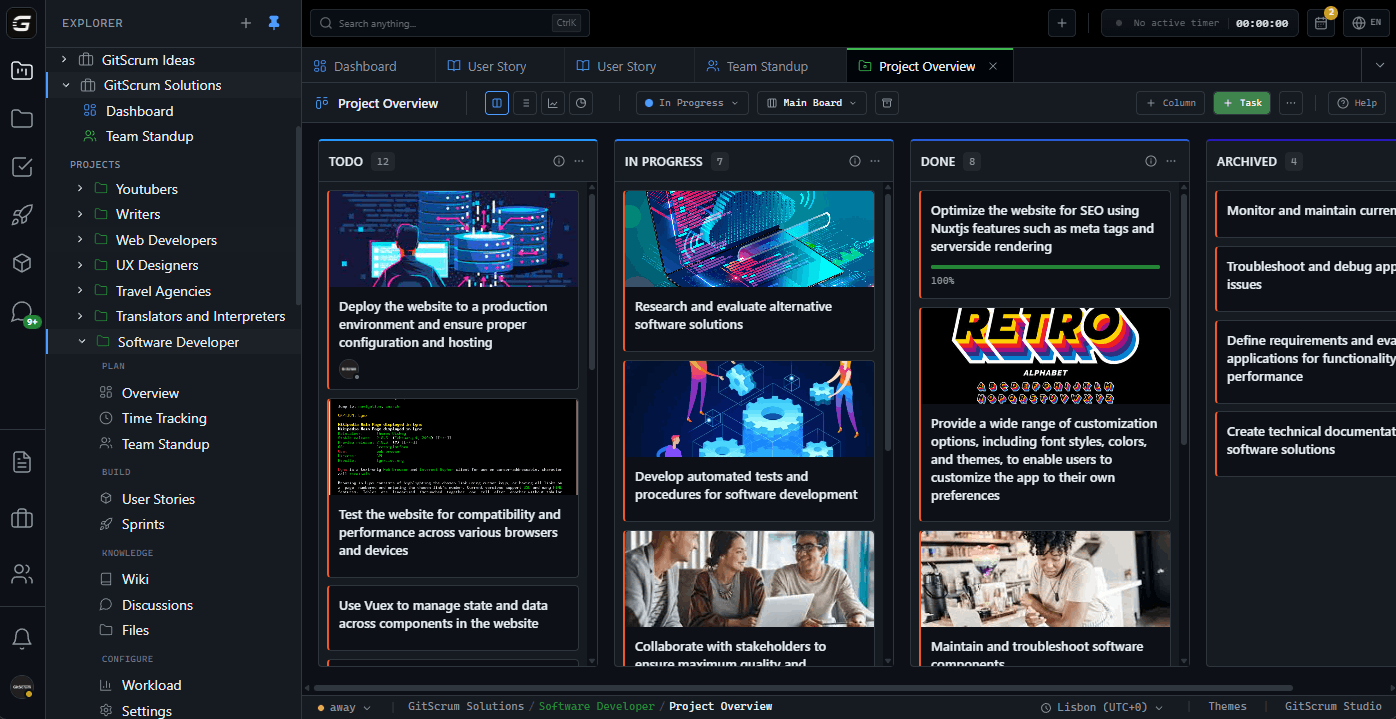
Simplified workflows with intuitive states: Backlog, To Do, In Progress, Review, Done. Developers understand it immediately.

Time learning the tool drops to minutes. The workflow serves the work instead of the work serving the workflow.

The GitScrum Advantage

One unified platform to eliminate context switching and recover productive hours.

01

problem.identify()

The Problem

Jira workflows accumulated complexity over years of customization

Dozens of statuses across multiple issue types with inconsistent rules

Transition rules nobody documented or understands

New developers spend days learning the tool instead of writing code

Workflow mistakes require admin intervention to fix

02

solution.implement()

The Solution

Simplified workflows with intuitive states that match how developers work

Clean transition rules that don't require tribal knowledge

New developers understand the workflow in minutes, not days

Less cognitive load from tools means more focus on actual work

Workflow serves the work, not the other way around

03

How It Works

1

Start with Simple Default Workflow

GitScrum provides an intuitive default workflow: Backlog → To Do → In Progress → Review → Done. Most teams work effectively with these states—no customization required.

2

Customize Only When Necessary

If your process genuinely requires additional states, add them deliberately. But question whether complexity is necessary—often simple workflows work better than elaborate ones.

3

Keep Transitions Intuitive

Any task can move to any adjacent state. No hidden rules, required fields that only appear conditionally, or transitions that fail mysteriously. What you expect to work actually works.

4

Automate Common Transitions

Use GitScrum's GitHub integration to auto-move tasks based on code activity. Branch created? Move to In Progress. PR merged? Move to Review. Automation handles routine transitions, reducing manual work.

04

Why GitScrum

GitScrum addresses Jira Workflows So Complex Nobody Knows the Correct Process through Kanban boards with WIP limits, sprint planning, and workflow visualization

Problem resolution based on Kanban Method (David Anderson) for flow optimization and Scrum Guide (Schwaber and Sutherland) for iterative improvement

Capabilities

  • Kanban boards with WIP limits to prevent overload
  • Sprint planning with burndown charts for predictable delivery
  • Workload views for capacity management
  • Wiki for process documentation
  • Discussions for async collaboration
  • Reports for bottleneck identification

Industry Practices

Kanban MethodScrum FrameworkFlow OptimizationContinuous Improvement

Frequently Asked Questions

Still have questions? Contact us at customer.service@gitscrum.com

Our process is genuinely complex—can GitScrum handle it?

GitScrum supports workflow customization when genuinely needed. But before assuming you need complexity, consider: does the complexity serve the work, or has it accumulated accidentally? Many teams migrate from complex Jira workflows and discover they work better with simpler ones.

How do we migrate from a complex Jira workflow?

Map your critical statuses to GitScrum's simpler model. Many Jira statuses are legacy or rarely used—this is an opportunity to simplify. Start with the default workflow and add complexity only when you hit genuine process needs, not inherited assumptions.

What if different teams need different workflows?

GitScrum supports custom workflows per project if genuinely needed. But consider whether differences are necessary—teams with similar workflows can share context and move between projects more easily. Standardization has benefits beyond simplicity.

Won't simple workflows lose important process controls?

The question is whether those controls add value. Many Jira workflow restrictions exist because they were added at some point, not because they're currently needed. Simple workflows with good communication often work better than complex workflows that slow people down.

Ready to solve this?

Start free, no credit card required. Cancel anytime.

Works with your favorite tools

Connect GitScrum with the tools your team already uses. Native integrations with Git providers and communication platforms.

GitHubGitHub
GitLabGitLab
BitbucketBitbucket
SlackSlack
Microsoft TeamsTeams
DiscordDiscord
ZapierZapier
PabblyPabbly

Connect with 3,000+ apps via Zapier & Pabbly