VS Code

GitScrum for VS Code, Google Antigravity, Cursor and Windsurf!

GitScrum logo
Solution

Linear Alternative with Time Tracking 2026 | Built-In

Linear has no time tracking. GitScrum adds what agencies need: one-click timers, billable reports, client invoicing—without Toggl or Harvest. Free trial.

Linear Alternative with Time Tracking 2026 | Built-In

Linear earned its reputation: the fastest, cleanest issue tracker for modern development teams.

If Linear had everything you needed, you'd use it. But it doesn't.

The missing feature: time tracking. Why time tracking matters: - Agency billing: Clients pay by the hour.

Without integrated tracking, you're reconstructing time from memory or using separate tools. - Project estimates: How long did similar features take?

Without time data, estimates are guesses. - Productivity insights: Where does time actually go?

Sprint velocity is one metric; actual hours per story point is another. - Resource planning: Who's overloaded?

Who has capacity? Time data answers these questions.

Linear's philosophy: stay focused, don't add features that distract. Admirable, but it forces time-sensitive teams into tool sprawl.

GitScrum's approach: keep Linear's speed and focus while including time tracking as a first-class feature. Not a distraction—a core workflow need for professional development teams.

The GitScrum Advantage

One unified platform to eliminate context switching and recover productive hours.

01

problem.identify()

The Problem

Linear has no built-in time tracking

Agency billing requires separate time tracking tool

Project estimates lack historical time data

Resource planning blind without hours visibility

Clockify/Toggl integrations create tool sprawl

Time data disconnected from task context

Invoicing requires manual data compilation

Story point velocity doesn't show actual hours

02

solution.implement()

The Solution

Time tracking built into every task card

One-click timer start/stop on any task

Time automatically associated with project and client

Historical time data improves future estimates

Team utilization visible across projects

Time reports exportable for invoicing

No third-party integration required

Hours per story point for accurate planning

03

How It Works

1

Track Time on Any Task

Open a task card. Click the timer button. Work. Click again to stop. Time logged automatically to the task, project, and client. No app switching. No manual entry.

2

Review Time by Context

Filter time logs by: project, client, team member, date range. See where time actually went. Compare estimated vs actual. Identify tasks that consistently take longer than expected.

3

Generate Client Reports

End of billing period: generate time report for client. Shows: tasks worked, hours per task, total billable time. Export to CSV or PDF. Ready for invoicing without spreadsheet gymnastics.

4

Improve Future Estimates

Similar feature coming up? Check historical time data. 'Authentication flows typically take 16 hours.' Data-driven estimates replace gut feelings. Team calibrates over time.

04

Why GitScrum

GitScrum addresses Linear Alternative with Time Tracking Built In through Kanban boards with WIP limits, sprint planning, and workflow visualization

Problem resolution based on Kanban Method (David Anderson) for flow optimization and Scrum Guide (Schwaber and Sutherland) for iterative improvement

Capabilities

  • Kanban boards with WIP limits to prevent overload
  • Sprint planning with burndown charts for predictable delivery
  • Workload views for capacity management
  • Wiki for process documentation
  • Discussions for async collaboration
  • Reports for bottleneck identification

Industry Practices

Kanban MethodScrum FrameworkFlow OptimizationContinuous Improvement

Frequently Asked Questions

Still have questions? Contact us at customer.service@gitscrum.com

Does GitScrum match Linear's speed?

GitScrum prioritizes performance like Linear. Sub-100ms interactions. No loading spinners. The time tracking features don't slow down the core experience—they're designed to integrate seamlessly.

We love Linear's design—is GitScrum as polished?

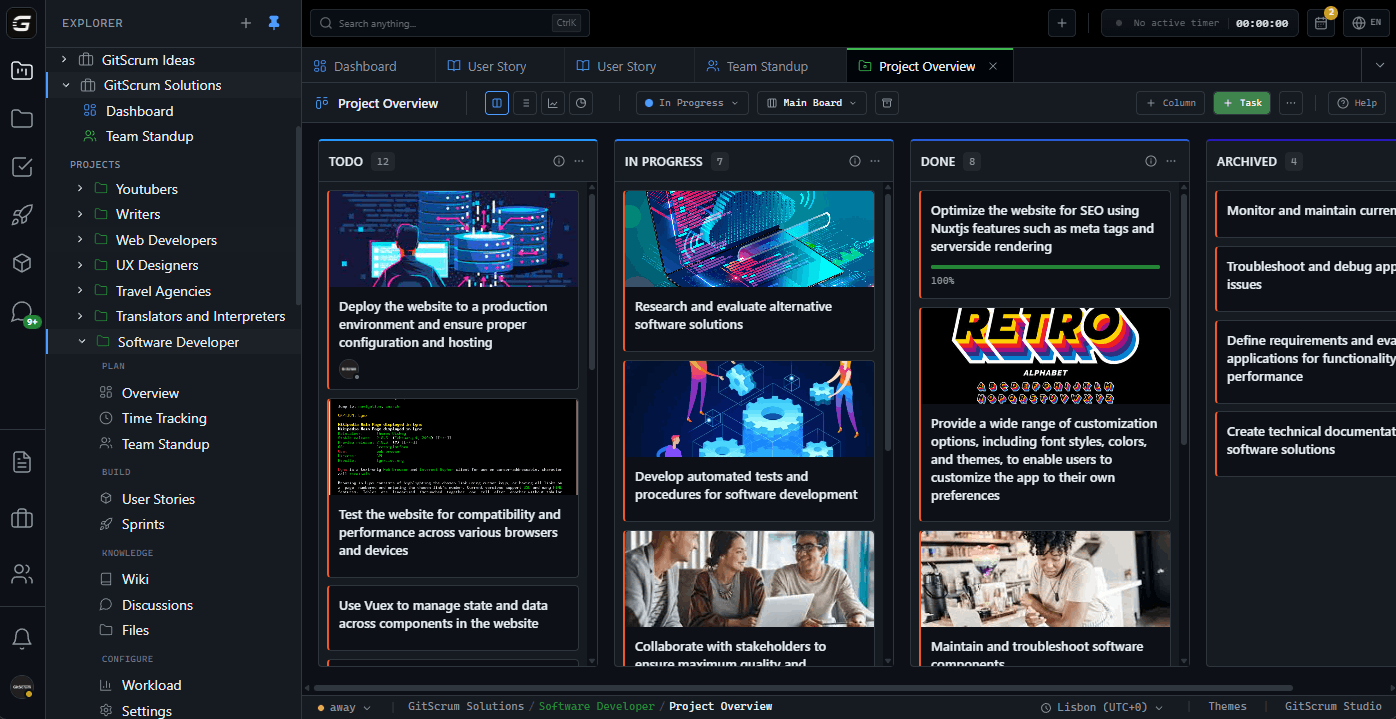
Different aesthetic philosophy: Linear is bright and minimal. GitScrum is dark-mode native and IDE-inspired. Both are intentionally designed. Try GitScrum to see if the aesthetic fits your team.

Can we import from Linear?

Yes. Linear export imports into GitScrum. Issues, labels, projects transfer. You'll set up time tracking (which didn't exist in Linear), but your existing work migrates cleanly.

What if we don't need time tracking?

Time tracking is available but not mandatory. If you don't use it, it doesn't clutter your workflow. But it's there when you need it—no third-party tool required later.

Ready to solve this?

Start free, no credit card required. Cancel anytime.

Works with your favorite tools

Connect GitScrum with the tools your team already uses. Native integrations with Git providers and communication platforms.

GitHubGitHub
GitLabGitLab
BitbucketBitbucket
SlackSlack
Microsoft TeamsTeams
DiscordDiscord
ZapierZapier
PabblyPabbly

Connect with 3,000+ apps via Zapier & Pabbly